
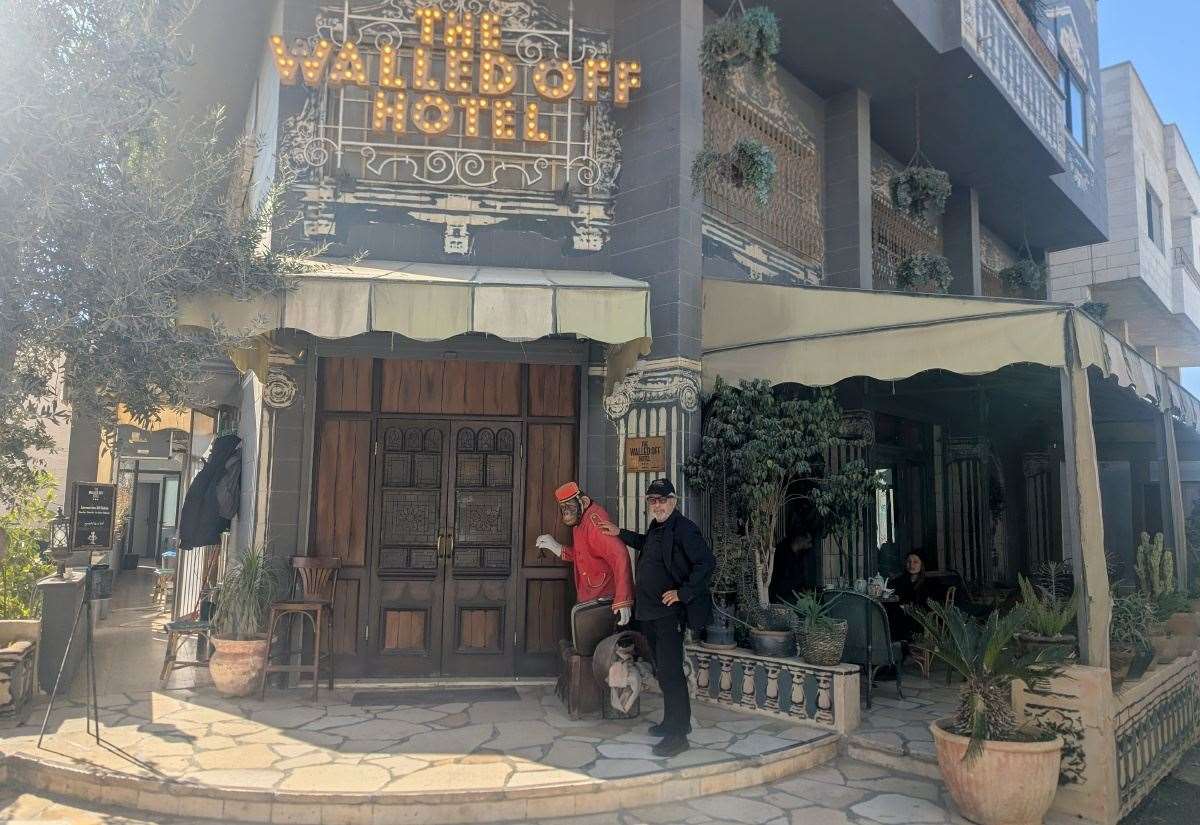

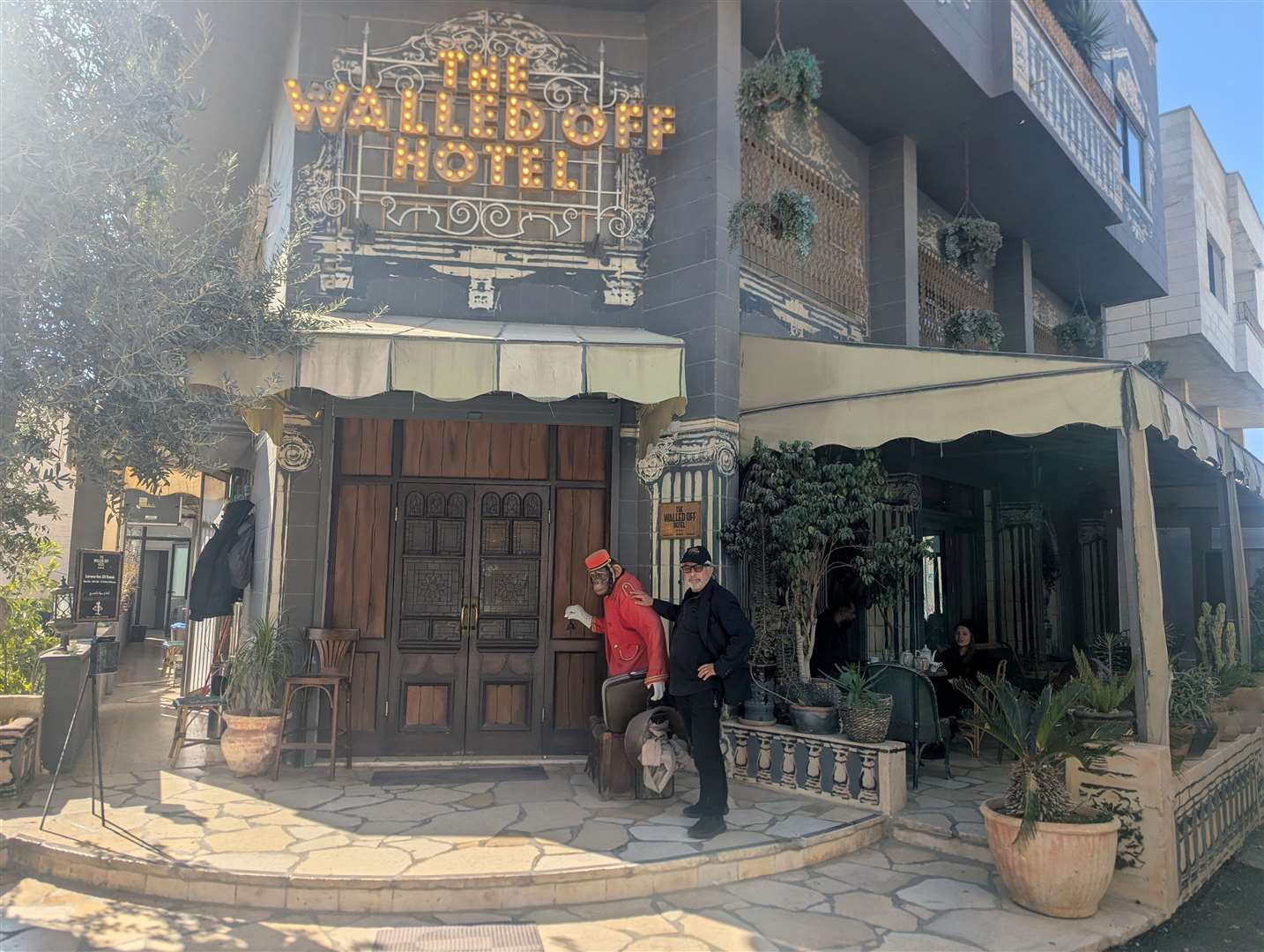
 Room at the inn? Fred Schlomka at The Walled Off Hotel.
For three long, silent years, the bells of Bethlehem did not truly ring.
The cradle of Christianity stood muted, suffocated by the horrific echoes of 7th October and the apocalyptic devastation that followed in Gaza.
But this year, the silence broke. The contrast between the ghost town of years past and today’s celebration is nothing short of striking. It is a miracle of resilience.
Streets that were once haunted by emptiness have been transformed, adorned with lights that defy the darkness. Crowds of Palestinians, their faces etched with both joy and weariness, jostle with returning tourists, all drawn to the grand parade and the ancient limestone entrance of the Church of the Nativity.
They line up to descend into the grotto, deep in the bowels of the earth, to touch the very ground where the child known as Jesus was born and worshiped by billions as the saviour, the prince of peace, in a land that has forgotten what peace feels like.
My journey began on Christmas morning in Beit Sahour, a Christian suburb where the air is thick with history.
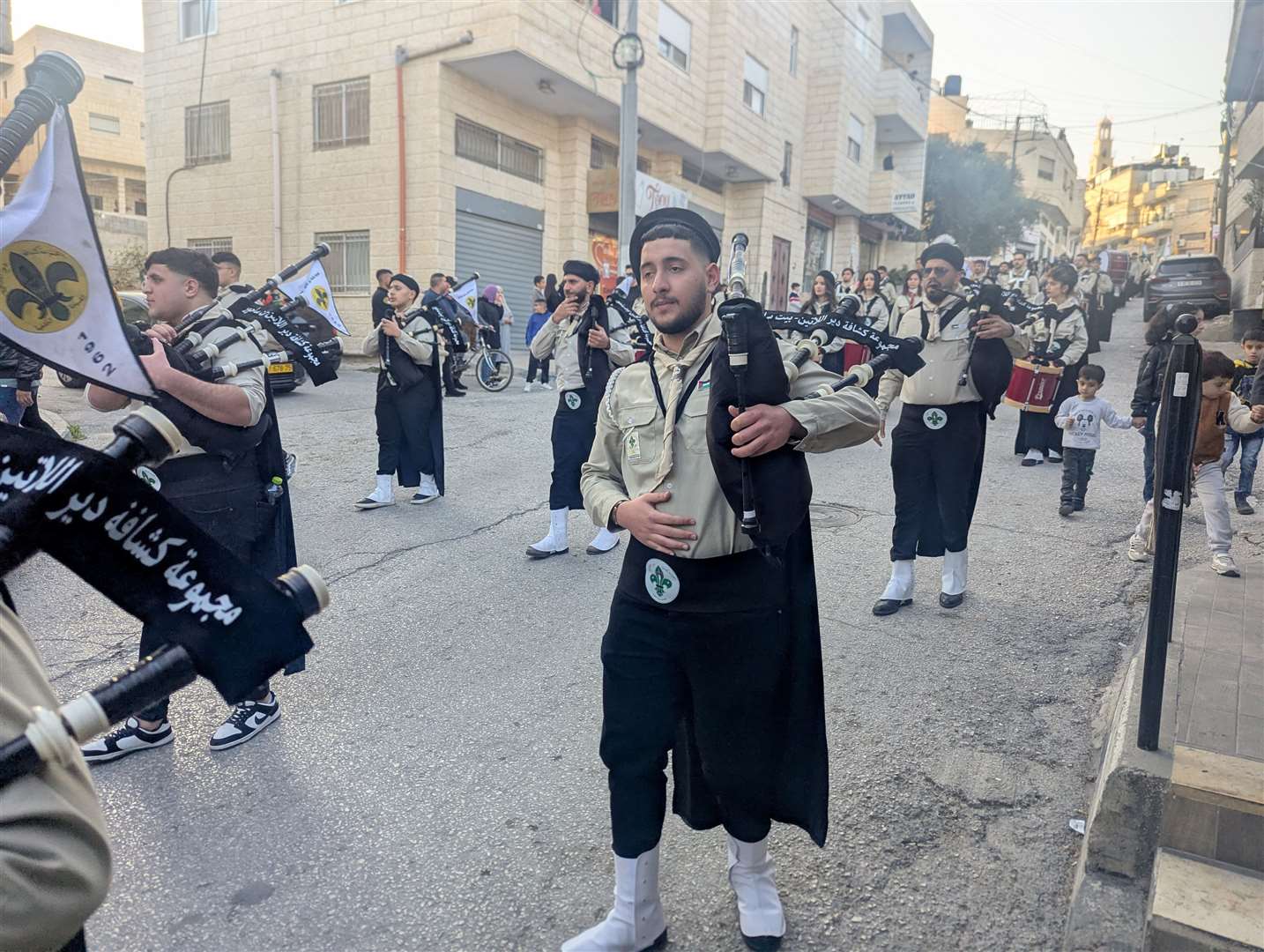 Scouts play bagpipes through Bethlehem. Photo: Fred Schlomka
This is the site of the Shepherds’ Field, where angels once broke the night sky to announce the birth of hope to humble men watching their flocks.
I sat there with my colleague, Mirvate, sharing coffee and conversation before my two-mile ascent to the centre of Bethlehem.
Mirvate runs our guesthouse nearby, a woman of immense strength who is slowly being ground down by invisible gears.
She tells me that AirBnB is refusing to transfer funds paid by our guests. This bureaucratic cruelty is likely born of politics, cutting off a lifeline for reasons unknown. It is a quiet form of violence; transferring funds to Palestine has become an obstacle course as Israel tightens the screws on Palestinian life. We sip our coffee, the warmth of the cup conflicting with the chill of the reality she faces. “Merry Christmas,” she says, but the words hang heavy in the air.
The walk from Beit Sahour to Bethlehem snakes through a commercial strip that feels like a mouth missing its teeth.
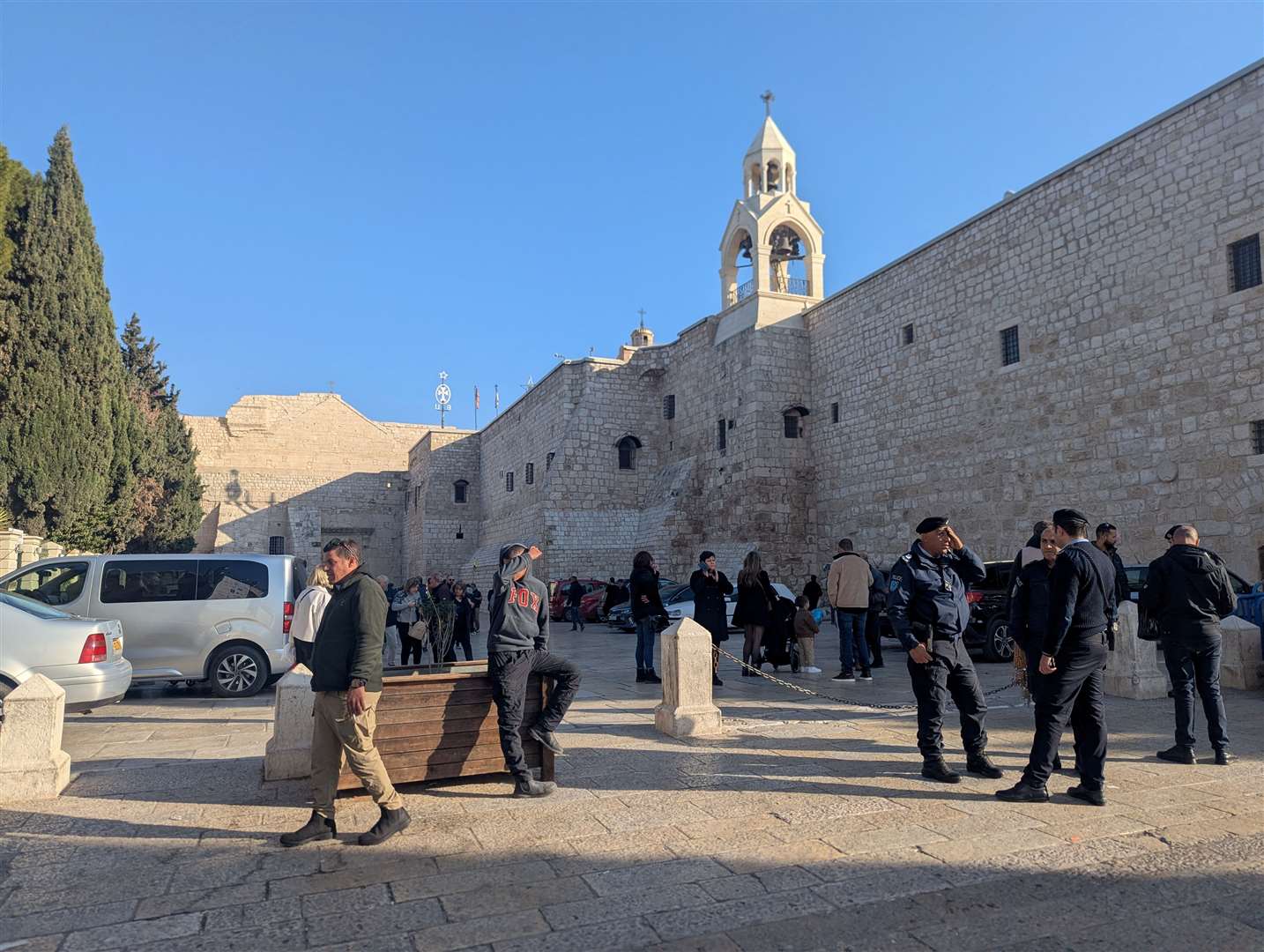 Crowds gather at the Church of Nativity.
The shops, mostly Muslim-owned, are shuttered for the holiday, a gesture of solidarity that echoes through the quiet. But there is a deeper silence here. In the 1950s, the heartbeat of Bethlehem was over 80 per cent Christian.
Today, that community has shrunk to barely 10 per cent of the city’s 30,000 residents. This isn’t just a demographic shift – it is an exodus. Crushed by the pressures of military occupation and the strangulation of opportunity, those with the means, often the more affluent Christians, have left.
They are the lucky ones, perhaps, but they leave behind a fracturing community, a luxury denied to the vast majority of Palestinians who remain trapped.
Yet the spirit of the city refuses to die. When President Yasser Arafat established the Palestinian Authority in the 1990s, Christmas was declared a national holiday. Today, it is a unifying embrace – Muslims flock to the city to share in the joy of their Christian neighbours. In a poignant parallel, Jewish Israelis have also begun to seek out the warmth of the season, with Tel Aviv’s restaurants offering Christmas dinners, and Yuletide trees twinkling in windows.
As I approached Manger Square, the solitude of the walk gave way to a sensory explosion. The crowds thickened, forcing me into the twisting, narrow artery of Star Street. Here, the air was alive with the scent of cardamom and roasted nuts. Vendors vied desperately for the attention of passersby, while roaming men with huge brass Rakweh, elaborate coffee pots, poured rich, dark brews for the throngs.
I paused at a shop display, catching the eye of a hopeful merchant holding a Farwa, the traditional long, fur-lined winter coat. He swore to me, his hand over his heart, that it was real fur, locally made, a piece of Palestinian heritage. But upon closer inspection, I found the small, white label: Made in China. The unwitting proprietor had forgotten to remove it. I didn’t leave disappointed in the coat; I left with a broken heart for the man, whose desperation to make a sale, to survive, forced him to pedal imported illusions in a city famous for its authenticity.
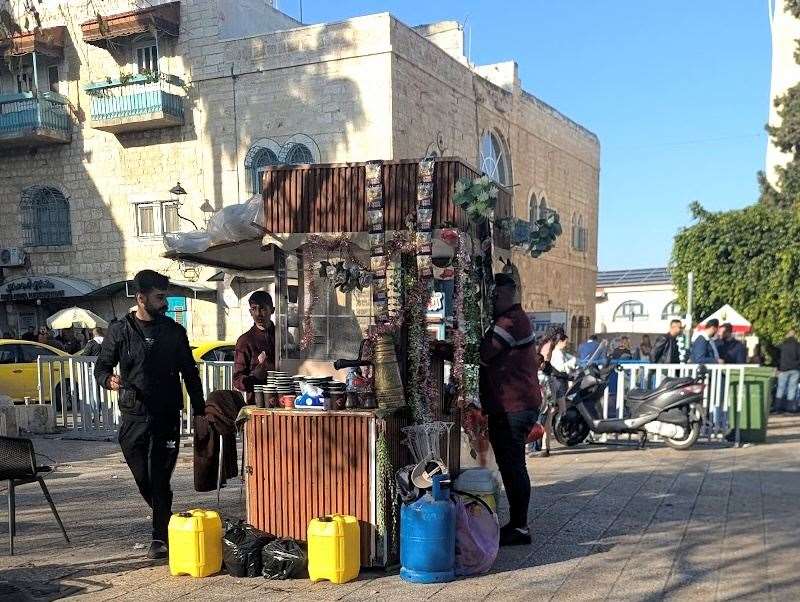 A coffee cart in Bethlehem. Photo: Fred Schlomka
Finally, the lane opened up, spilling me into Manger Square. It was a scene of defiant joy. A colossal Christmas tree dominated the plaza, standing guard over dozens of carts selling everything from popcorn to balloons. Huge banners draped from the buildings, insisting on celebration. Children ran everywhere, chasing balloons and clutching cheap plastic toys, their laughter piercing the air. It was the sound of pure innocence.
The adults smiled, too, but they wore their smiles in stark contrast to the grinding, work-a-day realities they endure under occupation.
Tourists were present, but they were the minority; most of the world still steers clear of Palestine, afraid to look it in the eye.
Looming over it all was the Church of the Nativity. Its huge limestone walls soared upward, a fortress of faith rebuilt time and again over two millennia. The current structure, dating largely to the 6th century under Emperor Justinian I, holds within it the ghosts of the original fourth-century basilica commissioned by St. Helena. The floor mosaics from that era remain, worn smooth by millions of pilgrims’ feet. It is a place where time collapses, where the weight of history presses down on your shoulders.
I eventually pulled myself away from the square for a meeting at the Walled Off Hotel, a bizarre and tragic art installation that functions as a hotel, designed and financed by the English artist Banksy.
It sits just metres from the suffocating shadow of Israel’s 25-foot high concrete wall, a grey scar that separates Rachel’s Tomb from the rest of Bethlehem. The tomb is now accessible only from the Israeli side, stolen from the city that houses it. The hotel had re-opened briefly for this Christmas season, a flicker of defiance, and will close again in January.
From there, I met with my colleague Mustafa, who runs a youth centre in the nearby Aida refugee camp, a place where childhood is often cut short by tear gas and raids. Together, we plotted new, peaceful co-resistance projects, small acts of light against the darkness of oppression. We discussed a new programme to bring music education to the most remote, deprived West Bank villages.
Modelled on the Island Ukuleles programme my wife and I established in the wind-swept Northern Isles of Shetland, this project will instead feature the Oud. We dream of replacing the sounds of conflict with the strumming of traditional instruments, giving these children a voice more powerful than violence.
The day’s festivities eventually spilled back over to Beit Sahour for the grand parade. It was a spectacle of pride that brings tears to the eyes. Brass bands and Bagpipe bands, run by local scouts and youth organizations, stretched for a mile, marching five or six abreast.
The musicianship was impressive, a disciplined display of dignity. Boys and girls strutted their stuff, playing a haunting mix of Arabic melodies and Western Christmas carols.
The bagpipes themselves are a complicated legacy of the British occupation from 1919 to 1948, a colonial echo repurposed into a Palestinian shout of joy. Even when the pipers rested, the drums continued, a heartbeat that would not stop. Pipe majors twirled their batons, hurling them high into the cool air and catching them with practised ease, while the street party roared its approval.
For a moment, just a moment, they were not occupied people; they were simply proud.
But now, the celebratory season is almost over. The lights will come down. Christmas has passed. Despite the fleeting magic of the parade and the prayers in the Grotto, the brutal reality of Israel’s occupation in Bethlehem and the West Bank remains ever-present. The demolition of villages continues in the silence of the night. The slow-motion ethnic cleansing never stops. The killing is ongoing.
As I look back at the lights of the city, I wonder if the world will ever truly wake up. Perhaps, if humanity can open its eyes to this tragedy, we might one day arrive at a future Christmas in Bethlehem where we can truly celebrate the promise of that child born here 2,000 years ago. We might finally arrive at a peace “that surpasses all understanding” (John 14:27). May we all live to see that day.
By Fred Schlomka
Do you want to respond to this article? If so, click here to submit your thoughts and they may be published in print.