
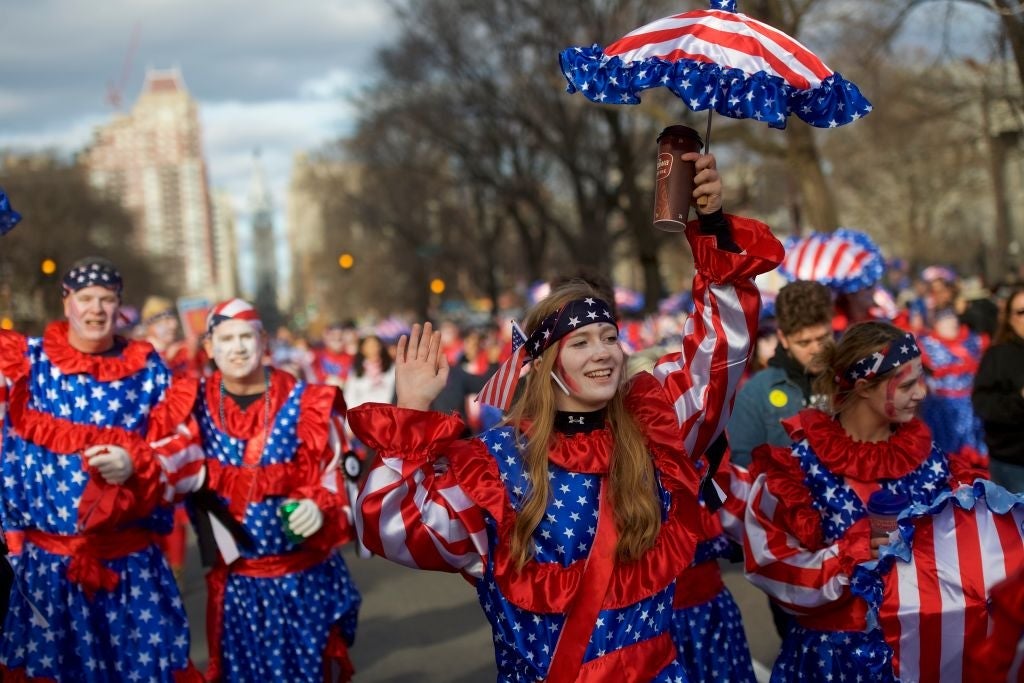
As Philadelphia prepares to celebrate New Year’s Day with its beloved Mummers Parade, some may wonder how the parade began back in 1901.
Philly’s Mummers Parade officially began in 1901, evolving from earlier Christmas mumming traditions brought to America by European immigrants.
“Throughout much of northern Europe and colonial North America, groups of mummers roved from house to house during the Christmas season, entertaining their hosts and expecting food, drink, or a small tip in return. Mumming and belsnickling in southeastern Pennsylvania persisted into the 1800s, not only in Philadelphia but also in smaller cities like Easton, Lancaster, Pottstown, and Reading,” according to DuComb.
Early organizers of the Mummers Parade moved the event from unruly street celebrations to an organized Broad Street parade coordinated with city sponsorship and prizes, attracting thousands of participants.
African American mummers competed for prizes on Broad Street between 1901 and 1929. African American composer James Bland is credited with creating the parade’s unofficial theme song, “Oh, Dem Golden Slippers.”
While many mummers initially marched in blackface makeup in the parade, the practice was banned after 1963 amid civil rights protests. Efforts to diversify parade participants continued as women became more involved from the 1970s onward. New minority groups joined during the 1990s and 2010s.
Over the years, the parade has showcased diverse performance categories — clowning, string bands, costumes, burlesque, and Broadway-style staging — with deep roots in South Philadelphia and neighborhoods such as Kensington and Port Richmond.
The parade route has changed over time, notably in 2015, when it started at the city hall judging stand and proceeded south along Broad Street.
At times, the parade has faced funding cuts and consolidations of club organizers, but it has always shown resilience. Cancellations occurred only in 1919, 1934, and 2021 due to the COVID-19 pandemic.