
 Listen to this article
At a glance:
A Pittsburgh row house collapsed after a foreclosure was filed but never completed
The city has more than 20,000 vacant homes, many tied up by tangled titles
Some homes are at risk because of structural failure nearby
Burden of demolitions affecting neighboring properties has shifted to contractors
PITTSBURGH, Pa. — At first glance, the row house at 418 Rochelle St. looks ordinary. Backed against a hillside in Pittsburgh’s Knoxville neighborhood, its porch is messy, but that’s hardly unusual.
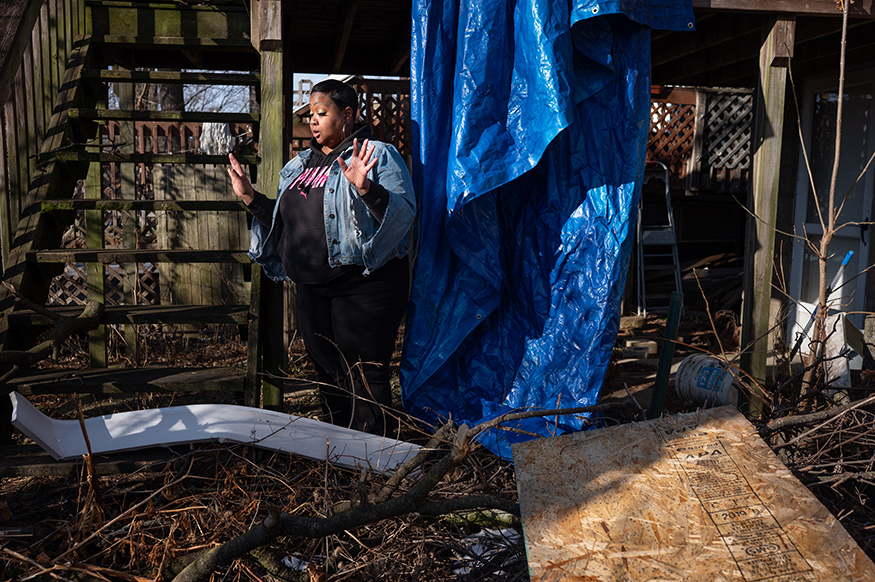
But if one were to walk up the front steps and peer through the window on a clear day, the view would be of the sky. Both stories have fallen into the basement.
The story of how the structurally sound, owner-occupied home of a middle-class Pittsburgh resident became a heap of rubble threatening adjacent structures is also the story of how a city that has shrunk in population by more than 50 percent since 1950 finds itself so short of affordable housing.
“I think we have a system that for too long has allowed houses that aren’t paying taxes to languish, and people aren’t living in them or taking care of them,” said Bill Shimko, executive director of the Hilltop Alliance.
Pittsburgh has more than 20,000 vacant housing units, according to U.S. Census Bureau estimates. That number represents about 15 percent of the city’s total stock. Thousands are unlivable or so-called “dead-end” properties, for which the owner died or departed without making arrangements to transfer ownership and left a “tangled title.”
“Because (the city is) not foreclosing — we’re not intervening — these properties are simply inaccessible to the average person,” said Sally Stadelman, acting executive director of the Pittsburgh Land Bank, an agency tasked with acquiring tax-delinquent properties and getting them back on the market.
Nicole Green was living at 418 Rochelle St. in 2005, when a series of injuries she suffered on the job as a correctional officer at the Allegheny County Jail caused her to fall behind on her mortgage. She received a letter like many Americans did in the mid-2000s, in which her mortgage servicer told her it was foreclosing.
She couldn’t follow the payment plan the bank laid out to prevent foreclosure. So, she left and moved in with her mother elsewhere in Pittsburgh.
“I didn’t want to be put out by the sheriff,” Green said this past fall. “I didn’t want to embarrass my brother; he’s a deputy sheriff. I vacated the property myself.”
So, it came as a surprise to Green this past spring when the city took her to court over code violations at her long-ago home. The city wanted the owner of the collapsed home to clean up the mess.
While court records show the bank filed to foreclose in 2005, it never followed through. The house stayed in Green’s name without her knowledge, as utility and tax debt piled up and the floors went down.
“If I knew that I owned it, I would have done more, and it would still be in good condition,” Green said. “I’m in a different position now than I was then. Everything would have been OK.”
Aimee Mangham, manager of outreach and services at the Hilltop Alliance, said she sits weekly in the magistrate’s court in Carrick, where cases like Green’s are adjudicated. She said Green’s situation is not uncommon.
“At least once a week you hear the story that ‘I didn’t even know I owned the property,’” Mangham said, because owners left when threatened with foreclosure.
The judge at a Dec. 11 hearing delayed ruling on Green’s case, allowing a few months to try to engineer a solution. The city may front the cost of demolition and place a lien against the property to reclaim the tens of thousands of dollars, though that would make it virtually impossible for Green to sell the property.
Dave Green, the director of the city’s Department of Permits, Licenses and Inspections, said city code requires the city to order property owners to demolish unsafe structures before it intervenes. If the owner doesn’t act, the structure can go on a list of properties for city-funded demolition, ranked in order of the danger they pose to the community. He said there are about 200 structures on that list currently, though there are far more that are condemned.
Shimko said what happened to Nicole Green is a flaw in the mortgage system.
“Unless (homeowners) are able to track the foreclosure litigation and have an understanding of it — and without the help of an attorney that isn’t easy — it puts them in a situation where they believe they lost their house and they take action to keep a roof over their heads,” Shimko said.
Green said if the bank had notified her they would put a lien on her house instead of foreclosing, she could have stayed and chipped away at the lien over time.
“My kids and my grandkids could be there,” she said.
The collapsed home on Rochelle is causing problems beyond its own footprint.
Michelle Hoyle lives two doors down and fears her home is developing structural problems as a result.
“The foundation has been messed up,” Hoyle said. “I can tell there’s some cracking, different things that I didn’t notice before,” and the issues seem to be “traveling” toward her house.
Hoyle, 48, said she grew up in the home, stayed in Knoxville almost all her life and moved back in when her mother became ill.
Her mother died two years ago, and she worries she may soon have to leave the home they shared.
“It’s happening more rapidly,” she said. “I don’t think I’m going to stay here long. I believe this home is going to leave me before I leave it.”
She said she can no longer exit through the rear of her house since 418’s porch collapsed, leaving debris all over.
Further down the row, there’s a gap between two homes where one was demolished about five years ago (satellite images show it was cleared between late 2019 and late 2020). Shimko said that demolition turned out to be a “hack job” and left an abutting neighbor with thousands of dollars in repair needs.
That neighbor, 93-year-old Elaine Stevenson, said she pursued help from city officials for years before a contractor came by and patched it up in recent weeks.
In the past, when the city had a row house demolished and a neighbor’s wall was damaged, it was up to the neighbor to get it repaired. Rob Columbus, manager of the city’s demolition program, said that in recent years the city shifted that burden to the city’s demolition contractors — good for the neighbor, but more expensive for his department.
He said demolishing a row home typically comes with problems.
“It’s almost like pulling a tooth,” Columbus said. “They borrow stability from one another. Once you pull one, they tend to shift. Those interior walls are not meant to be exterior walls.”
Beyond structural concerns, Mangham said the proliferation of decaying structures throughout Knoxville is bad for the neighborhood’s spirit.
“It brings the community down,” Mangham said. “You walk outside and it’s a part of the unspoken culture that you have to look at something so horrible every single day.
“It’s disheartening to see. It’s a wonderful community, I believe. There’s just some pockets that … you’ll see porches have fallen on the street and they’re just sitting there.”
Hoyle said the rapidly decaying state of her building has her considering whether it makes sense to have the deed transferred from her late parents’ name to her own.
“Now I have to think about if I should just walk away,” Hoyle said, noting that the abutting units’ condition would make it impossible for her to sell.
Editor’s note: This story was originally published by Pittsburgh’s Public Source and distributed through a partnership with The Associated Press.