

DePietro’s Pharmacy in Dunmore and Sheehans Pharmacy in Plains Twp. have seen demand for flu shots surge amid rapid increases in flu activity across the state and nation.
Recent state Department of Health data showed that, for the week ending Dec. 27, the percent of emergency department visits with a flu diagnosis was “very high” for all ages statewide. The state’s respiratory virus dashboard also listed flu, RSV and COVID-19 activity as “increasing rapidly” in Pennsylvania as of its most recent update.
The U.S. Centers for Disease Control and Prevention, meanwhile, recently estimated that there have been at least 7.5 million illnesses, 81,000 hospitalizations and 3,100 deaths from flu so far this season.
“There’s definitely been a surge,” Alexandra Riggleman, a pharmacist at DePietro’s, said Friday. “Right now we’re usually expecting less flu shots, but actually people are coming in more and more. … I’ve given back-to-back flu shots all day today.”
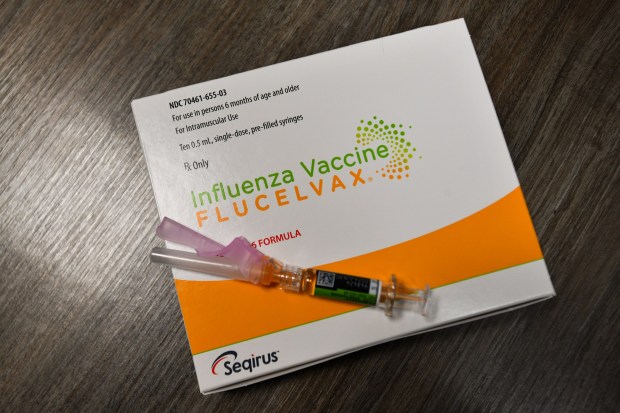 Flu shot packaging sits on a table at DePietro’s Pharmacy in Dumore Friday, January 2, 2025. (SEAN MCKEAG / STAFF PHOTOGRAPHER)
Kelly Mitchell, a pharmacist at Sheehans, said she and her colleagues have experienced the high demand, too.
“Most definitely, and people who usually don’t get (flu shots) are getting them this year,” Mitchell said. “I definitely think some people got very nervous around the holidays, so we saw quite a demand right around the holidays before everybody started to get together.”
Driving the rapid nationwide rise in flu is a new varient of the influenza A virus, a mutated version called subclade K, the Associated Press reported this week.
The CDC first identified subclade K in the U.S. in August. As of Dec. 19, about 90% of influenza A (H3N2) viruses the CDC had “genetically characterized” from U.S. samples collected since late September belonged to subclade K, the federal public health agency said.
“The new strain, it has a fast-moving mutation,” Riggleman said of subclade K. “It has emerged as a major threat this year.”
Citing Andrew Pekosz, a virus expert at Johns Hopkins Bloomberg School of Public Health, the AP reported that subclade K’s mutations are “different enough to evade some of the protection from this year’s vaccine.” Riggleman made a similar point, noting this year’s vaccine “may not be a perfect match” for the new varient while stressing people should still get the shot.
“I think there may be a mismatch between the strain circulating and the vaccine, but the vaccine is the best protection we have against the flu,” she said. “They’re definitely helping. I mean there’s no way to anticipate how effective they will be until the end of flu season, like in March and April, but … the vaccine is the best protection we have. It may be imperfect protection, but it is there to protect against the flu.”
And while the ultimate severity of the current flu season still remains to be seen, it is keeping the team at DePietro’s busy.
“People are coming in left and right for the flu shot, but we’ve also seen a lot of Tamiflu prescriptions that we’ve been giving out (and) a lot of people coming in for the at-home COVID and flu tests to test themselves at home,” Riggleman said. “So yeah, there is just an uptick in everything — in the actual virus, in testing and in people getting the flu shot.”