
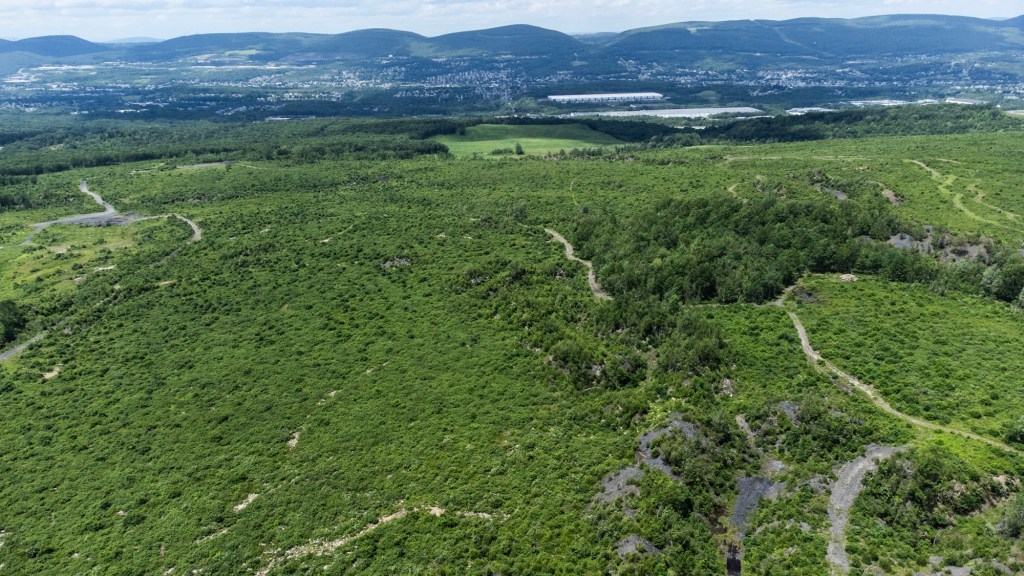
Olyphant is working to regulate data centers as the industry eyes the Midvalley town.
With data centers already proposed in nearby Archbald, Dickson City and Jessup, Olyphant Borough Council will likely vote during its next meeting on Jan. 13 to authorize solicitor and borough Manager C.J. Mustacchio to schedule and advertise a public hearing on a zoning amendment that would limit data centers to industrial land south and east of the Casey Highway while applying additional restrictions to any developments.
Mustacchio said in a phone interview Friday that he will ask council to give him the authority to set a hearing date, which he expects will likely be in late January or early February.
Although Olyphant has not yet received any data center applications, the borough has received interest to develop data centers in the upcoming Triboro Industrial Park, Mustacchio said.
Missouri-based real estate firm Sansone Group, operating under various limited liability companies, has spent $80 million since June to purchase four lots in the industrial park set to be built on a large swath of land in the middle of Route 247, the Casey Highway and Marshwood Road. Marketing brochures for the industrial park advertise two of the lots like warehouses with hundreds of parking spots and loading dock doors, but the other two lots are advertised as “build-to-suit opportunities” that note up 60,000 amps of electricity available upon request.
Sansone Group purchased the lots from Triboro, whose managing member is Charles DeNaples, the son of Keystone Sanitary Landfill co-owner Dominick DeNaples.
The site was approved for planning for warehouses, so the developer would have to come back for new land development approval as well because it was a change of use, borough engineer Lou LaFratte said.
Municipalities in Pennsylvania are required to allow for every type of lawful land use somewhere within their borders, which means they have to designate space for everything from data centers to landfills. By excluding data centers, towns open themselves up to legal challenges — an issue currently unfolding in Clifton Twp., where the developer behind a proposed “Project Gold” data center campus challenged the township’s zoning as exclusionary. Clifton Twp. supervisors were set to consider a settlement agreement Friday night where they would acknowledge their initial zoning was exclusionary.
To maintain control over the developments, Lackawanna County communities have largely designated data centers as conditional uses, meaning developers are required to adhere to a slew of conditions established by the municipality in order for a borough council or township board of supervisors to approve it. Conditional uses also require a public hearing where developers publicly discuss their projects and residents can testify for or against it.
Olyphant’s proposed ordinance would make data centers a conditional use in its CM-2 “large scale mixed commercial/manufacturing district.” The CM-2 district includes the Triboro Industrial Park and encompasses land south and east of the Casey Highway — opposite most of the town. Just past Marshwood Road, the land becomes a conservation district at the Marshwood Reservoir.
The CM-2 zone is Olyphant’s most restrictive zone, Mustacchio said.
Both the Lackawanna County Regional Planning Commission and the Olyphant Planning Commission recommended the ordinance for approval, he said.
If council adopts the legislation, data centers will have a minimum setback of 50 feet that extends to 200 feet near residential zones and uses, and buildings would be capped at 80 feet tall, Mustacchio said. The borough will also require data centers to use utility-provided power, prohibiting them from using on-site power generation, though they could have backup batteries and backup generators, he said.
Data centers would be subjected to water service regulations with a required study that would include items like calculations on projected water needs and a geographic map with a radius of at least 1 mile from the site, Mustacchio said. There would also be a required impact study for electricity that would show that adequate capacity is available on the applicable supply lines and substation to “ensure that the capacity available to serve the other needs of the service area is consistent with the normal projected load growth envisioned by the provider,” he said. The data centers would have to pay for the upgrades — namely service lines and an electrical substation — needed to ensure that capacity is available.
Developers would also have to demonstrate through a sound study by a professional acoustical expert that their installation of sound-reducing materials or systems would reduce the sound generated by data centers and associated equipment.
Other conditions include provisions for fencing and security, architectural standards, buffers, noise and vibration control, and a negative impacts section requiring that any activity producing air, dust, smoke, glare and exhaust must be carried out in a manner not perceptible beyond the property lines, Mustacchio said. There are also safety provisions and a decommissioning and abandonment removal section requiring the developer to put up a security to remove or demolish the data centers when they’re no longer in use, Mustacchio said.
“If they don’t do it within a certain amount of time pursuant to a plan that they’re required to provide to us, that the removal can be done by the borough, and the cost shall be assessed by the owner of the property,” he said.
Residents throughout the Midvalley have raised concerns about what would happen to data centers when they’re no longer in operation, comparing them to the remnants of the coal industry still dotting the local landscape.
Unlike every other town in Lackawanna County, Olyphant and neighboring Blakely operate their own electric distribution systems, so data centers would purchase the power directly from the towns rather than through PPL Electric Utilities. Mustacchio said that means Olyphant will be directly involved in the electrical service process compared to towns who don’t operate their own distribution system.
So far, nearby communities that adopted data center ordinances include Archbald, Blakely, Jessup and Mayfield. Dickson City will hold a public hearing on a data center zoning ordinance on Jan. 20 at 5:30 p.m. at its Borough Building, 901 Enterprise St., Dickson City, according to a public notice published Friday in The Times-Tribune.
Olyphant looked at a variety of other data center ordinances, both local ordinances and out-of-the-area legislation, like a York County model ordinance, Mustacchio said.
“I think it will protect us,” he said, pointing to the location, the existing regulations in the zoning district, the added regulations in the proposed ordinance and Olyphant’s direct involvement in the electricity.