
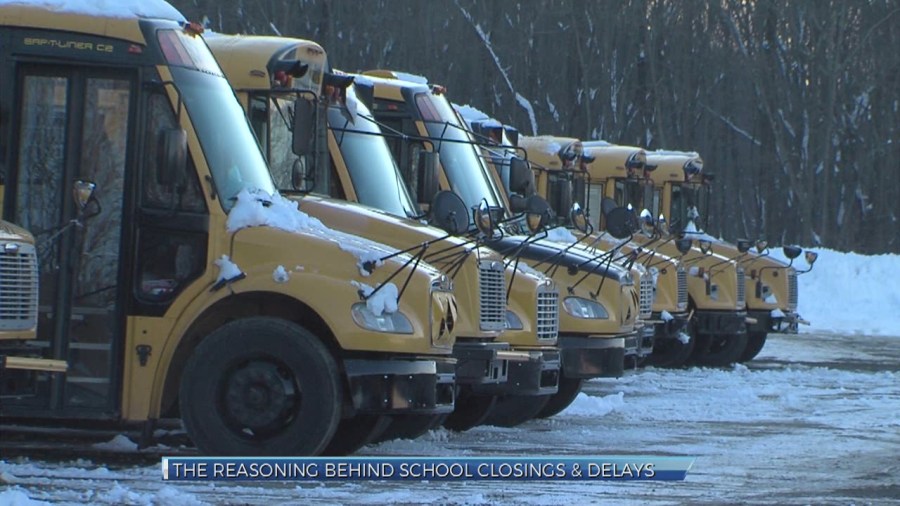
(WHTM) — Every kid wishes for a “snow day” to stay home from school, but many may not know what goes into choosing when to call for weather-related delays or cancellations.
According to Dr. Gina Eosco of the Cherokee National Strategic Programs, northern states experience winter weather more than southern states, and therefore have better access to resources and infrastructure. This means northern schools do not typically close just for snow, but rather for frigid temperatures.
“Imagine a student waiting for a bus or walking to school in -20°F temperatures,” Dr. Eosco said in an interview with Weather Underground. “Snow by itself won’t harm students, but the cold may.”
Dr. Mark DiRocco, the executive director of the Pennsylvania Association of School Administrators, says these decisions are much tougher than people think.
Thanks for signing up!
Watch for us in your inbox.
Subscribe Now
“The easiest decision is when there is 12 inches of snow on the ground – make the call the night before and get a little extra sleep in the morning,” said DiRocco in a 2018 interview with abc27. “When you get extreme temperatures like we’re seeing right now, then you have to factor in other variables. How many of your kids walk to school? Can they be outside without exposure to potential frostbite? Sometimes there are frostbite advisories.”
Dr. Eosco says superintendents collaborate closely with local departments of transportation (DOTs), weather officials, and other agencies to pinpoint the timing of the weather, analyze road and sidewalk conditions, and determine how quickly they can recover.
“When the snow falls is critical,” said Dr. Eosco. “Can DOTs and public works clear the roads in time? What about the sidewalks? Almost all weather information is important—timing, temperature, wind chills, snow amounts, etc.—but how other local and state agencies (e.g., DOTs) respond is important too. Student safety (and of course staff safety) comes first.”
Dr. DiRocco says several superintendents in neighboring school districts may make a joint decision when issuing delays or cancellations. Several schools send students to the same technical school or share special education resources, so closing some schools, but not others, could disrupt transportation and programs.
Local emergency managers typically use and value the local National Weather Service forecast, however school superintendents also take parents into account.
“As soon as one parent hears that Station ‘A’ is forecasting 12 inches of snow, the parent wants to know why the schools aren’t making the decision to close… now,” said Dr. Eosco. “For superintendents, social pressure or the parental perception of the forecast weighs heavily on their decisions.”
Get traffic alerts from the abc27 mobile app for the latest local delays and road closures
Drs. DiRocco and Eosco say that although most children cheer when schools decide to close, many may not be aware how inconvenient those days can be, especially for local economies, teachers with established lesson plans, and working-class families with limited resources.
“One thought in particular weighs heavily on the minds of superintendents across the country: they know that for some children, the school lunch is their only meal of the day,” said Dr. Eosco. “Canceling school may mean no food for that child.”
“In 14 years as a superintendent, I can tell you that is the single part of the job that never got easier,” Dr. DiRocco said. “We understand that it tremendously inconvenienced parents, especially working parents. From my perspective, I always tried to err on the side of safety. I was willing to put up with a few unpleasant phone calls.”
Copyright 2026 Nexstar Media, Inc. All rights reserved. This material may not be published, broadcast, rewritten, or redistributed.
For the latest news, weather, sports, and streaming video, head to ABC27.