
Even in the best of economic times, paying for a wedding — which can cost tens of thousands of dollars — can be difficult.
But what if it — or any other service — only cost you your time?
For one Allentown woman in 2010, as the country was emerging from the Great Recession, that’s all it took, recalled Kathy Perlow, 73, a Bethlehem resident who has dedicated years to timebanking and wants to see it get some more investment in the Lehigh Valley.
The Lehigh Valley once had a thriving exchange, but participation waned during the COVID pandemic.
“We did an entire wedding for a timebanking member,” Perlow said. “She was a trained medical interpreter, and she had logged all her [timebanking] hours as a medical interpreter.”
Timebanking uses time credits as a medium of currency, rather than money. Within the system, every hour is valued the same, regardless of who contributes the time. And when it is working properly, as it does throughout the world, timebanking can contribute mightily to a community, Perlow said.
Edgar S. Cahn, who once worked on civil rights and anti-poverty legislation in President Lyndon B. Johnson’s Justice Department, is credited with establishing the modern timebank concept. Cahn, who died in January 2022, became a proselytizer for what he called the “time dollar” — a currency in which an hour of work is worth an hour of work, whether it’s performed by a maid, a mechanic or a mechanical engineer.
Years ago, Bethlehem resident Susan Schaffer read magazines to a patient at Good Shepherd Rehabilitation as part of the local timebanking community.
“I think in exchange, I had someone help me with me my computer,” she said.
“I love the concept of helping each other, cooperating, socializing with like-minded people,” Schaffer said. “Reciprocity is one of my favorite words, and this program is a perfect illustration. So that’s what led me there.”
The Lehigh Valley timebank started in 1999 as Community Exchange to address patients who were discharged from a hospital but needed support such as housekeeping and cooking. Sponsored by Lehigh Valley Health Network and funded by the Dorothy Rider Pool Health Care Trust, it morphed, with LVHN’s blessing, into a timebank to provide mutual help more broadly, and support residents’ social health.
The Neighborhood Health Centers of the Lehigh Valley then hosted what was called the Neighbor2Neighbor program, but the nonprofit is no longer coordinating it.
“Before COVID, it was good,” Neighborhood Health Centers CEO Melissa Miranda said. “Since COVID, it has been challenging.”
It hasn’t gone away, according to Perlow, who serves on the Health Center board. But it needs someone to run it besides her, since she also serves on the national TimeBank board, she said.
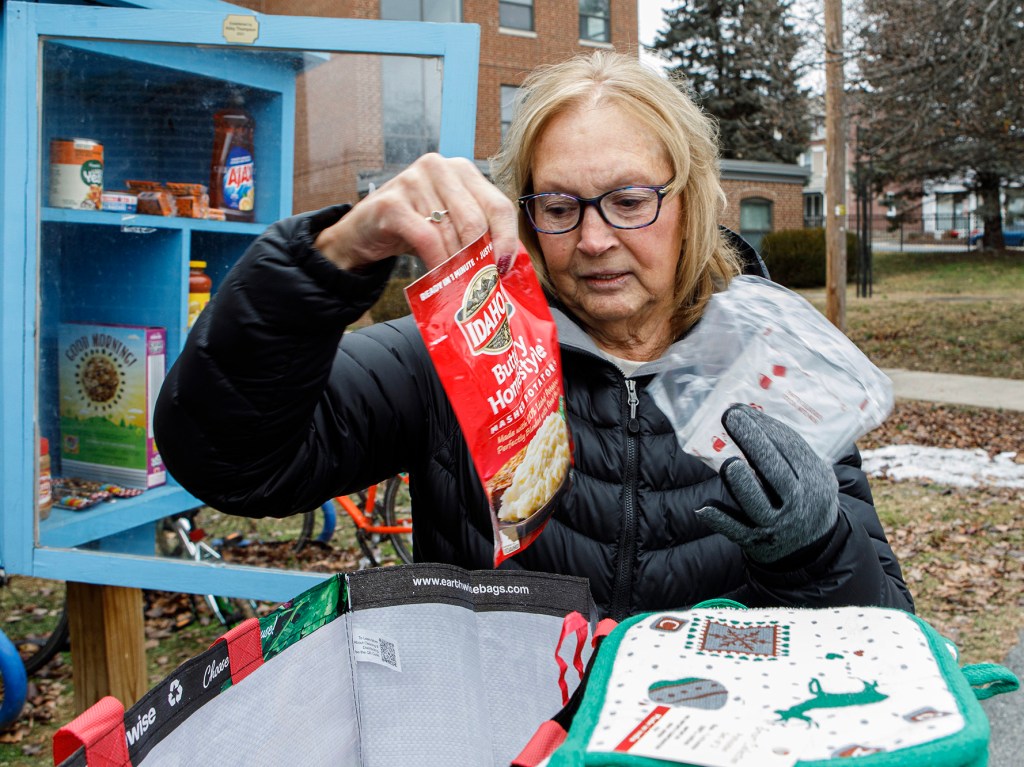
“We just need someone to do it,” said Perlow, who is among area community activists who see unmet needs, such as stocking Blessing Boxes to help unhoused people in Bethlehem. She spoke to The Morning Call recently in the River Crossing YMCA Bethlehem branch after restocking food in a community box outside.
Ideally, Perlow said, she would like to find a coordinator who has community contacts, and who can maintain records and keep track of the shares earned and spent in a timebank. She also would like to see a coordinator for each of the Neighborhood Health Center’s five clinics.
“My next goal is: How do I get the word out in the community?” she said.
Perlow knows about timebanking firsthand. She got to know Cahn through her work with the Lehigh Valley timebank, and learned tai chi mind-body practice for years for free by helping the instructor find free space to give lessons.
Another way of bringing back the concept, Perlow said, is including timebanking in disaster preparedness for communities, as a way of bringing together neighborhoods.
Rick Daugherty, executive director of Lehigh Valley Active Life, said the organization has a similar concept, a Shared Housing Resource and Exchange Program, in which older homeowners in Lehigh and Northampton counties agree to provide space for people looking for a place to live. Sometimes the arrangement could be performing household chores in lieu of rent, he said.
“This is a way not only to maximize talents, but it is a way to connect with other people,” Daugherty said of timebanking.
A transaction performed partly to find help and possibly make friends would seem to go against classical commerce, said Michael A. MacDowell, a retired economics professor and president emeritus at College Misericordia in Luzerne County.
“It would have to have to be a pretty closed society and [timebanking] really smacks at kind of a traditional economy where bartering was the way people enacted,” MacDowell said. “It was why money was created thousands of years ago.
“In a closed economy in a small area, it might indeed work,” he said. “But as a way to engage in economic trade, not only is it inefficient, it is probably ineffective.”
But hours have been exchanged in time banks across the country and in multiple countries, including Spain, Italy, China and Malaysia, Timebanks.org Executive Director and CEO Krista Wyatt said. Several timebanks exist in Pennsylvania, including in counties adjacent to the Lehigh Valley.
“Across the world,” Wyatt said in a recent message, “TimeBanks are proving that when we value every person and their time, we create a world that works for all of us.”
In some examples cited by Wyatt:
Parents are trading hours to share childcare, so no one has to choose between a paycheck and their children.
Seniors who once felt isolated now have neighbors who visit, cook meals, and offer rides, because dignity and companionship matter.
People facing loneliness are finding connection through simple acts of care: a phone call, a shared meal, a helping hand.
Communities are pooling skills, repairing homes, tutoring kids, offering rides, and building resilience by investing in one another.
“If we would all embrace timebanking as a way to strengthen our community,” Perlow said, “I think more people would get involved. Times have changed, and I get it, but maybe that’s where we need to get back to, like start neighborhood by neighborhood.”
MORE INFORMATION
Website: Timebanks.org
To learn more about plans for a local timebanking group, contact Kathy Perlow at kathy.perlow@gmail.com.
Morning Call reporter Anthony Salamone can be reached at asalamone@mcall.com.