
Although I’ve never had a problem with it, I tried to quit caffeine a few years ago. My morning tea was quickly replaced with cold showers and my evening tea with a decaffeinated version. During this time I also switched from cane sugar to monk fruit sweetener, stopped drinking alcohol in social settings and started taking less mainstream supplements such as ashwagandha and selenium. I exercised obsessively, my routine consisting of a modified version of one promoted by David Goggins. Curiously, I never managed to quit smoking during this time.
I was in community college, floundering and completely unsure of my trajectory. Health obsession was a simple way to take control of my life, and in all honesty, it worked. No matter what challenges awaited me on a given day, my daily 10-mile cycling commute made me feel like I was on top of the world. Although this ego-fueled routine got me through my time at Borough of Manhattan Community College, I’m beginning to realize the same thing won’t work at Pitt. Two years after my caffeine-free experiment, I’m once again drinking tea, even after 3 p.m. — gasp — and although I still haven’t quit smoking, I no longer carry any nicotine on me. Once a masochistic ritual, my exercise is now mostly derived from walking around campus, my sleep more restful than it has been in years.
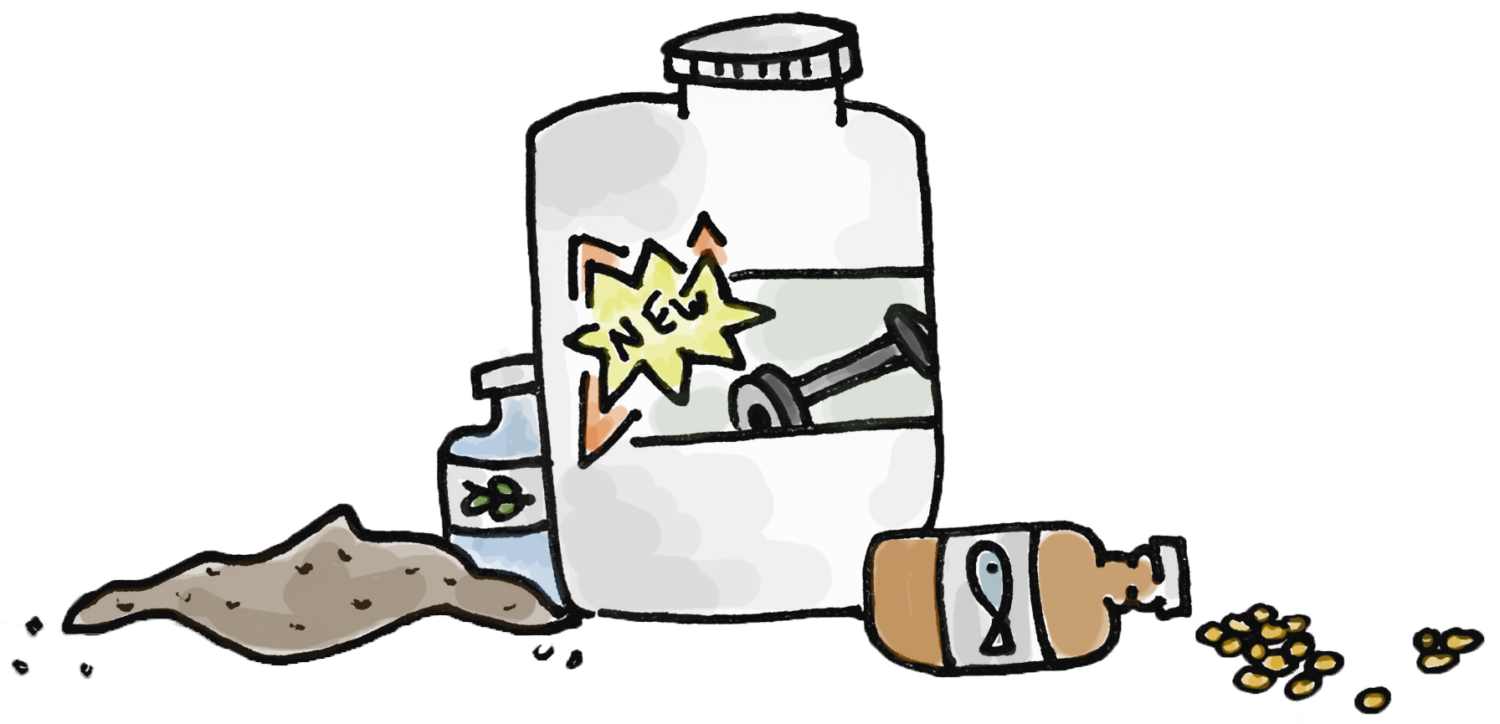
From grapefruit juice diets to the shakeweight, crafty salesmen have been trying to sell “health in a bottle” for hundreds of years. And while earlier remedies like colloidal silver have been proven to be nothing more than placebos, the same cannot be said for products such as David Beckam’s recent all-in-one supplement, IM8. Leveraging the reputations of world-renowned scientists, Beckham’s marketing team touts the superiority of IM8 over other supplements such as AG1. Locked in a sort of pharmacological arms race, the two companies attempt to formulate the “only supplement you will ever need.” But aren’t they missing something?
Far from being ready to optimize their morning routines with a perfect formulation of pre, pro and post biotics, most Americans would be better advised to establish a consistent bedtime, turn off their phone notifications and eliminate energy and soft drinks from their diets. Listening to an episode of Huberman Lab, one gets the impression that “optimizing mental and physical health” is an activity which is readily accessible and recommendable to everyone. But the reality is that optimization can only be built off of an established, comfortable baseline. Many of us are better off adding morning walks to our routines than meditating in front of a $200 red light device and better off buying a $100 standing desk than a $300 gym membership.
This isn’t to say that all unprescribed supplements are useless or that using holistic approaches is bad. Everyone has a unique relationship with their body, and everyone will prioritize different aspects of their life. Even in the case of an all-in-one supplement like AG1, one study showed that taking the product for several weeks may support a healthy gut microbiome. While there do exist cheaper alternatives to digestive health — like oral hygiene and reduced-sugar diets — it’s not always a bad thing to look for an easy “health boost.” Still, when looking at consistent approaches to personal health, I’ve found that establishing a diet full of proteins, fats and limited carbs is more than enough of a challenge. While taking compounds like AG1 or over-the-counter drugs like acetaminophen is unlikely to give your child autism, it’s important to be familiar with the dosages and usages of any given substance, to know how to effectively treat yourself when you are actually sick.
All things equal, there is something to be said for the very reasons as to why we might want to improve our health. As a member of our community shows an improvement, we may find ourselves admiring or cheering them on. Sometimes these changes are clear as day — a former smoker losing their chronic cough. Other times, they only appear as subtle hints — the starry-eyed glow of someone in a healthy relationship. In either case, “socially supported” changes can be said to not only solidify a recent improvement but to bring us closer to the important people in our lives.
When I stopped trying to be my own doctor, I didn’t only stop worrying about my health. I embraced the fact that medicine is complicated and that establishing a trusting relationship with my primary doctor is much more important than trying to “biohack” my way into a different life. To me, being healthy is simply about accounting for the changes that your body naturally goes through, listening to its signals and finding the solutions that work.
Stepan Kopeykin is a transfer student from the Borough of Manhattan Community College. His favorite movies and books include Interstellar, The Big Lebowski, Choke and The Secret History. You can find him drinking three to four cups of tea a day and playing catch with the wall outside of Hillman. He runs a personal Substack page and can be reached at [email protected].