
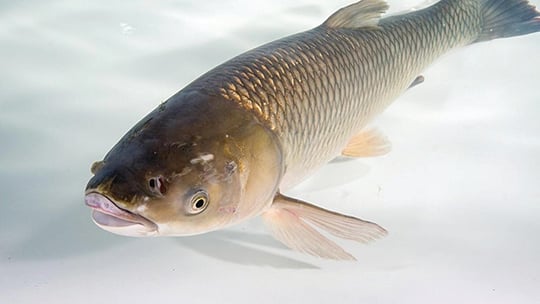
East Lansing, Mich. — Research from Michigan State University is protecting the Great Lakes from a dangerous threat looming specifically in and around Lake Erie.
For roughly a decade, Michigan State scientists have been studying grass carp, one of four carp species invasive to U.S. freshwater ecosystems (bighead carp, silver carp and black carp are the other three).
All four species share similarities that can dramatically disrupt ecological communities they invade, such as the size they can grow to by being lavish feeders (upward of 4 feet long and 100 pounds) and the prolific rate at which they can reproduce – amplified by the fact that there are no natural predators in the Great Lakes to neutralize their presence.
Whereas silver carp and bighead carp feed on plankton and can compete with the juvenile life stages of important Great Lakes species such as walleyes, yellow perch and lake whitefish, grass carp feed on aquatic vegetation and can disrupt riverbanks and lakefronts, affecting fish, bird and wildlife populations and promoting increased algal blooms and decreased water clarity.
MORE COVERAGE FROM MICHIGAN OUTDOOR NEWS:
‘Dinosaur Fish’ documentary traces Michigan’s sturgeon restoration
Michigan bear hunters record strong 2025 harvest
Hunting incidents decline during Michigan’s 2025 seasons
While recent attention has been given to preventing bighead and silver carp from migrating into Lake Michigan by implementing deterrent measures as they move northward through the Mississippi River basin, grass carp have been detected in the Great Lakes basin since the 1980s.
Presently, grass carp have been detected in each of the Great Lakes except for Lake Superior, with the greatest number of detections coming from Lake Erie.
In 2015, urgency to control grass carp increased considerably when natural spawning was documented as occurring in Lake Erie’s watershed.
According to Michigan State Fisheries and Wildlife assistant professor Scott Colborne, the carp aren’t breeding in the Great Lakes themselves, but rather in nearby tributaries. That’s where he and team members at Michigan State are studying the intricacies of their behavior in these river systems and use what’s learned to better catch and contain them.
“Our best indicators show that the population of grass carp is still relatively low in and around the Great Lakes, which gives us a chance of maintaining this status and – if we’re really fortunate – extirpating and eliminating future reproduction events,” Colborne said.
“Our ultimate goal is that grass carp are no longer established in the Great Lakes, and we still have a chance at making that happen.”
To do this, researchers are using acoustic telemetry, a type of fish-tracking technology that Colborne specializes in.
Acoustic telemetry incorporates sound to track populations of fish, where underwater acoustic receivers collect data on fish surgically tagged with acoustic transmitters. Using information garnered from the acoustic telemetry research, scientists from the University of Toledo, Michigan and Ohio DNR, U.S. Fish and Wildlife Service, USGS, and Michigan State have gained insight into ways management strategies could be improved based on time of day, location of carp activity, and gear used for capturing.
Heightened focus has been given to tributaries of Lake Erie such as the Maumee and Sandusky rivers in Ohio because grass carp need the flow of rivers to keep their eggs afloat when they spawn, Colborne said. Without it, their eggs will sink and never hatch.
Knowing this, researchers have used acoustic telemetry to target grass carp activity in these locations. It’s knowledge management teams have harnessed to catch grass carp with greater efficiency.
In addition to leveraging acoustic telemetry to identify the most effective strategies for capturing grass carp and deterring their reproduction, Colborne also said teams are constantly evaluating the data to understand movement patterns so that they can prevent grass carp from spreading.
What they’ve learned is that grass carp have the potential to disperse considerable distances – making it that much more critical to get ahead of them.
Grass carp tagged in the western part of Lake Erie have been detected as far east in Lake Erie as Buffalo and Dunkirk, New York.