
ERIE, Pa. — Wrapped in a sheet, Dasa — the Erie Zoo’s 33-year-old orangutan matriarch — lounged high in her exhibit. The moment she spotted Melissa “Roo” Kojancie, she swung down to greet her.
Dasa’s son, Otis, followed. He stood behind his mother, peeking over her shoulder and pestering her like any rambunctious 7-year-old might. Dasa pressed her hand against the window.
Kojancie, a former zookeeper and now the president and CEO of the Erie Zoo, smiled wide and returned the gesture. They had done this before.
Though it’s been several years since Kojancie, a 2000 graduate of the biology program at Penn State Behrend, has worked directly with Dasa, the connection between them — built over quiet mornings, shared routines and earned trust — has never faded.
Finding her place among the animals
As a teen, Kojancie considered a career as a veterinarian, but, she said, she quickly realized that the profession wouldn’t allow her to form the deep, personal bonds with animals that she craved. She didn’t want to treat animals, she said. She wanted to connect with them.
When she learned about an animal-care internship at the Erie Zoo in the summer of her junior year, Kojancie jumped at the opportunity. The Franklin-area native faced one big obstacle, however — summer housing. There are no residence halls at the zoo.
A summer undergraduate research grant solved that problem. Kojancie was selected for a project that studied the rate of metamorphosis in salamanders. The grant covered housing.
“If I didn’t get that grant, I wouldn’t be here today, because I couldn’t have taken the zoo internship that summer,” she said. “Within a week, I fell in love with working at the zoo.”
That passion set her on a path that would take her from intern to full-time zookeeper to internship coordinator to animal-care staff supervisor to chief operations officer and eventually to the top: president and CEO of the Erie Zoo.
That career trajectory resulted in the rarest form of CEO, one with such a breadth of experience that she can jump into nearly any role in the organization.
“I can drive the train, feed the lions, clean the llama yard, teach a class, or build a scarecrow,” Kojancie said. “I’ve done it all.”
From the llama yard to the boardroom
Kojancie’s deep knowledge of the zoo’s day-to-day operations shapes her view of its future. She said she envisions innovative, state-of-the-art exhibits that give animals enrichment opportunities and control over their environment, like whether to go outdoors or stay indoors.
“We want to keep the intimate, small-zoo feel and experience but expand over time,” she said.
Growth and exhibit improvements are something Kojancie said she now sees as possible with the unanimous vote by Erie City Council to transfer ownership of the zoo from the city to Erie Events, which will provide $500,000 in annual operating funds.
It was a move Kojancie and the zoo’s board wanted.
“The zoo was generating 95% of our operating income,” she said. “A rainy weekend impacted our bottom line. Erie Events will provide a secure source of operational support.”
A bigger role in a changing animal world
For Kojancie, plans for growth aren’t just about new exhibits, she said — they’re about strengthening the zoo’s role in the larger conservation landscape.
“We are here to do something for the greater good,” she said. “Zoos today are committed to animal conservation and species survival. In many cases, they are leading the way in reintroducing species back into the wild.”
She’s proud of the conservation work that Erie Zoo staff members do, Kojancie said. It’s not limited to global conservation efforts.
“Our staff make time to do boots-on-the-ground conservation work,” she said.
Her team recently created the “Last Change Lagoon,” a place where people can donate unwanted goldfish, rather than releasing them into Lake Erie, where they are an invasive species. The team has helped the Erie Bird Observatory tag birds, and they participate in a variety of initiatives, like a monarch butterfly watch, that track or support native species. The zoo also partners with other zoos in managed-breeding programs that are designed to save endangered species.
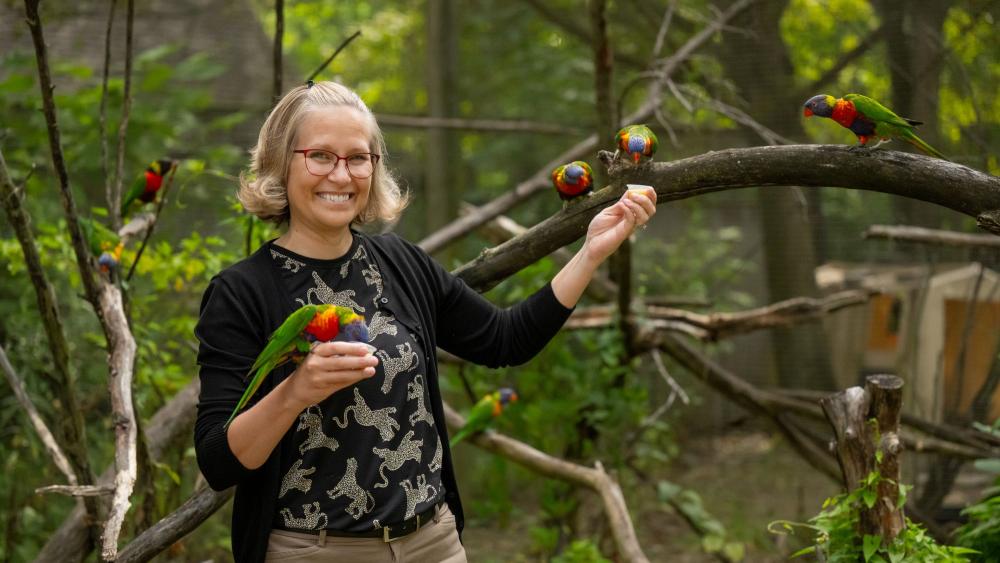
While Kojancie now spends most of her days in the zoo administration building, she is never far from the animal-human connections she thrives on.
“When I walk through the zoo or stop in to see Dasa, it centers me,” she said. “Protecting endangered species is my ‘why’.”