
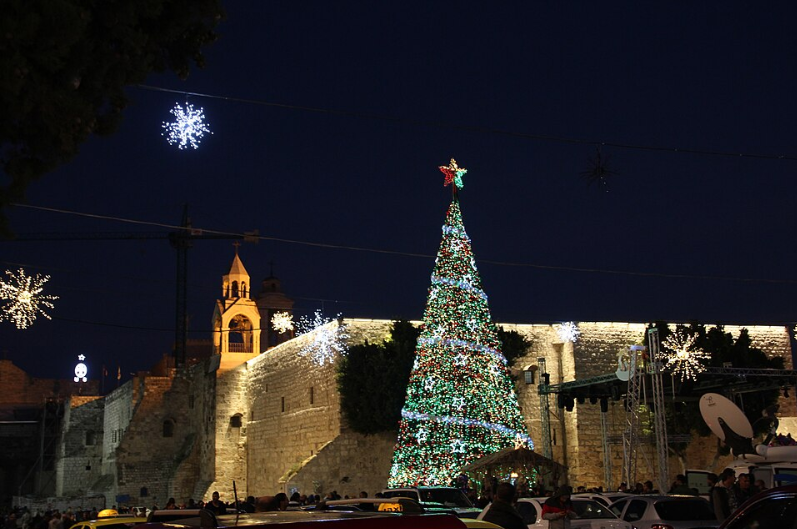
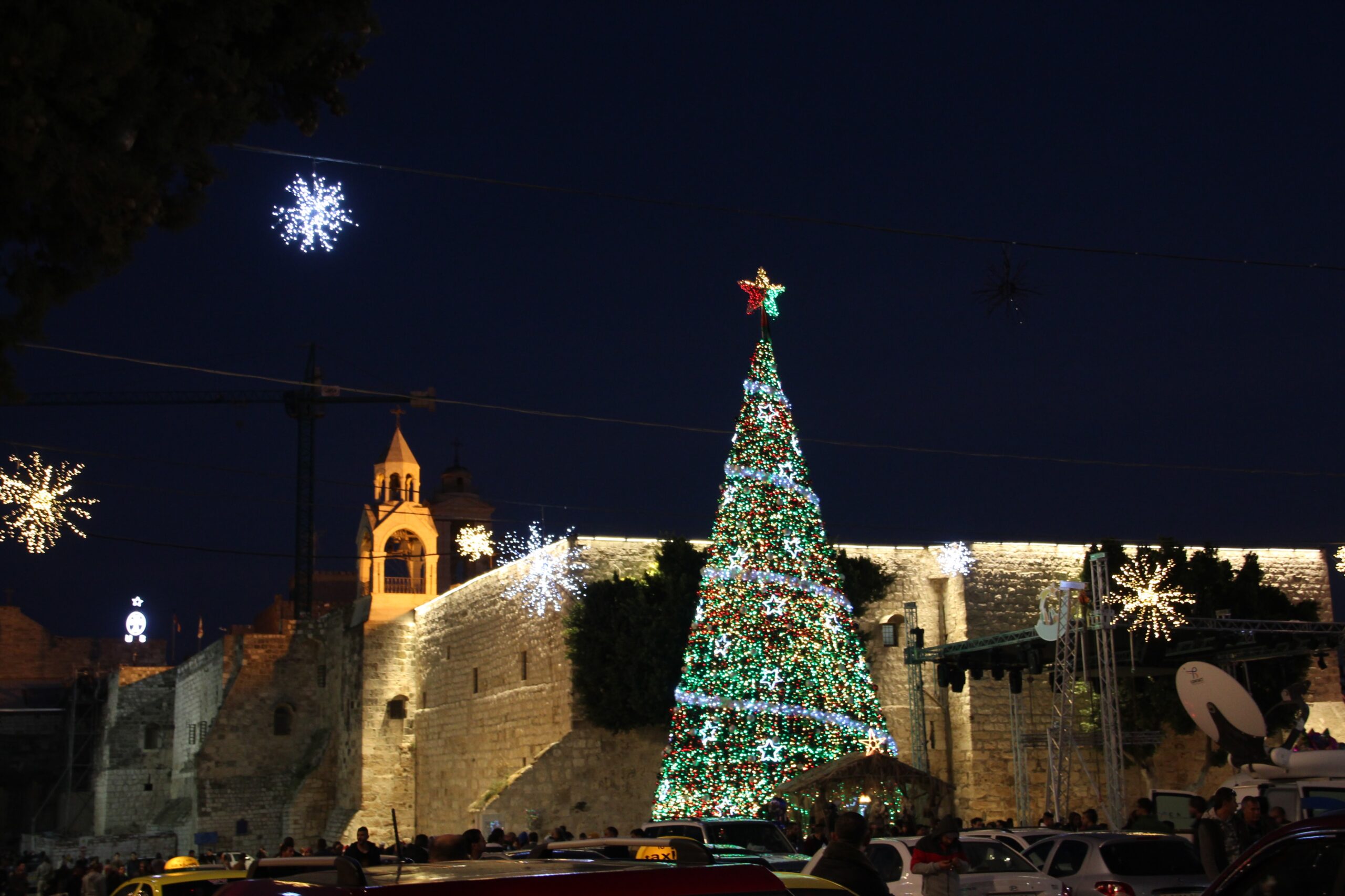
Illustrative image of Christmas in Bethlehem, 2015 (Fjmustak, CC BY-SA 4.0, via Wikimedia Commons)
On Christmas day nearly every major news site reported the same story: Christmas in Bethlehem returns after two years of war. These reports tell a story of renewed celebrations, coexistence, joy, and holiday spirit amid ongoing Israeli raids in Palestinian cities, settlement expansion, and settler violence.
While naming Israel as the boogeyman, these reports brushed Islamist extremist violence against Christians under the rug despite reports of at least two attacks in the days before Christmas.
Just next door to Bethlehem in the Christian town of Beit Jala, Muslims severely beat a Christian man, prompting residents to complain to the Palestinian Authority and plead for better protection just five days before the holiday.
In Jenin, two days later, Palestinian extremists set fire to the Christmas tree and nativity scene belonging to the Holy Redeemer Church of Jenin.
Holy Redeemer Church in Jenin’s Christmas tree destroyed in arson attack. Under the Palestinian Authority, there is growing hostility toward Christians.
Attacks on Christians, their sites & symbols are unacceptable at all times. Even more so, as we approach Christmas this week. pic.twitter.com/neiDCVA0Z4
— Israel Foreign Ministry (@IsraelMFA) December 23, 2025
In Nablus, just 40 kilometers south, the Council of Churches canceled its public Christmas festivities, citing solidarity with the suffering in Gaza. Jerusalem Center for Applied Policy and long-time Christian activist Elias Zarina wrote on social media that the public festivities were actually called off due to threats from local Islamists.
The news media’s rosy portrait of Christmas in Bethlehem was free from any critique of the Palestinian Authority and Palestinian leadership.
The Palestinian Authority is an authoritarian Islamic government. Freedom of expression and religion are limited in areas under its control. There can be negative consequences, including arrest, for criticizing authorities or their Islamic rule, so churches are compelled to be diplomatic in their engagement with their Muslim neighbors, according to the NGO Open Doors, which supports Christians persecuted internationally.
“The majority eats the minority here. The Christians isolate themselves, out of fear of upsetting society in one way or another,” one country researcher said in their latest report on the subject, published in 2025. This longstanding dynamic was previously noted by CAMERA’s Dexter Van Zile in 2012 (“60 Minutes Smears Israel for Christian Exodus from Holy Land”).
The NGO’s 2025 report said that the primary drivers of Christian persecution in Palestinian society are Islamic oppression, religious nationalism, ethno-religious hostility, clan oppression and dictatorial paranoia. Christians who converted from Islam face the most severe persecution as they face threats and intense pressure to give up their new faith, starting with their immediate families.
Strikingly, while multiple organizations track attacks against Christians in Israel, primarily in Jerusalem, there is no comparable tracking specifically dedicated to Christian persecution in the Palestinian West Bank. The absence of a dedicated incident-tracking mechanism for Christian persecution in the West Bank — especially when contrasted with the intensive scrutiny applied to Israel — contributes to systematic underreporting, reduced media coverage, and significant information gaps when perpetrators are Islamist.
Notably, it is far easier for Palestinians in the West Bank to criticize Israel, which has a Freedom House Freedom Index score of 73 out of 100, than to criticize the Palestinian Authority-ruled West Bank, which holds a much lower score of 22 out of 100.
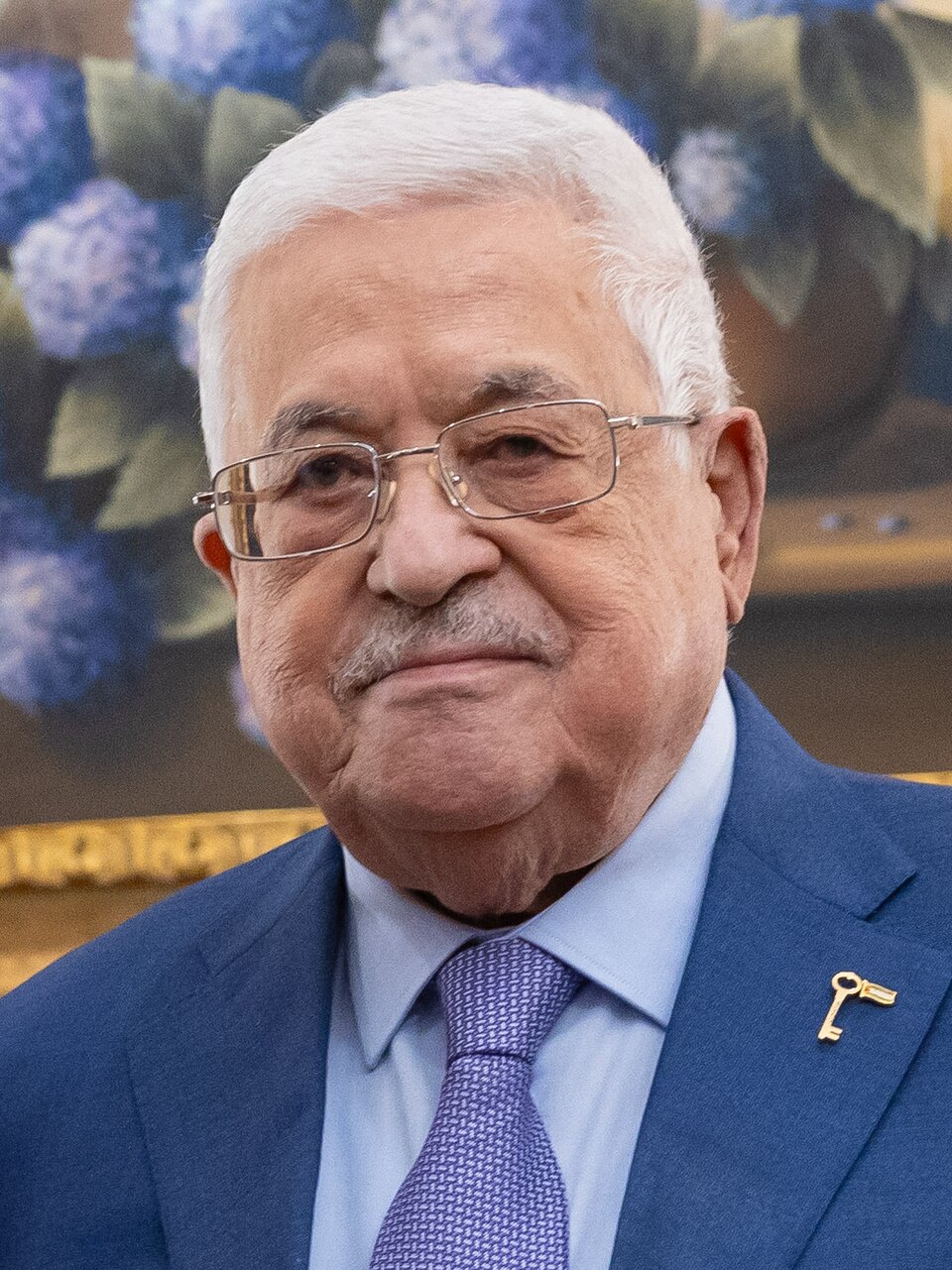
Mahmoud Abbas (Photo by Number 10, CC BY 2.0, via Wikimedia Commons)
Coverage of Christmas in Bethlehem was a missed opportunity for reporters to hold authority to account. Ethical journalism does not run on uncritically embracing government-pushed stories. Unfortunately, outlet after outlet chose to amplify the message of an authoritarian regime led by Mahmoud Abbas, who has remained in office for over two decades, long after his official five-year term expired.
Organizational or governmental reports which do address Islamist abuse against Christians often qualify alleged attacks as unconfirmed or anecdotal or embed the phenomenon inside broader reporting about social pressure and governance issues. Several cases cited in the U.S. State Department’s 2006-2008 International Religious Freedom reports focused on the West Bank and the Gaza Strip highlight this phenomenon.
According to the State Department documents, the Palestinian Authority failed to investigate the involvement of PA officials in unconfirmed but credible reports of Christians being targeted for extortion or abuse.
In these cases, landowners accused Palestinian security forces and judicial officials of collaborating with criminals to extort property illegally from Bethlehem area Christians. The criminal entities allegedly used forged land documents to assert ownership of the lands belonging to Christians, the documents said.
The PA failed to prevent the seizures of Christian-owned land and police did not investigate most of these cases, according to the State Department documents.
In two cases police arrested and then released the suspects on bail and allowed them to continue occupying the land in question, according to the 2007 report. “Local religious and political leaders confirmed that no such attempts to seize Muslim-owned land took place,” the report stated. However, considering that the allegations were against authorities, and there is limited freedom of expression, it’s unclear how these officials can confirm that.
Additionally, in September 2006, a Christian resident of Bethlehem “claimed” unknown assailants threw Molotov cocktails at his home and car, according to the same report. He charged that this attack was in retaliation for speaking out against theft of Christian land in the city and complained that PA officials were not doing anything to apprehend the perpetrators.
Also in 2006, and mentioned in the same report, Qalqilya’s YMCA branch closed after local Islamists firebombed its office and appealed to the Hamas-led municipal council to shut the facility. Various political factions in the city condemned the incident, but no action was taken to reveal or punish the perpetrators.
A State Department 2015 report said that in June of that year, leaflets bearing the Islamic State of Iraq and the Levant insignia and threatening local Christians with death if they did not leave Jerusalem during Ramadan were distributed throughout the Palestinian neighborhood of Beit Hanina in eastern Jerusalem. Palestinian leaders, citing the overwhelming rejection of the group among Palestinians in local polling, publicly stated their suspicion that the leaflets were not authentic, and condemned the fliers and any threats to local Christians.
However, Israeli police arrested east Jerusalem residents as recently as April 2025 for contacting ISIS operatives abroad. In 2014–2015, at least 13 Arab Israelis —including six schoolteachers — were arrested on suspicion of supporting ISIS in towns and cities across Israel.
Palestinian leaders’ insistence that the leaflets could not have originated locally, based solely on ISIS’s unpopularity, reflects an extraordinary effort to deflect responsibility from any member of their own community for the threatening leaflets.
In fact, P. Khoury, who pastors the Calvary Baptist Church said that his church and its staff, based in eastern Jerusalem, have faced harassment, loss of income, physical assaults and an always-present threat of death.
Khoury wrote on the FBC Bethlehem website, the organization under which his church operates, that their current landlord issued them an eviction notice due to pressure from Muslim neighbors and extremists.
The West Bank’s Christian Population
In 1949, the number of Christians living in the West Bank area stood at 51,053 after coming under Jordanian control, according to the Jerusalem Center for Security and Foreign Affairs. The population declined to 45,855 in 1961, and then further declined to 42,565 by 1967 when Israel took control of the West Bank, accounting for six percent of the population.
Since 1997, the population of Christians in the West Bank has grown by 17 percent to 46,850, as of the latest count in 2017. In contrast, the total West Bank Palestinian population has grown by 61 percent in the same time frame, from 1.79 million to 2.88 million.
In Bethlehem specifically, prior to the 1993 Oslo Accords, approximately three-quarters of the population was Christian. By 2025, after three decades of Palestinian rule, Bethlehem’s Christian population declined to approximately 10 percent.
NGOs, think-tanks, and government reports have cited several factors — both security-related and economic — behind the Christian population’s slow growth throughout the West Bank and the decline in Bethlehem.
When the Hamas war erupted in 2023, over 142 Christian families left Bethlehem over concern of an uncertain and alarming future, according to Zarina of the Jerusalem Center for Applied Policy.
“Christians in these areas are subjected to a systematic policy manifested through harassment, violence, psychological terror, forced displacement, and the confiscation of property by extremist families driven by rigid Salafi ideology and supported morally and financially by states known for backing extremist movements, foremost among them Turkey and Qatar,” Zarina said. “In this context, the Palestinian Authority appears either unable or unwilling to enforce the rule of law and protect the Christian minority.”
Christmas Festivities Halted
Nablus’ public Christmas festivities have been on hold since 2023, with local leaders — like their coreligionists in other West Bank communities — citing the turmoil in Gaza. Zarina, however, maintained that these festivities were halted because of “sweeping restrictions” which prevented Christians from celebrating.
In 2015, festivities were canceled amid the height of the “Stabbing Intifada,” The New York Times reported at the time.
While some Christian Palestinian academics and authorities insisted that the restrictions were not a ploy to stop Christians from celebrating the holiday, others in the community voiced concern that this decision to cancel highlighted how the minority community felt obligated to “show its allegiance in a society that is becoming more conservative and more Islamic,” per The Times report.
The highly publicized Christmas festivities in Bethlehem this year, according to Zarina, was used as a Palestinian Authority tactic to improve its perception in the Western world.
This marketing effort aims to portray the Palestinian Authority as a “moderate” alternative to Hamas – within discussions about the future of the Gaza Strip – that allows for pluralism and rejects terrorism, according to Zarina.
The Pope’s Condemnation
Cardinal Pierbattista Pizzaballa, who attended the Bethlehem festivities, has highlighted the issue in interviews, albeit rarely. As recently as January 2025, the Latin Patriarch of Jerusalem told First Things that the Palestinian Authority leaves Christians vulnerable to Muslim thugs due to its weak hold on the population.
In 2005, after the Christian community sent a dossier detailing 93 alleged incidents of abuse perpetrated by Muslim extremists against Palestinian Christians, then-Father Pizzaballa said, “The problem exists,” though he stressed, “We are not talking about a confrontation with all Muslims.”
International media has eagerly cited his statements condemning Jewish settler attacks which are far easier for him to make considering the freedom of expression and religion enjoyed in Israel, as opposed to the West Bank. Strikingly, the same journalists fail to report on his rare condemnation of Muslim perpetrators and the Palestinian Authority failure to prevent attacks.
Samir Qumsieh, who runs Nativity TV, a Christian television station, told Gatestone in April 2024 that he is worried about the future of Christians in Bethlehem, and fears the day when the churches in Bethlehem will become museums. “Looking at the facts on the ground, you can see that there is no future for the Christians here. We are melting; we are disappearing.”
While international media have heavily reported on the hardships West Bank Christians face due to check points and sporadic attacks from Jewish residents, the same media outlets have demonstrated far less interest in the daily pressure and discrimination the same community faces from the Palestinian Authority and their Muslim neighbors.
Journalists at legacy newspapers with enormous resources have the responsibility of examining the complexities of the environments they write about to provide complete stories, not just partial ones.
Comments are closed.