
When eighth grader Lilly Jones thinks about Philly’s future, she worries the city will become more industrial, more tech-centered — less beautiful. She envisions self-driving cars, a Center City so full of screens and flashing lights that it looks like Times Square. More skyscrapers and less greenspace.
Listen to the audio edition here:
“Just walking through Philly in general, there is not a lot of green. There might be some trees here and there and in some certain parts of Philly there might be some greenery, but it’s not all of Philly,” Jones says. “I just want kids, adults, elders — whoever — to be able to see how beautiful Philly can be, if it was all natural, instead of just being fake and industrial.”
Visions of the future — especially when it comes to design — tend to bend less toward the realistic and more towards science fiction. They might focus more on exciting technologies (anyone else still waiting for flying cars?) than the practical infrastructure like housing, bridges and greenspace that helps our society function.
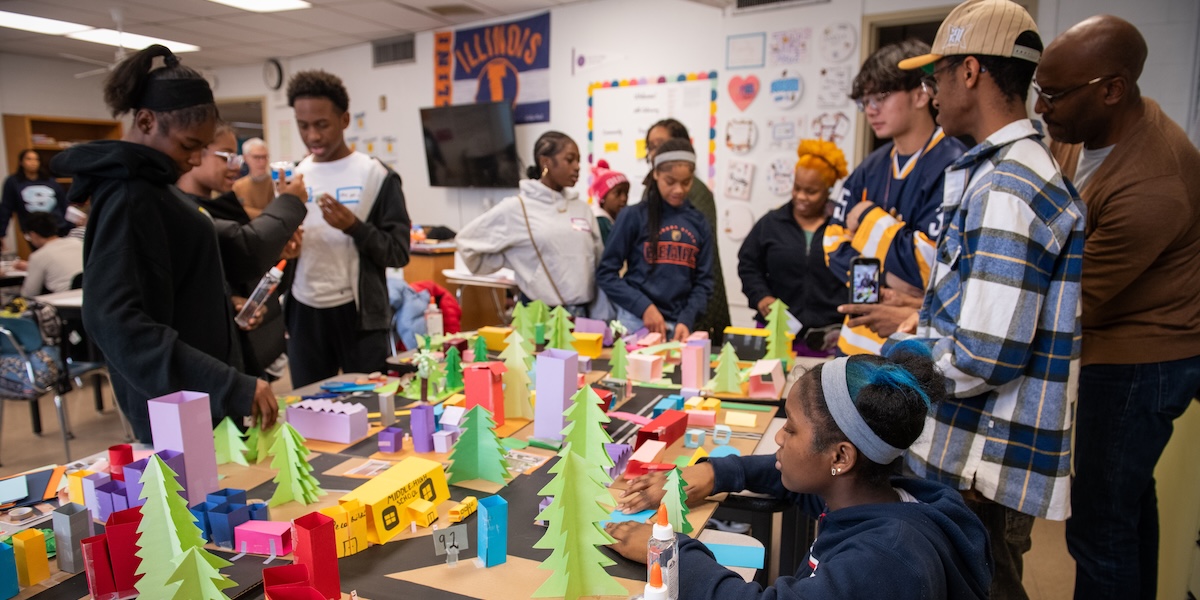
But a new program from Penn and Breakthrough of Greater Philadelphia, a Germantown nonprofit that offers teacher training and enrichment courses for middle schoolers, is setting out to change that. It asked 20 eighth graders, including Jones, to come up with practical — but exciting — designs for Philadelphia’s future. Students thought about how they could expand rec centers or increase rooftop gardens in the city. The students, already participants in Breakthrough’s programming, came from schools across the city.
The program was part of a broader project, helmed by Penn’s Weitzman School of Design, called “New Philadelphia: The People’s Vision is Coming Soon,” which considers what Philadelphians of all ages want their city to look like in 2076.
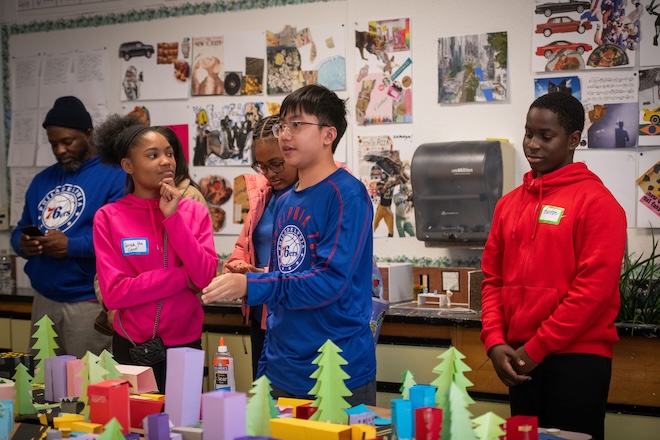 Photo by Kait Privitera A new vision for Philadelphia
The idea for “New Philadelphia: The People’s Vision is Coming Soon” grew out of an ongoing partnership Penn architecture professor Rashida Ng has developed with the Philly Peace Park, a grassroots organization that offers sustainable farming, green economy and wellness programming at their two community parks / urban farms in North and West Philly. Ng has worked closely with the park’s leaders to bring students from her and her colleague Eduardo Rega Calvo’s spatial justice seminar to their locations, and in 2023 the Peace Park participated in Penn’s Housing Justice Futures symposium, which considered how race and climate change influence housing design and policy.
“We think that there’s a vision here for a future of Philadelphia that is more responsive to people’s needs, their desires,” Ng says. “The idea is that the things that people want in their neighborhoods are achievable.”
“It’s not every day where adults listen to kids. [We] can give adults ideas on how we want the future to look like for ourselves and our kids and I think we can — as a community with adults and other children — make this world more than what it is.” — Lilly Jones, 8th grader
Ng was thinking about design and the future of Philly ahead of the 250th anniversary of the signing of the Declaration of Independence this year. She was inspired, in part, by some of the counterprotests that took place in Philly over the bicentennial in 1976, when more than 40,000 people marched in protest of the Vietnam War, unemployment, racial inequality and poverty in the city. Ahead of the 250th, Ng wanted to create an opportunity for Philadelphians to share what they wanted for their neighborhoods, how they envisioned them growing and changing, over the next 50 years. She partnered with the Peace Park on these efforts because of their track record of engaging with neighbors on design efforts.
“We really want to encourage people to reflect and remember that America is still an experiment. It’s continuous, and that means that we can actually transform what the future looks like,” says Lavinia Davis, director of operations and special programs for Philly Peace Park. “But we have to do it together.”
As part of the program, Ng and her partners knew they wanted to elevate the voices of children, who are often left out of the city planning process. Ng had spoken at Breakthrough’s career conversations events in the past, so they felt like a natural partner to bring children’s voices into the project. She worked with DesignPhiladelphia, a nonprofit that offers design education programming for kindergarteners through 12th graders in Philly, to create a curriculum.
Then, they brought in a team of Penn grad students to teach courses on planning and design across nine sessions, held every two weeks during Breakthrough’s fall semester. Lessons focused on everything from sustainability and resiliency to how design affects community building.
“I think it’s important to expose them to design and the role that it plays in society,” says Michael Spain, director of design education for DesignPhiladelphia. “If they understand these concepts and how it works and how it affects them, we’ve done our job.”
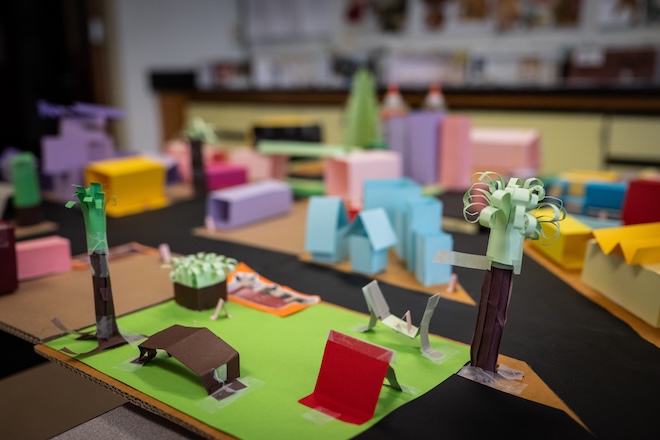 Photo by Kait Privitera Designing Philly’s future
The program started small, teaching students about “third spaces” — places outside of home, work or school where people can gather and build community. Then, they asked students to build models and collages of third spaces that either already existed in their lives or that they would like to see using construction paper, cardboard and magazine clippings.
Some students mentioned libraries and recreation centers in their neighborhoods. Others said Breakthrough was their third space. Many designed spaces had outdoor areas with fields or basketball courts and indoor spaces where they could spend quiet time reading or playing on a tablet. Philly has more than 150 recreation centers, but students wanted more places where young people could gather for free. (Makes sense, considering they’ve been banned from malls, carnivals and a host of other places).
“There’s not a lot of community centers in Philly, so that’s what we put in our new city model,” says Kaleah Parker, a student who participated in the program. “It had libraries, basketball courts, track fields, football fields, and it was about access to stuff you could do outside of home and school.”
“We want to encourage people to remember that America is still an experiment. It’s continuous … we can actually transform what the future looks like. But we have to do it together.” — Lavinia Davis, Philly Peace Park.
As the program progressed, students moved from designing individual spaces to neighborhoods and considering what they want Philly as a whole to look like. Instructors asked students what they’d keep from Philly’s existing infrastructure — they loved our historic sites, the promise of the stadium district and Philly’s 4,000 murals — and what they’d change. Many said they wanted more natural space, like urban forests in the city. Others took a more futuristic approach to greening the city, envisioning rooftop gardens and covering our sports arenas with vining plants. They drew sketches and built models, and used AI design tools.
“I was able to be creative and work with them to make ideas for a better future for all of us,” says Andy Nguyen, another student who participated in the program. “We learned how to keep clean and care for the environment in the projects that we worked on.”
Jones wants to create a greener city as a way to counter both the lack of nature she sees when she walks through the city today and the industrialism she fears is in store for the future. She liked working with other students to combine their ideas. The program also got her interested in becoming a graphic designer.
“It’s not every day where adults listen to kids,” she says. “I think us kids can give adults ideas on how we want the future to look like for ourselves and our kids and I think we can — as a community with adults and other children — make this world more than what it is.”
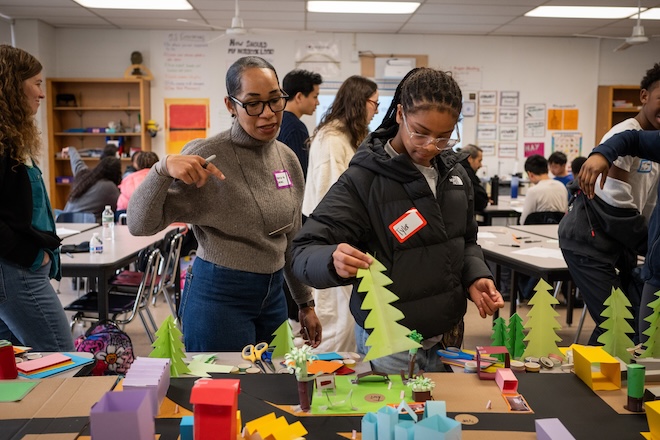 Photo by Kait Privitera What will Philly actually look like in 2076?
Ng is in the process of reviewing the student’s projects so that she can work with the Philly Peace Park and an AI visualization lab to incorporate them into part of “New Philadelphia: The People’s Vision is Coming Soon,” a larger exhibit coming later this year. Students who participated in the program also had an opportunity to share their designs last month with teachers, parents and friends.
“Each individual eighth grader had a different view of their community,” says Sakina Parks, program manager for Breakthrough.
While the City might not be gathering ideas from eighth graders any time soon, design educators say it’s important to think about the needs of children when designing cities. Kids will have to live with the design decisions adults make. Today’s eighth grader will be in their sixties for the country’s tricentennial.
When city planners think about the need the needs of vulnerable residents — including children, women and the elderly — they make cities safer and more accessible for everyone. Kids are also good at outside-of-the-box, innovative thinking.
Ng says, “What’s really wonderful about children is … their ideas about the future are a little bit less fixed, and it’s sometimes easier to tap into the imaginations of children.”
The process also transformed the students themselves, encouraging them to think about environmental justice and homelessness — and how better urban design can help ensure people have affordable, healthy places to live.
“We’re not necessarily creating more designers, but good citizens,” Spain says.
 MORE ON STUDENTS AND OUR FUTURE
Photo by Kait Privitera