
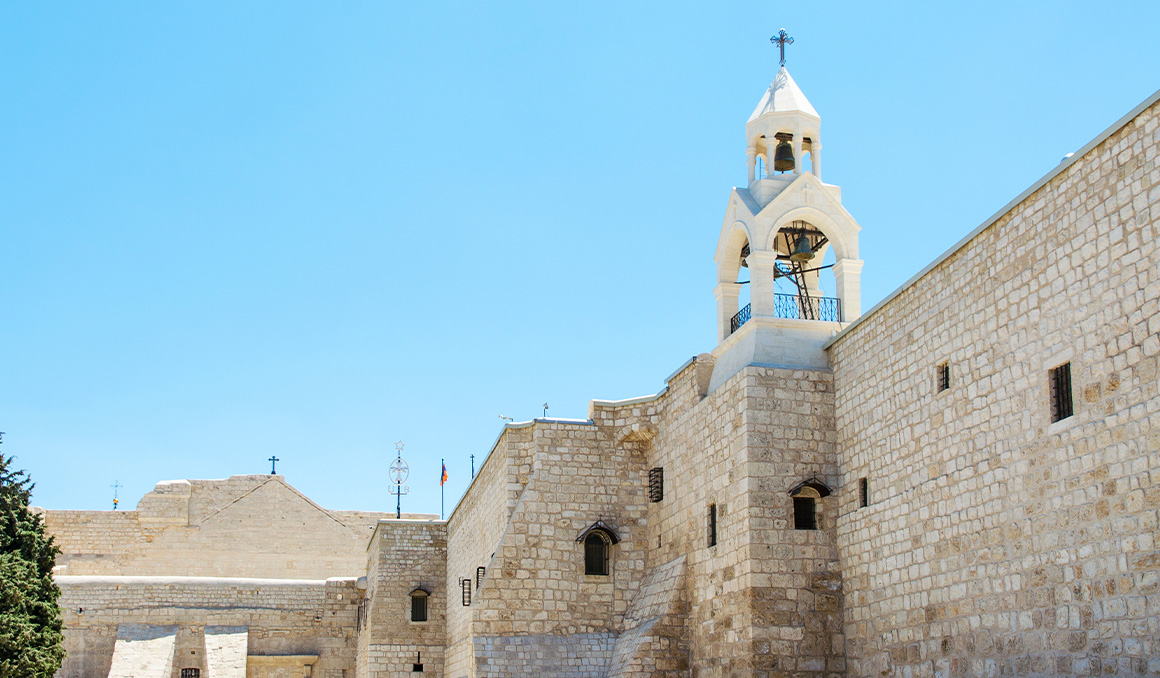
The mayor of Bethlehem says the survival of Christianity in the city where Our Lord was born depends not only on protecting holy sites, but on preserving the local Christian community itself — which he describes as the city’s “living stones.”
In a wide-ranging interview published Jan. 13 with Jason Jones, president and founder of the Vulnerable People Project, Bethlehem Mayor Maher Canawati described his role as mayor as both civic and spiritual: He is charged with sustaining Bethlehem’s economy, safeguarding its Christian presence, and advocating internationally for justice and peace in a time of war and instability.
“The message of peace, the message of Christ, the message of Christmas would not be the same if this community is diminished,” Canawati told Jones. “And I’m inviting everybody to come and walk Bethlehem, walk the history of Bethlehem, make the Bible alive in their visit.”
He also urged pilgrims to connect with the people in Bethlehem — the “living stones” who make up the Mystical Body of Christ.
Reviving Christmas amid ongoing violence
Canawati assumed office in May 2025. He told Jones that one of the most consequential decisions of his first few months as mayor was his choice to revive Bethlehem’s Christmas celebrations after two consecutive years of cancellations tied to regional violence and economic devastation. Advisers warned the move could damage his political future, but he said the city had no other option: “I listened to my heart.”
“We’ve lost 4,000 people during these two years of war,” Canawati said, citing forced business closures and families who have fled the region. “To reignite tourism can only be done by reigniting the spirit of Christmas.”
After announcing the return of Christmas celebrations, Canawati said he received more than 7,000 messages of support from around the world. He recounted that “not even one message was negative.”
As Reuters reported, in December Bethlehem lit its roughly 65-foot Christmas tree, adorned with traditional red and gold lights, in front of the historic Church of the Nativity, revered as the birthplace of Christ.
Speaking to Jones, Canawati pushed back on perceptions that Bethlehem is unsafe, calling it “the safest place in the world.” He said pilgrims are slowly returning, including large groups of Indian Christians with ancient ties to the Holy Land.
Ethnic cleansing and suffering in Gaza
Canawati spoke at length about Palestinian suffering, describing what he called decades of historical displacement, and an ongoing humanitarian crisis in Gaza despite the U.S.-brokered ceasefire.
“There is no other word than ethnic cleansing,” he said, citing the large Palestinian Christian diaspora. “Christian Palestinians in Palestine are 165,000. Christian Palestinians in [the] diaspora are 4 million.”
>> Exclusive interview: Franciscans of the Holy Land explain plight of Christians in Bethlehem <<
Of Gaza, he said, “What happened in Gaza was definitely harsher than genocide,” pointing to civilian casualties and the destruction of churches and hospitals.
Canawati also shared personal experiences to illustrate the daily reality for many Palestinians. He recalled witnessing the killing of his best friend when he was 11 years old in 1989.
“I’ve seen Israeli soldiers barging into our shop, our businesses, taking all of the gold and taking all of our home furniture and my mom’s jewelry and all that,” he also told Jones. “I’ve seen my cousin shot at the checkpoint just for no reason, coming back from a party. I’ve seen family members dying at the checkpoint while trying to reach a hospital in an ambulance.”
Despite that history, Canawati said Palestinians seek reconciliation rather than revenge: “If you look deep into our souls, we want to forgive. We want to let go of all these feelings.”
“Each Palestinian, every Palestinian, has a story to tell,” he said. “But at the end, we want to live in peace. We want to share this land and build bridges of peace in order to prosper, in order to have a better future for our kids. And that’s exactly the message of the Palestinian people.”
Distinguishing Judaism from political conflict
Canawati stressed that Palestinians do not oppose Jews as a people or religion but rather Israeli policies that force displacement.
“We have no problem with the Jewish people, with the Jewish community. We have a problem with Zionism,” he told Jones. “We have a problem with those who want to kick us out, who want us gone. We have a problem with those who are against humanity.”
The mayor also rejected terrorism, citing Palestinian Authority President Mahmoud Abbas’ denunciations of violence: “Terrorism is not in our dictionary. As Palestinians, we denounce it.”
He framed Palestinian statehood as a matter of protection and dignity, not militarization: “We don’t want to build an army. We just want to make sure that what happened to us in the past eight decades will never, ever happen again to the Palestinian people. We need to protect these people.”
Praise for U.S. involvement
Canawati credited President Donald Trump with helping initiate momentum toward ending the conflict, saying, “I know that the situation in Gaza until today is not well, but we also must thank the American people and President Trump for at least putting a start to the end.”
He also described a recent visit by Ambassador Mike Huckabee as an important step in helping U.S. leaders hear directly from Palestinian Christians. “Without justice, you are hurting both sides,” Canawati said.
A direct appeal to Christians worldwide
Canawati closed the interview with a direct message to Christians worldwide.
“Do not forget about the living stones of Bethlehem,” he said. “We are waiting for you here in Bethlehem, and Bethlehem is safe. It is very important that you come walk the streets of Bethlehem, make the Bible alive, connect with the living stones, and also advocate for justice so we can live in harmony. So we can live in peace.”
Jones, a Catholic, added that his hope is that Bethlehem will once again be overwhelmed with pilgrims.
“Here’s my prayer: That you have the same problem next year that the mayor of Bethlehem had 2,000 years ago,” he said, “that there’s no room at the inn.”