
Note: In the months leading up to the April 11 celebration of our Nation’s 250 anniversary at the Kempton Community Center, the Allemaengel 250 Committee will share about the group’s name, mission, educational events, program highlights and most important, the names of the Patriots in Albany, Lynn, Heidelberg, Weisenberg and Lowhill townships who fought in our battle for independence from England.
A sense of shared history exists between the five townships of Albany in Berks County and Lynn, Heidelberg, Weisenberg and Lowhill of Lehigh County: all were settled in the mid-1700s by predominantly German, Swiss and Huguenot immigrants from the greater Rhine Valley in Europe. This common thread led volunteers from our area’s three historical societies to adopt “Allemaengel 250” for their local celebration of America 250.
Let’s look at the what, why and region of the Allemaengel name, a novel term even to most historians, today only familiar to some as the name of a road in Lynn Township.
Many of the references to the name Allemaengel, or variations of this name, have only been passed down through mouth or handwritten recordings, often related to local religious congregations, by generations of these early settling immigrant families.
A well-documented Moravian congregation existed in Lynn and Albany townships from the 1740s. Count von Zinzendorf, the patron of the Moravian Church, was recorded to have passed through and stayed the night in the Allemaengel during his visit to Pennsylvania in 1742.
 The Allemaengel 250 Committee will host a free, all-ages birthday party to celebrate our nation’s 2026 Semiquincentennial at the Kempton Community Center on April 11. The committee’s Liberty Bell logo was designed by Kempton artist Jon Bond. (Photo courtesy of Allemaengel 250 Committee)
Most families that settled in the area were either Lutheran or German Reformed and many of their early churches shared pastors. Henry Muhlenberg, the father of the Lutheran Church in America, first granted the land for the “Allemaengel” congregation where Jerusalem “Red” Church now stands in Albany Township in 1746.
Reformed pastor Michael Schlatter traveling in this frontier area in 1747, recommended establishing a pastoral charge that would include “Magunchy, Allemängel and Schamaltzgass” (Macungie, Allemaengel, and Salisbury).
Benjamin Troxell in his book, Skizzenaus dem Lecha Thale (Scenes from the Lehigh Valley) about the European settlement of the region published in 1880 states: “From my vantage point on Blue Mountain, the townships of Heidelberg and Lynn lay directly before my eyes; Schocharie Mountain obstructed the view to the southwest and limited the westward vista to the sugarloaf-shaped Donatkopf on the border of Lynn and Albany. This entire region was known 150 years ago as “Allemängel,” because the first settlers literally had to endure every kind of hardship — a lack of roads and connections to other settlements, a lack of protection against Indians and wild animals, a lack of wagons and horses, of cattle, farming implements, and provisions — for which they repeatedly traveled to the settlement on the Lehigh River to obtain supplies.”
The 1914 three-volume history of Lehigh County that many families still rely on for a great deal of genealogical information and local history includes a description of the territory covered by frontier Fort Everett located just north of Lynnport, Lynn Township: “The territory included within the boundaries of Albany township, Berks county, and Lynn township, then Northampton and now Lehigh county, was known at the period now under consideration as Allemängel.”
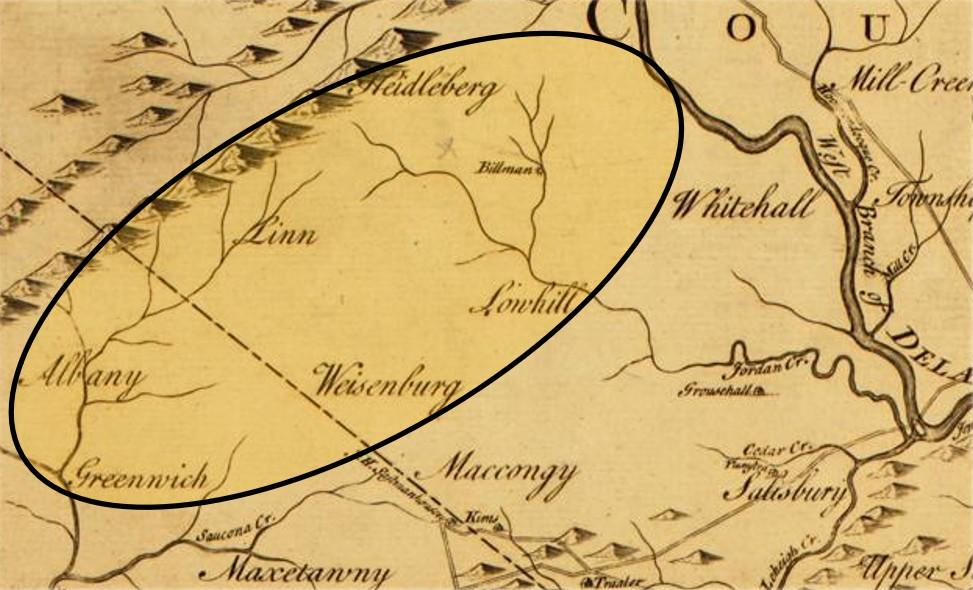
In 1973, Arthur K. Klingaman, local genealogist and historian, in an article on “The History of Albany Township” noted: “Allemangel” was the name for that region in Berks and Lehigh Counties in Pennsylvania which now encompasses the townships of Lynn, Heidelberg, Weissenberg, Lowhill in Lehigh County, and of Albany and the northern part of Greenwich in Berks County.”
Allemaengel 250 Committee member and founder of the Albany Township Historical Society Jon Bond stated in 2001 “There are several theories regarding the origins of the word “Allemaengel” and its application to an area which comprised parts of Berks and Lehigh Counties. Historians differ on the meaning of this word, some feeling that it shows the privations faced by the early ‘German’ settlers who forged their new homes with scant means and minimal experience working the soil of this area (blue, resistant strata of shale).
Others suggest an opposing meaning; that the area was able to provide the people with all their wants, or all necessities. Still others think that it refers to an area in Germany from which the people immigrated. Whatever the meaning, it became apparent that the land was indeed bountiful and the population expanded rapidly in the mid to late 1700s. My personal belief is the latter…I can imagine my forbears coming to these beautiful rolling hills and valleys and realizing their dreams of starting new lives in William Penn’s “Holy Experiment. With their German agricultural ingenuity, they soon strengthened the soil with lime and good old-fashioned manure.”
Local Pennsylvania German historian, Don Breininger says based on what he has read of the area and learned from earlier generations: “As the territory was being settled in Penn’s Woods, the Germans took up land in the back area of Bear Creek which went from what is now Macungie all the way up to Ziegels area and presently Fogelsville. When that land was all taken, Allemaengel was founded. It included Lowhill, Weisenberg, Lynn, Heidelberg and Albany. These township names did not exist until after 1753 when the townships came into existence.”
Without listing additional references, our research concludes that since the Allemaengel never existed independently as a political or administrative division, significant period maps defining the Allemaengel boundaries likely do not exist. (See attached map of the suggested Allemaengel region as drawn by Allemaengel 250 Committee member Peter Glogovsky). Boundaries aside, there can be no dispute of the historic significance of our committee’s namesake as a celebration of the German-speaking communities who settled the area in colonial times and their distinct contributions to our nation’s founding.
In the second article of the Allemaengel 250 series, the Allemaengel 250 Comittee will share our mission and the student educational programs being planned for April 11.
Submitted by Ann Wertman and David Hunsicker Jr., of the Allemaengel 250 Committee