
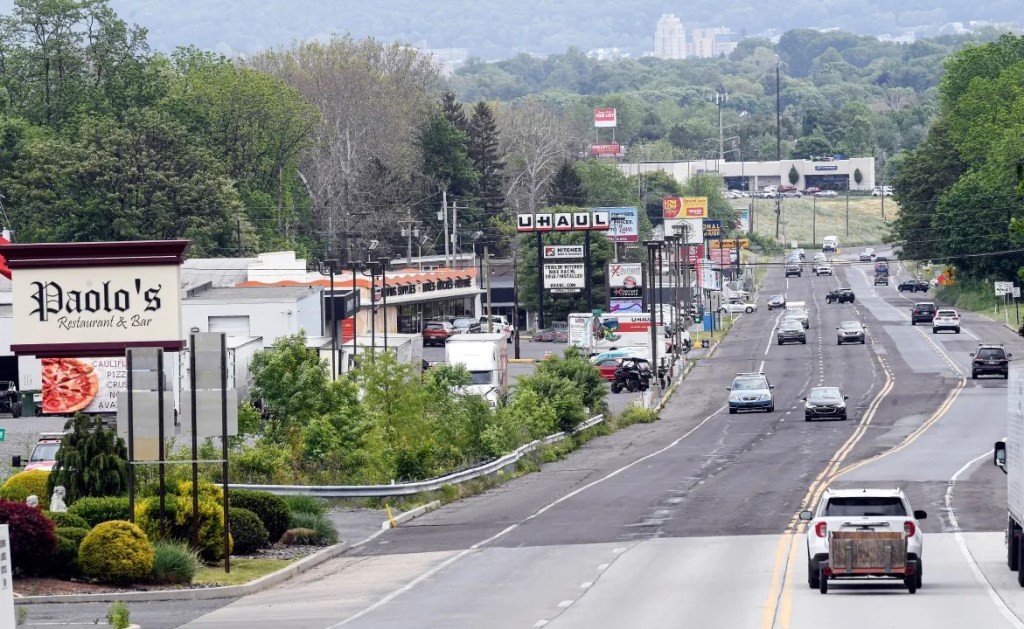
Cumru Township officials and consultants unveiled plans for a townshipwide revitalization that aims to court commerce, revitalize parks and housing and create new sources of tax revenue.
The plan presented at a meeting Wednesday came about after more than a year of efforts by a steering committee involving the township, Berks County, the Greater Reading Chamber Alliance, the Gov. Mifflin School District and consultants Delta Development Group Inc.
The collaboration aimed to analyze Cumru’s features, survey residents and build a vision that addresses the area’s challenges.
Delta representatives presented the five-year plan as a road map to a refreshed housing stock; new recreation opportunities; a walkable Lancaster Pike retooled to attract mixed-use and commercial developers; and a townshipwide rebranding that emphasizes the area’s positive features.
Some residents at the meeting voiced concerns that the plan doesn’t go far enough to reduce the tax burden on residents. They said focusing on bringing in new people doesn’t benefit those paying taxes now.
Others said existing recreation space is underused and adding more would burden public works. They argued that perceptions about the school district could deter homebuyers.
Township officials argued that the plan was still in its early stages, noting the complexities of undergoing a townshipwide reimagining and urging residents to give the process a chance to play out.
“We needed to get our eyes on the (challenges facing the township) and very clearly understand the picture,” said Commissioner Andrew Donnell. “This was phase zero. From here, we get to start thinking about and brainstorming, with everyone here’s feedback, what we do about the picture.”
Consultants hired
In a split decision, Cumru officials hired Delta in August 2024 to create a plan to generate tax revenue that wouldn’t involve building warehouses near residential developments.
Some officials at the time argued that new warehouses were the only viable means of funding increasingly expensive municipal services.
Other commissioners said courting commerce along Lancaster Pike (Route 222) could fuel an economic revolution and offer new revenue.
The board’s last pro-warehouse holdouts lost their seats in the November election.
At an earlier meeting in January, the board approved extending the contract with Delta for one year at a cost of $6,000 per month.
Commissioners recently approved a 23% increase to the township’s tax rate. Officials said the increase was needed to offset stagnant real estate valuations as well as rising staff costs and other expenses.
Poised for growth
Cumru is well-positioned for growth, according to Delta’s plan.
The township covers over 20 square miles and has a population of about 16,000.
Delta notes the area boasts a relatively high-median household income of $93,000, as well as a high resident retention rate and access to a deep talent pipeline from nearby colleges.
Cumru also benefits from being close to health care centers like Reading Hospital; regional hubs like Harrisburg, Philadelphia and Allentown; and access to highways like Route 222 and Interstate 176, Delta said.
They said the area’s scenic beauty and access to recreational areas like Nolde Forest add to Cumru’s desirability.
 Consultants developing a plan to revitalize Cumru Township say the area’s scenic beauty and access to recreational areas like Nolde Forest are selling points. (BILL UHRICH/READING EAGLE)
Delta claims the area’s strategic location and strong socioeconomic qualities mean there is potential to fill a $150 million market gap in the township’s retail and service sectors.
For all its positives, Cumru also faces significant challenges.
Delta notes that the area’s steep slopes, uneven terrain and abundance of small, privately owned plots limit developability in many cases.
Many areas lack access to water and sewer infrastructure. Expanding that access may require costly investments and tapping into an already overextended sewer system, Delta said.
Other issues include the limited capacity of the school district, several isolated rural pockets, underutilized state land and an aging housing stock that is not attractive to younger buyers.
To address those challenges, the plan proposes a comprehensive strategy involving updating Cumru’s zoning to accommodate mixed-use projects; offering temporary tax incentives for developers; building a positive brand for the township; and seeking local, county and state funding for housing revitalization, site planning, infrastructure upgrades and recreational opportunities.
Some notable suggestions include:
• Expanding mixed-use overlay zoning districts along Lancaster Pike, Old Lancaster Pike and I-176 corridors.
• Creating a Lancaster Pike master plan that emphasizes pedestrian-friendly travel, an improved streetscape, and a combination of residential, retail, office and public space.
• Strategic land acquisitions to prepare sites for development along major commercial corridors.
• Creating a housing rehabilitation program in partnership with the Berks County Housing Authority that uses state funds to help lower income homeowners and landlords fund repairs.
• Developing a recreation plan to create a pedestrian and bike-accessible system of parks, trails, playgrounds and sports.
• Working with local leaders and business owners to develop a cohesive marketing strategy and brand for the township and promote that brand via a modernized website and increased social media presence.
Donnell noted any decision that stems from Delta’s recommendations will have to be approved by commissioners.
“None of the decisions are being made behind closed doors,” Donnell said. “We did our best to engage the community throughout this process and we want the community’s feedback as we move forward.”
Residents’ concerns
Some residents were worried the plans didn’t do enough to generate taxes
“I heard a lot of great ideas, but I didn’t hear anything about reducing our tax load,” said Mike Nowotarski, who is an alternate on the township zoning hearing board.
He said development along Lancaster Pike was stifled after Route 222 was built, and an easy solution to get traffic off the highway was needed.
Nowotarski said existing recreation opportunities like Nolde are underutilized and that putting in more would only lead to more costs.
“I go to Nolde all the time and see no one,” Nowotarski said. “I don’t know how much of this stuff we actually need.”
Nowotarski also worried that offering LERTA privileges or other tax abatements to developers could see them leave after the abatement runs out.
“I don’t get a 10-year tax waiver so why should we give them to businesses,” Nowotarski said.
Judith Ingram said she thought it would be malpractice for the township to go into debt to try and court developers.
She also wondered how building new townhouses would benefit current residents.
“The higher the (population) density, the more the cost of services,” Ingram said. “You think we’re going to sell our houses and move into condos so we can walk to the local supermarket? It seems all externally focused.”
Commissioner Greg Miller noted the goal wasn’t just to build new townhouses.
“In all the conversations I’ve had with various developers … it’s going to be a variety of things spread across the area,” Miller said. “Mixtures of commercial, mixtures of residential and even potentially some industrial updates in areas that are already zoned industrial.”
The Delta plan notes areas like the former Titus Station power plant are candidates for redevelopment.
Donnell said the plan’s goal isn’t to increase the tax burden on residents or the school district.
On the issue of tax abatements, offering those benefits can seem counterproductive but should be seen as an investment, said Teresa Sparacino, vice president of community development at Delta.
“I was borough manager in Carnegie, an old steel town,” Sparacino said. “We adopted a tax abatement program. What it did was revitalized our Main Street, but it also brought in two corporate centers, which not only increased the property tax base but created jobs.”
Other residents said there is a perception that the school district is of lower quality than other neighboring districts, and that has driven away young homeowners who would otherwise be interested in Cumru.
Miller acknowledged the perception but questioned whether it was based in reality.
“I don’t think we have a failing school district by any means,” Miller said.
Kevin Armour thanked the commissioners for taking steps toward a solution to Cumru’s issues.
“I think there are a lot of things that we just need to get out in the open,” Armour said. “Weigh the pros and cons and make an active decision as a community.”
Glenn Emory urged residents to consider future generations.
“We want our offspring to thrive generations down the line,” Emory said. “If we don’t do something now, we’re not doing a good thing for our younger people that are so important to the growth of our community.”
Miller said people enjoy living in Cumru and steps need to be taken to ensure that doing so remains affordable.
“What we have to do here is foster a whole image that this is a good place to live,” Miller said. “People like living here, they just want to see some other amenities.”