
By Dan Armitage
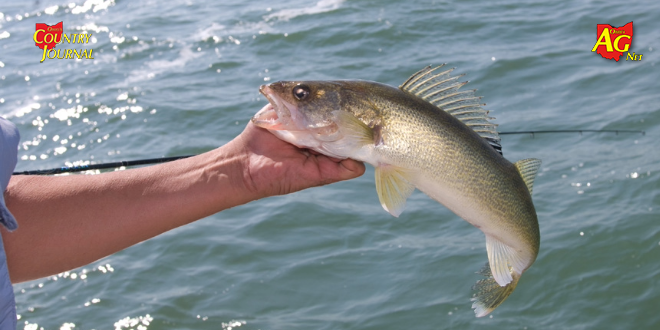
Lake Erie anglers are rejoicing over results from the 2025 Lake Erie trawl surveys, which revealed the walleye hatch was the sixth largest of the past 38 years, according to the Ohio Division of Wildlife (ODOW). The 2025 west zone yellow perch hatch ranks as the seventh largest of the past 38 years, while hatches in the central and east zones were below average.
Data from annual trawl surveys indicate spawning success and survival of young walleye and yellow perch, allowing biologists to predict how many fish will enter the catchable population as 2-year-olds in 2027. The indices are a key piece of information used by the inter-agency Lake Erie Committee of the Great Lakes Fishery Commission to determine annual levels of safe harvest for walleye and yellow perch.
Lake Erie has maintained its reputation as The Walleye Capital of the World because of its world-class walleye fishing, fueled by above-average hatches in eight of the past 11 years. The 2025 western basin walleye hatch index, which includes trawl sites in Ohio and Ontario waters, was 128 fish per hectare (a standard measure of catch per area). A hectare is equal to approximately 2.5 acres. This is the sixth largest hatch of 38 years of surveys and is well above the average of 57 fish per hectare.
Walleye production in the central basin remained strong, with a 2025 survey index of 26 young-of-year walleye per hectare, well above the long-term average of 8 per hectare. This index ranks fourth in 36 years of surveys. Central basin walleye hatches are likely a small component of the lake-wide population, but tagging studies suggest that fish hatched in the central basin spend more time there as adults compared to migratory walleye from the western basin. Above-average central basin walleye hatches may seasonally provide local fishing opportunities when schools of migratory walleye are not present.
Walleye from the strong 2025 hatches should reach catchable size, surpassing the 15-inch minimum length requirement, as early as spring 2027. Walleye fishing is expected to remain fantastic for many years.
Lake Erie yellow perch are surveyed and managed as regional populations within discrete management zones, which the Division of Wildlife uses to monitor yellow perch hatch success and, by comparing results to previous years, determine safe harvest levels.
The west zone (Toledo to Huron) yellow perch hatch, as determined from Ohio and Ontario trawl surveys, was above average in 2025 and should make a noticeable contribution to the catchable adult population in 2027. The survey index was 733 young-of-year yellow perch per hectare, above the average of 467 fish per hectare, and ranking seventh of the survey’s 38 years.
Surveys in the past decade have shown a trend of more consistent hatch success in the west zone. This year’s strong hatch, along with contributions from previous years, is expected to support the trend of good yellow perch fishing in 2026 and beyond across the west zone.
The central basin is split into two management zones for yellow perch: the central zone (Huron to Fairport Harbor) and the east zone (Fairport Harbor to the Ohio-Pennsylvania border). Survey catches were below average in the central and east zones, with indices of 10 and 5 young-of-year perch per hectare, respectively.
This year, frequent, strong winds limited survey days in the central basin, and fewer trawls than usual were completed. Many anglers caught limits of large yellow perch near central basin harbors in late fall 2025, especially near Lorain and Cleveland, indicating that good seasonal opportunities still exist despite lower population sizes.
Variability in regional yellow perch hatch success is expected on Lake Erie because of the size of the lake, differences among basins and zones, and prevailing weather conditions. Hatch success is largely determined by the timing and availability of favorable conditions for both spawning and survival of newly hatched yellow perch in the spring and summer. Strong lake-wide yellow perch hatches are rare.
For more information on the Lake Erie fisheries and to find fishing reports, maps, and more resources, visit wildohio.gov.
Sturgeon released
Speaking of sportfish, reintroduction efforts for state-endangered lake sturgeon have expanded to the Cuyahoga, Sandusky, and Scioto rivers. As part of a large, regional partnership, 6- to 8-inch-long juvenile sturgeon were released in the Cuyahoga, Sandusky, and Scioto rivers for the first time, as well as in the Maumee River as part of ongoing restoration efforts, according to the ODOW.
The U.S. Fish and Wildlife Service and the Toledo Zoo reared the fish for release. Two thousand sturgeon were released in the Cuyahoga River, and 3,000 sturgeon were released in the Maumee River during Toledo’s annual Sturgeon Fest last October, while an additional 750 went to the Sandusky River. What’s more, 30 juvenile sturgeon were surgically implanted with monitoring tags by The Ohio State University and released in the Scioto River last November.
Juvenile lake sturgeon measure 6 to 8 inches long when they are released into Ohio rivers, where the long-lived fish grow to several feet in length as adults. They were once abundant in Lake Erie and the Ohio River, spawning in tributary rivers of those larger bodies of water, but declined over the last 150 years because of dams that blocked access to spawning sites and unregulated harvest. Ohio lost all known spawning populations of lake sturgeon. Following water quality improvements and barrier removals, habitat assessments have demonstrated that the Cuyahoga, Maumee, Sandusky, and Scioto rivers have suitable habitat to support spawning lake sturgeon.
Lake sturgeon are a bottom-dwelling fish that feed on invertebrates and small fish. They are capable of reaching 6 to 8 feet in length and upwards of 200 pounds over their 100-year lifespan, making sturgeon the largest fish in the Great Lakes. Female sturgeon need up to 25 years to reach sexual maturity and only reproduce every few years, meaning species recovery is a long-term project.
Biologists expect lake sturgeon released in the Cuyahoga, Maumee, and Sandusky rivers to travel downstream to Lake Erie, while those released in the Scioto River would move into the Ohio River, with the hope that as the fish mature, they’ll return to these waterways to spawn. Since the Division of Wildlife and its project partners began annual lake sturgeon releases in the Maumee River in 2018, fisheries biologists have documented increased numbers of lake sturgeon in Lake Erie. The early signs of success from the Maumee River provide optimism for the Cuyahoga, Scioto, and Sandusky river efforts.
The Division plans to release lake sturgeon in all four rivers in future years to create a viable, reproducing population of the ancient species in the Lake Erie and Ohio River watersheds. The fish are protected in Ohio as an endangered species, and if you encounter one, report it at wildohio.gov and release it carefully if caught!
Processed deer supports local food pantries
Some 3,350 pounds of processed venison were collected by the ODNR during last month’s deer gun seasons alone to support local food pantries. Deer donation days were held at select locations across the state, and more drop-off days were planned to allow hunters to donate deer from the additional gun weekend and muzzleloader season.
This season, the Division of Wildlife is partnering with the Ohio Department of Rehabilitation and Correction’s (ODRC) Ohio Penal Industries’ (OPI) meat processing facility at the Pickaway Correctional Institution (PCI) for the donation days. So far, 1,150 pounds of venison have been given to the Ohio Association of Foodbanks for distribution to West Ohio Foodbank (Allen, Hancock, Hardin, and Wyandot counties), Mid-Ohio Food Collective (Delaware, Knox, Licking, Marion, and Union counties), and Second Harvest Food Bank of North Central Ohio (Crawford County).