
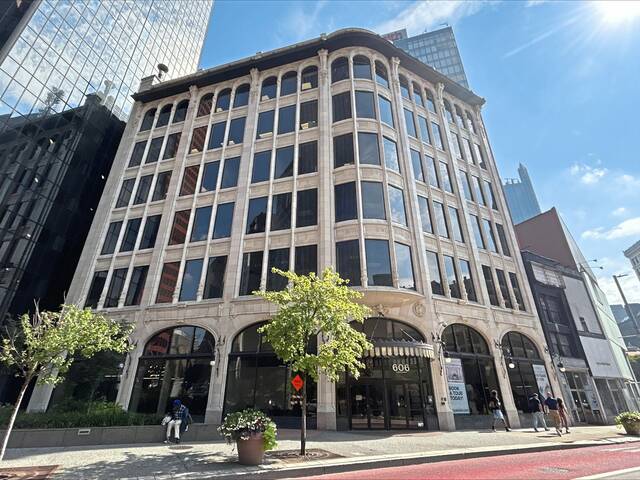
It is a deeply troubling number by any accounting: Nearly a full quarter of all classes of downtown Pittsburgh office space was vacant through the third quarter of 2025, concludes the latest report from the Jones Lang LaSalle (JLL) real estate firm.
“Keep in mind (that) one year ago, the rate was 19.5% and pre-pandemic it was just 16.9% at the close of 2019,” reminds Frank Gamrat, executive director of the Allegheny Institute for Public Policy.
“This is despite the ongoing process of converting office space to residential space, with much of it, like the Gulf Tower conversion, being subsidized by taxpayers,” he says.
“Will this plan be a worthwhile investment for taxpayers?” he asks. “Or will it just be a trade of office vacancy with residential vacancies?”
JLL says that for the best space, known as class A space, the vacancy rate is also up from the third quarter in 2024, 20.7% vs. 17.4%. For the lower-class B space, that rate jumped from 24.9% in 2024’s third quarter to 34.5%, an increase of nearly 40%.
“The conventional thought is that to entice employees back to the office, many firms are upgrading space by moving into buildings with amenities that will make that return more palatable such as coffee shops, workout spaces and lounges,” says Gamrat, a Ph.D. economist. “But in that upgrade, many firms are also reducing their office footprint, thus requiring less overall space.”
He says the jump in the lower-class space vacancy may be a result of the desire to convert office to residential space. “As we mentioned in earlier briefs, older, lower-class buildings are most appropriate to convert due to many factors such as abundant natural light. But a building can best be converted if it’s empty. That implies that firms may be forced out of lower-class buildings to empty them so conversion to housing can be carried out,” Gamrat says, adding that this theory is borne out through the vacancy rate changes in the city’s outlying areas.
With the Downtown office market continuing to be dogged by high vacancy rates, it’s clear that the work-from-home-culture brought on by the 2020 pandemic is still resonating years later, Gamrat says.
“Instead of providing a welcoming environment for business, which includes a safe environment and a low-tax, less-burdensome government, the remedy chosen is to convert mostly empty office buildings to residential use.
“But,” he reiterates, “is this just trading off one problem for another? High office vacancy rates for high apartment vacancy rates?” Gamrat asks. That’s a distinct possibility, and as mentioned in previous briefs, that the population in and around Pittsburgh has dropped tremendously over the decades and a reversal is a long shot at best, he says.
“Who will live in these new apartments/condos? There has yet to be a report showing the demand for Downtown living,” Gamrat reminds. “And without jobs to attract migrants to the city, the conversion plan will remain a very faint hope.”
And there’s a very perturbing ancillary bottom line to all this, the think tank scholar concludes:
“The only beneficiaries will be the developers who are feeding at the taxpayer trough as they demand more and more money to carry out these conversions,” Gamrat says. “The taxpayers will be left with less-full pockets and a city with still-high vacancy rates.”