
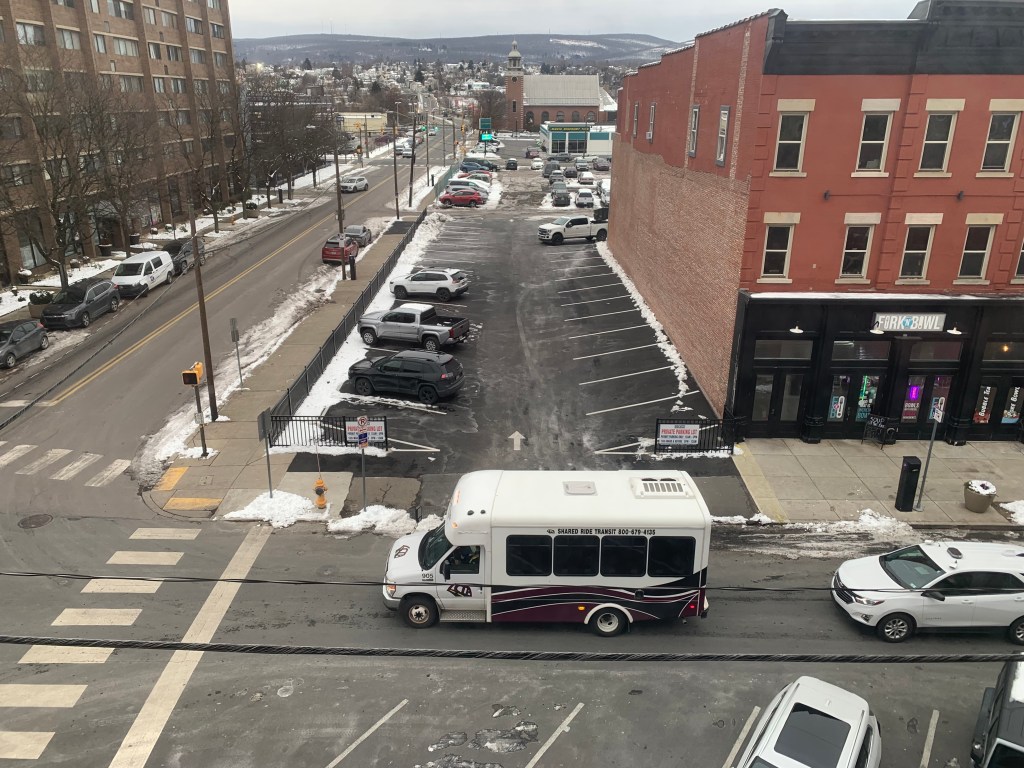
Nearly two years ago, Scranton sued the city Zoning Board to reverse its approval of a new, private parking lot at 301 Penn Ave. and Linden Street.
Through a settlement of that lawsuit last summer between the city and the property owner, which is a firm of developer Don Mammano, the city ended up approving the parking lot — but with even more parking spaces than the Zoning Board had approved in February 2024, as well as other changes.
The board wants to know how that happened. During its monthly meeting Jan. 14, board members raised questions about the parking lot and events that led up to its construction late last year, according to an Electric City Television simulcast and recording of the meeting posted on YouTube. Board member Jim McDermott said the board’s 2024 approval of a parking lot called for 16 spaces, including one disabled-accessible space, shrubbery, period lighting and an entrance/exit in Raymond Court at the rear of the lot. But the lot has 34 spaces, no shrubbery or period lighting and an entrance from Penn Avenue and exit in the alley, McDermott said.
“The city of Scranton appealed our decision for a parking lot — period. They said it wasn’t allowed in a downtown zone. Apparently there was some agreement reached,” McDermott said.
Board Chairman Bob Gattens and member Shawn Walsh said any agreement stemming from the lawsuit should have been sent back to the Zoning Board for review.
“I just wish we got a clear explanation on why we were overturned by the city,” Gattens said. Walsh asked, “But were we overturned? Did they win in court or they just came to an agreement?”
Zoning Board Solicitor Daniel Penetar replied, “I believe they came to an agreement. I’ve been doing this for over 20 years and this is the first and only time I’ve ever seen the city appeal our decision. … So it was out of our hands. I have not seen the agreement.”
Gattens continued: “I’m a little concerned with that, because why have a Zoning Board at that point there. We’re here to make decisions, what we see, what the ordinance reads and everything. I think if anything they should have been directed back to the Zoning Board and maybe at that point, make some changes to it and reapply.”
Efforts were unsuccessful Tuesday to reach the administration of Mayor Paige Gebhardt Cognetti or Mammano.
Zoning board members said they learned of the new parking lot late last year when its fence was rejected by the city’s Historical Architecture Review Board, and the decision went to Scranton City Council. It overturned the HARB fence rejection and sent it back to HARB, which then approved the fence.
During a council hearing Dec. 9 on HARB’s rejection, Mammano said he erected the fence when he paved the lot and striped it for permit parking and parking for ventures by restaurateur Rob Friedman at the 16th Ward and at Mammano’s GAR Building, both across the street from the parking lot.
City Planner Don King told the Zoning Board that landscaping at the parking lot should take place in spring or summer; and the city engineer recommended that traffic enter through Penn Avenue and exit through the alley.
Gattens asked King to review whether the lot needed any disabled-accessible parking spaces, adding, “I think the other stuff is going to be a moot point.”
Parking lot timeline
December 2020: The over-120-year-old J.G. Plotkin & Son Shoe Co. at 301 Penn Ave. and along Linden Street was destroyed by fire Dec. 19, 2020, with the cause undetermined due to the extent of the damage. With its construction dating to at least 1898, Plotkin long had been an anchor of the Penn Avenue Historic District. The shoe business had been in East Mountain resident Richard Plotkin’s family since 1910.
March 2023: A firm of developer Don Mammano bought the fire-ravaged Plotkin property, but the building was too far gone to save and he later demolished it.
February 2024: Mammano intended to construct a building on the Plotkin lot, but was not yet ready to do so. He instead got Zoning Board approval of a variance to turn the vacant property into a parking lot with 16 spaces.
March 2024: The administration of Mayor Paige Gebhardt Cognetti filed an appeal lawsuit in Lackawanna County Court against the city Zoning Board, claiming it erred in approving a parking lot at the former Plotkin site.
April 2024: Mammano’s firm, Linden Taylor LLC, sought and received court approval to enter the city lawsuit appeal against the Zoning Board because, as the property owner, the firm would be affected by its outcome.
July 2024: A joint stipulation in the lawsuit indicates an unspecified settlement is under negotiation regarding the future permitted use of the property. “The settlement, if achieved, will resolve any and all claims and disputes” between the city and property owner Linden Taylor LLC, according to the stipulation.
July 2025: The lawsuit was settled and formally discontinued, though details were not disclosed in the publicly available court docket.
Fall: Mammano got a building permit from the city to turn the gravel site into a paved parking lot. As part of this work, he also had a fence installed. The city issued a stop-work order on the fence because he first needed to get approval for it from the city Historical Architecture Review Board. Mammano had the fence installation completed anyway because he thought a prior variance approval of the parking lot and building permit for the paving of the lot also included a fence. Mammano belatedly submitted an application to HARB for the fence.
November: HARB rejected the fence application on procedural concerns and a lack of details in an application that differed from the fence that was erected. The rejection went to Scranton City Council for upholding or reversing.
December: Council unanimously overturned HARB’s rejection of the fence, sending the dispute back to HARB. It then approved the fence, with a suggestion that Mammano try to incorporate vegetation as decorative screening.
January: The Scranton Zoning Board raised questions about the parking lot and events that led up to its construction late last year, in light of the city’s lawsuit appeal against the prior zoning approval.