
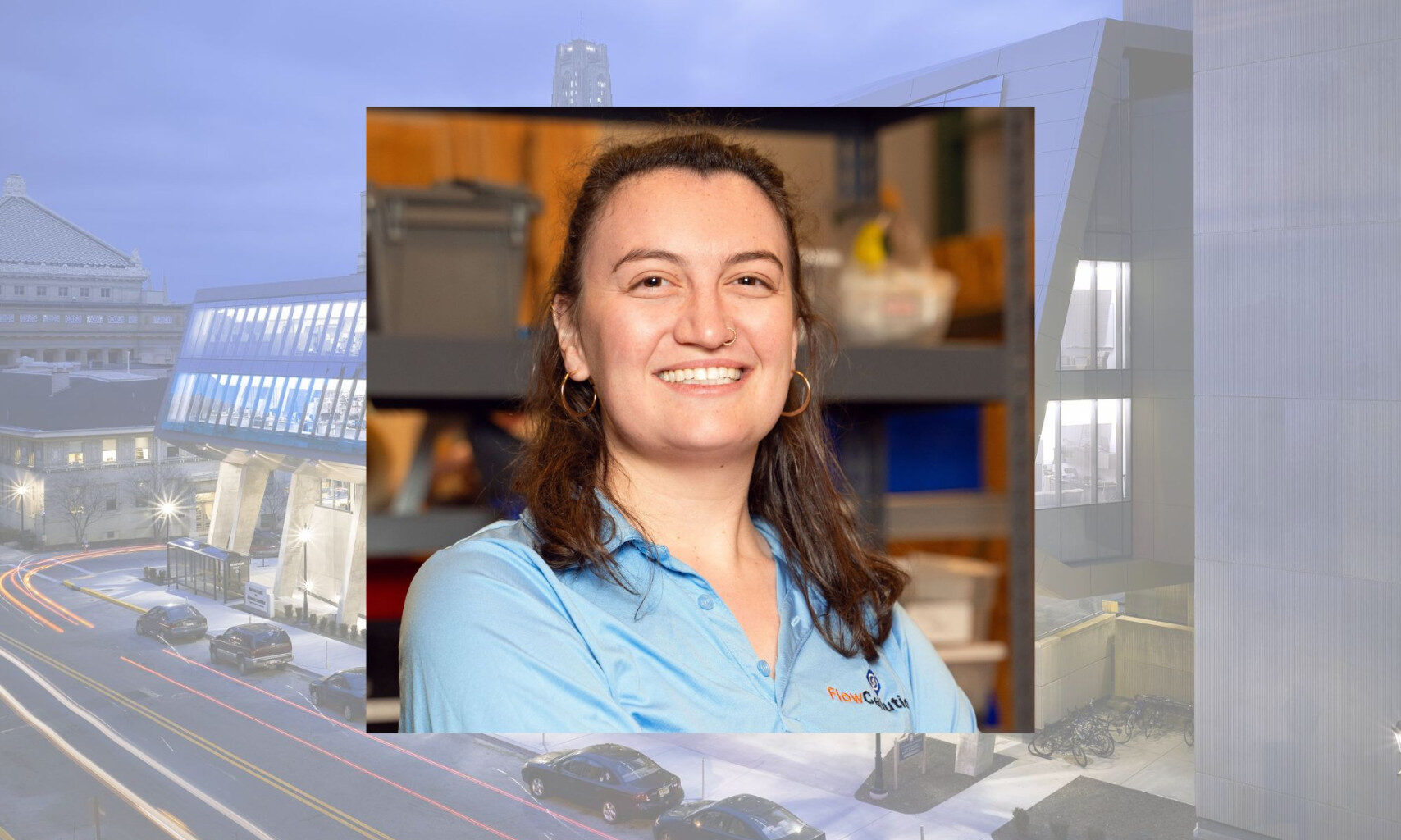
When Becca Segel (ChemE PhD ’2025) sets out to make a difference, she does it—no matter that the challenge is as daunting as reducing carbon emissions and promoting a cleaner energy future.
Segel’s drive recently earned her a spot on Forbes’ 2026 30 Under 30 List for Manufacturing and Industry, recognizing her work as founder and CEO of FlowCellutions, a startup that develops technology to monitor redox flow batteries. This honor places her amongst a select group of young entrepreneurs who are changing the world, and it reflects a journey that took root at the University of Pittsburgh.
In 2020, after graduating from Case Western Reserve University with her bachelor’s degree in chemical engineering, Segel weighed the fastest, most effective way to address climate change. She considered national research laboratories or a career in industry but settled on something else: starting her own company.
“I fell in love with electrochemistry as an undergraduate and was introduced to redox flow batteries,” Segel said. “The batteries are a promising piece in the puzzle to reduce carbon emissions.”
Flow batteries are large systems, some the size of a shipping container, that hold liquid electrolytes which are pumped through a central unit to produce and store electricity. Using inexpensive, earth-abundant materials, the batteries can last for decades without serious degradation, and they can store renewable energy to power microgrids, hospitals, data centers, and even neighborhoods.
Determined to continue researching this technology and start a company, Segel enrolled at Pitt’s Swanson School of Engineering to pursue a PhD in Chemical Engineering.
“I chose Pitt because it had the Big Idea Center and two fantastic advisors, professors James McKone and Chris Wilmer,” said Segel, a fourth-generation Pitt graduate.
At the Swanson School, Segel joined McKone’s research group, where her work focused on developing sensing technology to monitor flow batteries in real time. That research became the foundation of FlowCellutions, which she founded in 2022 with the support of her advisors.
Segel also found invaluable support at Pitt’s Big Idea Center, which connects students to resources like mentoring, workshops, and competitions that help them turn their ideas into action.
“The Big Idea Center was a huge help,” Segel said. “I learned so much about starting a business and gained practical experience through the competitions they sponsor.”
In 2022, Segel won Pitt’s Randall Family Big Idea Competition. That same year she was the first author of the paper “Flow battery electroanalysis 3: online kinetics measurements using ultramicroelectrodes in channel flow” (DOI: 10.1039/d2ta02132c) and was recognized as one of the Pittsburgh Business Times’ 5 Founders Under 25.
‘;