
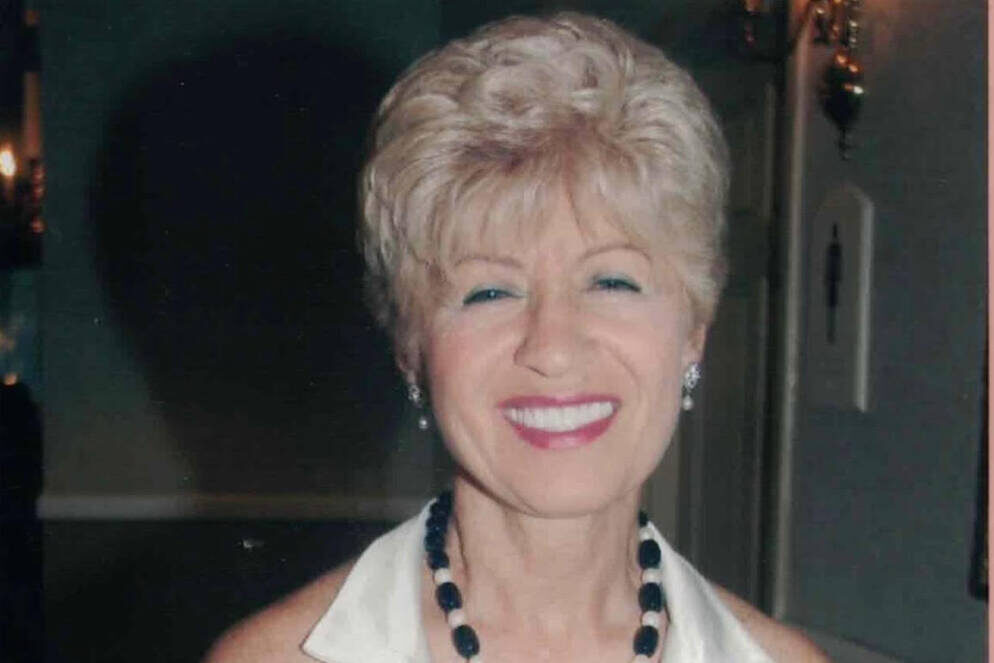
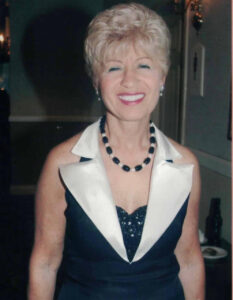
 Courtesy of the Fishman family
Sofya Fishman of Philadelphia believed in forward motion — in learning, adapting and refusing to be defined by circumstance.
That outlook carried her across continents and political systems, from a childhood marked by war and displacement in the Soviet Union to a long career as a computer systems analyst in the United States. Along the way, it shaped her approach to family, work and daily life: practical, optimistic and deeply committed to creating opportunity where none seemed available.
“She came from nothing,” her son, Steve Fishman, said. “And she never took opportunity for granted.”
Fishman, a Ukrainian-born immigrant who spent more than two decades as a lead systems analyst at the Federal Reserve Bank of Philadelphia, died on Dec. 14. She was 85.
Born on Jan. 1, 1940, in Kiev, then part of the Soviet Union, Fishman (née Roytenberg) was a baby when Nazi Germany invaded the Soviet Union in 1941. As German troops advanced and Jews were targeted for mass killings, her family fled Kiev, narrowly avoiding the fate that would later claim tens of thousands of the city’s Jews at Babi Yar.
Her family’s wartime escape is preserved in a written memoir by a cousin, kept within the family and later translated from Russian into English by Fishman herself. The memoir describes how her extended family — several sisters, their children and elderly relatives — loaded their belongings onto carts and fled on foot, hiding during bombings and selling horses to obtain food, water and tickets to cross the Caspian Sea.
The memoir describes missed train connections, overcrowded transport and narrow escapes. At one point, the family was unable to board a ship that later sank. Ultimately, they crossed the Caspian Sea and reached Central Asia, where they survived the remainder of the war amid hunger, illness and loss. Several adult men in the family, including Fishman’s father, did not survive the war after being drafted into the Soviet Army.
The family returned to Kiev after the war to a city devastated by destruction and famine, the memoir recounts. In the years that followed, Fishman grew up shaped by scarcity, collective responsibility and perseverance.
“She learned early how fragile life could be,” her daughter, Alla Fishman, said. “But she also learned that you keep going.”
Despite systemic barriers facing Jews and women in the Soviet Union, Fishman excelled academically. Family members described her as exceptionally gifted in mathematics. Alla Fishman said her mother graduated university with the highest honors, though her achievements were often minimized or formally denied because of antisemitism and gender discrimination.
“She was extraordinarily bright,” her daughter said. “But there were ceilings she knew she would never break there.”
Fishman met her future husband, Genrikh “Gary” Fishman, through mutual friends while they were young adults in the Soviet Union. Their children said the marriage, which spanned nearly six decades, was built on shared responsibility and mutual support. Genrikh trained as an electrician, and the couple began raising their family in Kiev while navigating professional restrictions and persistent antisemitism.
By the late 1970s, those constraints — and their determination to secure broader opportunities for their children — led them to leave. In 1979, the family emigrated through a Jewish sponsorship process that took them through Poland, Austria, Italy and Switzerland before reaching the United States.
The journey took several months. While awaiting visas in Italy, Fishman immersed herself in travel and culture, visiting museums and historic sites and introducing her children to art and architecture — a preview of the interests that would later define her American life.
After settling in Northeast Philadelphia, Genrikh continued working as an electrician while Sofya undertook a second professional transformation. Though already highly educated, she enrolled in an intensive computer programming course while attending English as a Second Language classes in the evenings. She mastered multiple programming languages and entered the emerging field of corporate computing at a time when few women — and even fewer immigrant women — were doing so.
“She reinvented herself,” said Steve Fishman. “She didn’t hesitate.”
Steve and his sister Alla benefited from resettlement services that helped place them in Jewish day school and Jewish summer camps.
Fishman worked as a consultant at Bethlehem Steel and at major Philadelphia-area banks before joining the Federal Reserve Bank of Philadelphia. There, she spent more than 20 years in the bank’s technology division, eventually becoming lead systems analyst.
Her work included converting large volumes of financial and tax data from paper-based systems into digital formats, helping modernize how financial information was processed and reported. In the late 1990s, she helped update computer systems to ensure they continued functioning as dates changed from 1999 to 2000, work that required extensive testing.
“She took that responsibility very seriously,” her daughter said.
Fishman retired at 75, proud of her work and of the country she had chosen. Family members said she embraced American civic life and spoke often about the freedoms she had gained. Every holiday party she made featured little American flags all over her house.
She devoted herself to culture and family, her daughter said. She attended opera, ballet and orchestra performances, traveled extensively, read voraciously and skied. She cooked, hosted gatherings and encouraged curiosity in others.
“She believed education and culture were essential,” her son said. “Not luxuries.”
Though not formally observant, Fishman maintained Jewish traditions at home, celebrating holidays and emphasizing Jewish identity as a source of resilience and continuity.
To her grandchildren, she was known as “Bubbie,” remembered for her energy, humor and insistence on independence. They recalled her tutoring math, attending performances and modeling confidence and joy.
She also took practical steps to support future generations, including setting aside funds for her grandchildren’s education.
In later years, as illness altered aspects of daily life, family members said her essential character remained intact.
“She was still herself,” her son, Steve Fishman, said. “Optimistic, curious and loving. That’s how we knew her, right to the end.”
Ellen Braunstein is a freelance writer.