
Heating with wood, then coal, then gas
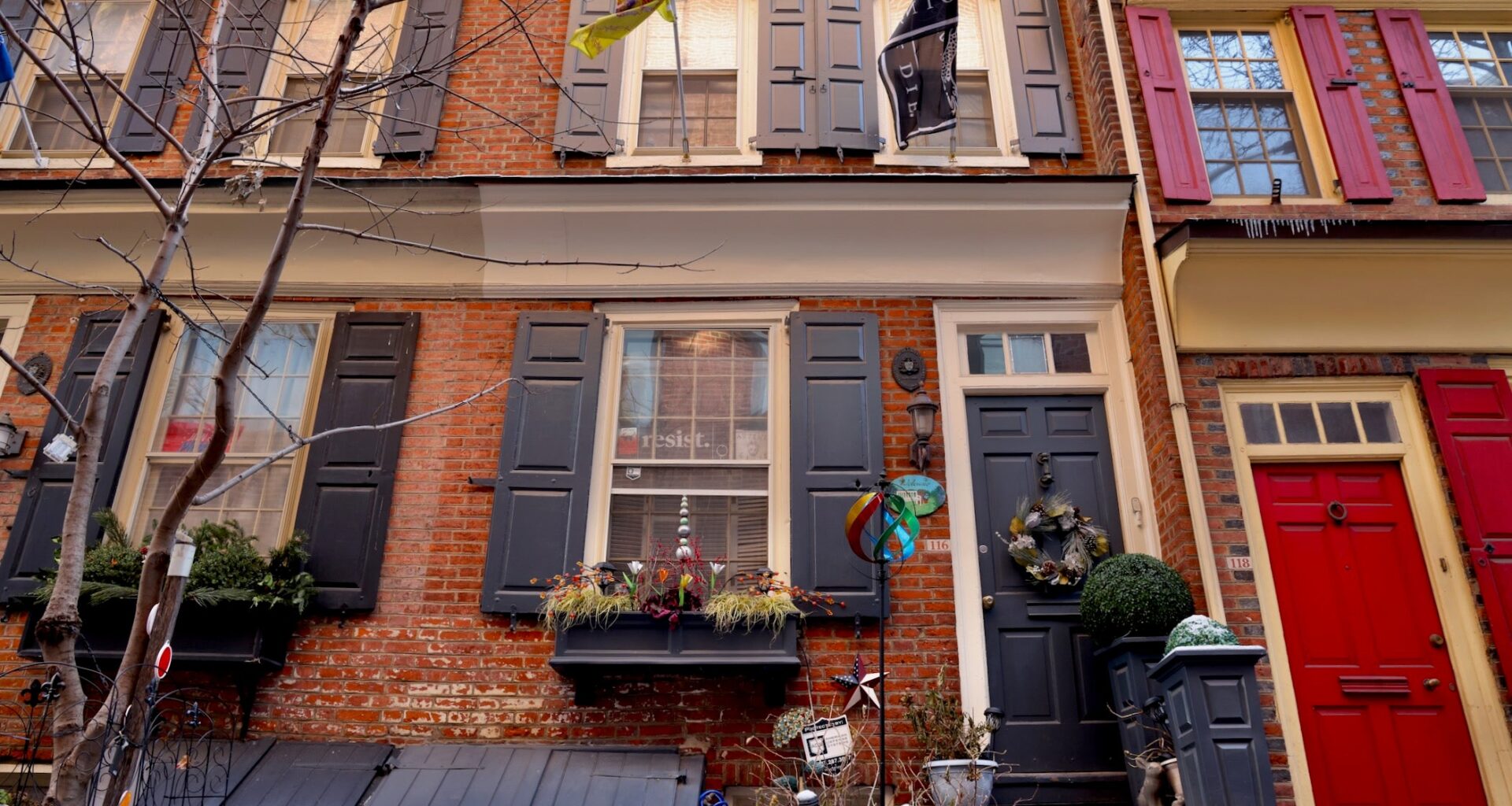
When Berryman’s home was built in the mid-1700s, it was heated by fireplaces, one on each floor. Today, they’re paneled over, with book shelves covering the old fireplace on the first floor.
“They were massive, and the one in the kitchen in particular was not just for heating, but for cooking,” Berryman said.
At the time of the American Revolution, Philadelphians heated their homes “almost exclusively” with wood, said Christopher Jones, a historian at Arizona State University who has studied the history of energy transitions in the mid-Atlantic.
“As the population grew, wood became more expensive, because it got somewhat more scarce,” Jones said.
Meanwhile, in the 1820s, the cost of coal produced in Pennsylvania began to fall, as canals were built to transport it more easily, Jones said.
By 1830, heating homes with coal was cheaper than using wood, Jones said. But many households delayed switching over because while Pennsylvania anthracite coal burns efficiently, it’s difficult to light without a stove.
“There was a lot of resistance to switching over, in part because you had to invest in a stove, which was an upfront capital cost that made it more challenging,” Jones said. “You had to learn new [cooking] techniques, and you lost some of the aesthetics of what the old things were.”
Efforts to make stoves more affordable and promote anthracite coal as the “workingman’s fuel” led to most Philadelphians heating their homes with coal by the mid-1800s, Sean Adams, an energy historian at the University of Florida, wrote in the Encyclopedia of Greater Philadelphia.
Coal was first carried in buckets to stoves on each floor, Jones said. Later, it was burned in a furnace or boiler in the basement, with warm air, hot water or steam piped throughout the home.
In 1940, census records show most homes in Philadelphia were still heated with coal. By 1960, oil passed coal as the dominant home heating fuel, followed closely by gas piped into the house by a utility.
By 1970, utility gas had become the dominant fuel in the city, as it remains today.
Berryman’s home is now heated with a gas-fired furnace. She said her heating and cooling ducts run through the old chimneys.
Similar to how residents of her home may have heated only the rooms they were using before the advent of central heating, Berryman uses electric fireplaces on each floor to supplement her gas furnace.
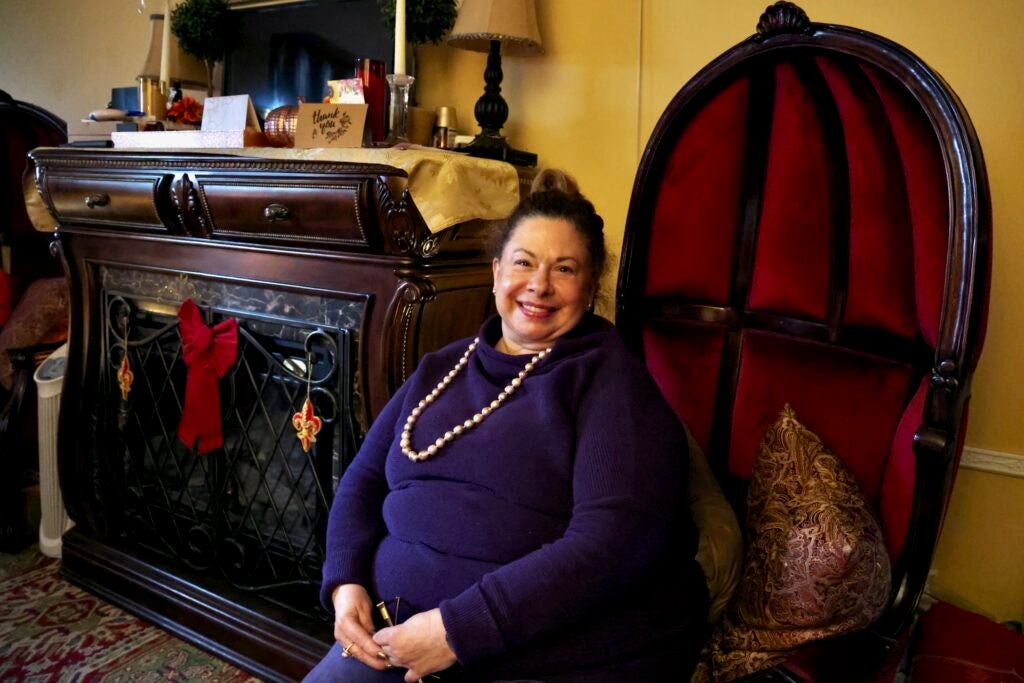 Jane Berryman warms herself beside an electric fireplace in her historic rowhouse in Old City. (Emma Lee/WHYY)
“Why are you paying big bucks to heat a whole house if basically — in my case — I hardly ever use the top floor of my home?” she said. “I want to be cozy in my bedroom. I don’t want to be shivering if I’m down here watching Stephen Colbert. So I tend to turn on the electric fireplace in the room that I’m in and within 20 minutes, bam, I’m at 70 degrees.”
No air conditioning: ‘Back in the day, you suffered’
While brick rowhouses are good at retaining heat, they are “awful” when it comes to cooling, said Drexel adjunct professor Bruce Laverty.
“During the summer months, they bake, and bricks will get hot and then during the darkness hours, they radiate heat,” he said.
Back around the time of the American Revolution, homes like Berryman’s would have been cooled simply by opening the windows.
“That was it,” Laverty said.
While the first modern air conditioning unit was invented around the turn of the 20th century, home air conditioning units did not become widely available until the 1940s.
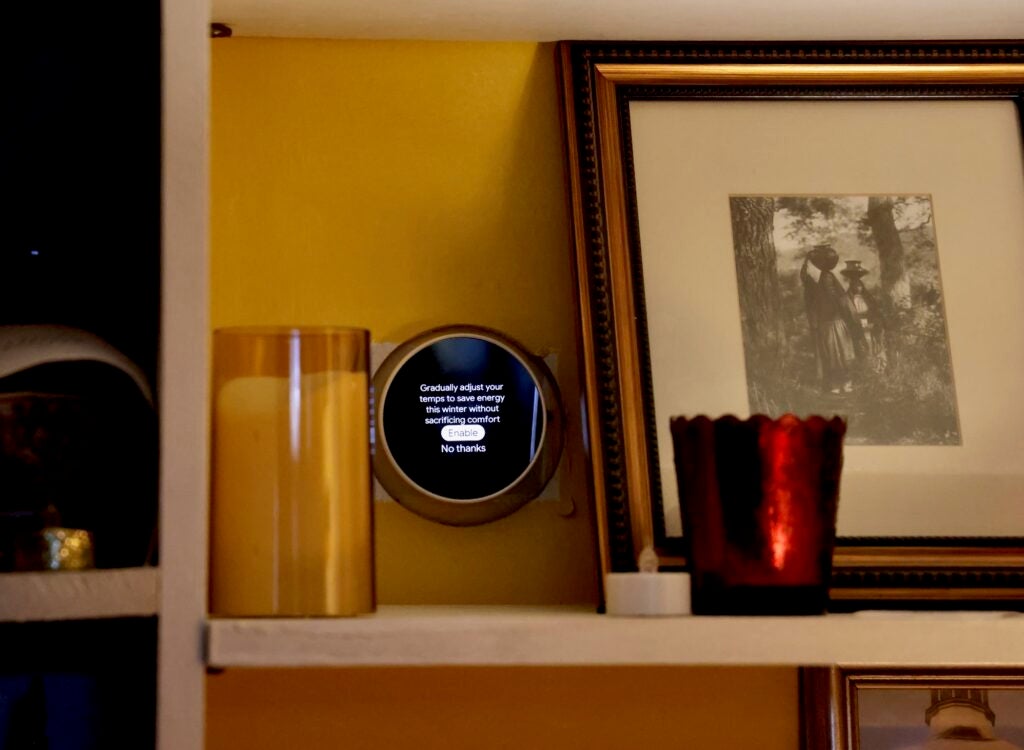 A smart thermostat controls the heat in Jane Berryman’s historic home. (Emma Lee/WHYY)
Berryman’s home had central air conditioning when she bought it in 2014. She said she does not romanticize what it would have been like to live in her house during the time of the American Revolution. She imagines wearing the layers of clothing typical of the time, with nowhere cool to take refuge from the summer heat, other than perhaps a root cellar.
“Back in the day, you suffered,” Berryman said. “I count my lucky stars all the time that I have the [modern conveniences] that I do.”
A colonial-era rowhouse goes solar
In 2019, Berryman decided to make another upgrade that would further modernize her historic home.
“I thought, ‘Okay, I give PECO a lot of money every month,” she said. “Why am I doing that? And what can I do to not be contributing to environmental problems?”
She decided to go solar.
Berryman said she needed to replace her roof before the panels could be installed, and the system cost around $13,000. But she’s grateful she made the investment.
She expects the panels will raise the value of her home, and they’ve already lowered her electricity bills significantly. She now pays PECO around $15 per month in the winter and over $100 per month in the summer, which she said is less than half of what her neighbors pay.
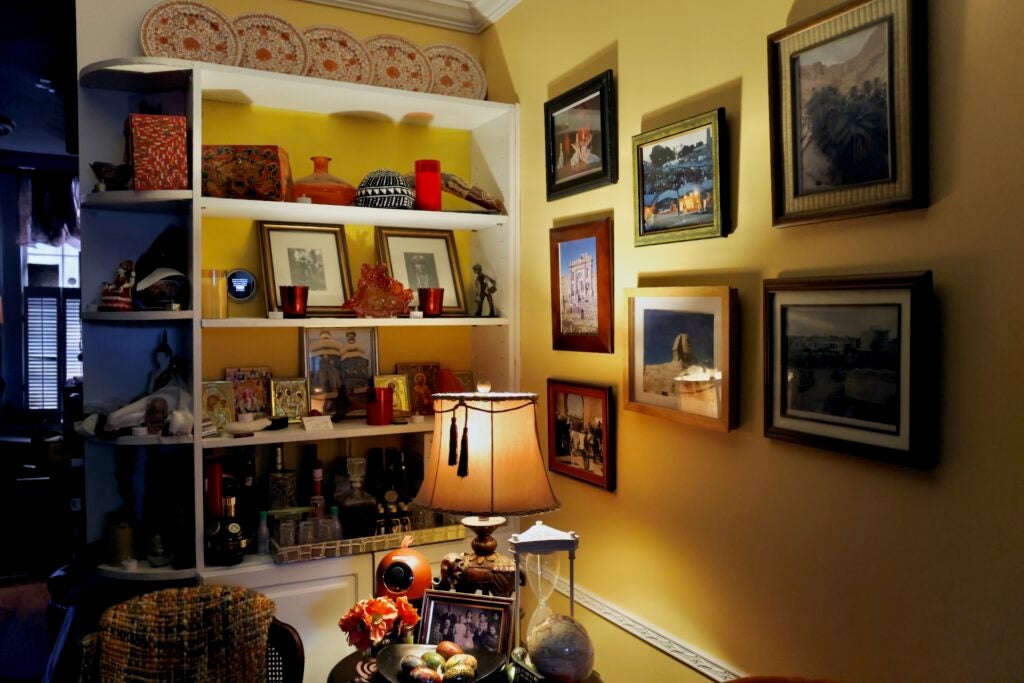 Shelves and framed photographs fill the space once occupied by a massive fireplace in Jane Berryman’s historic Old City house. (Emma Lee/WHYY)
“I’m just proud that this home can stand as an example,” she said. “Regardless how old the home is, if you have a south-facing aspect, you too can go solar.”
Berryman sees the solar panels as part of her contribution to the legacy of her more than 250-year-old home.
“You’re a caretaker, not really an owner,” she said. “You’re taking care of this for the next generation. You’re making sure the home stays current and keeps up.”