
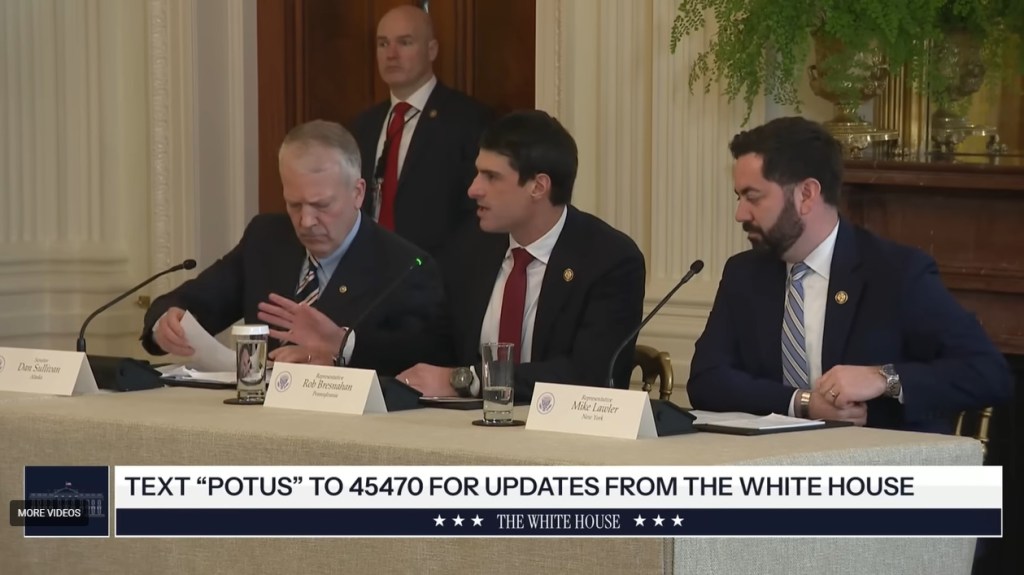
U.S. Rep. Rob Bresnahan touted the impact the Rural Health Transformation Fund may have in his district during a roundtable discussion last week with President Donald Trump, administration officials and fellow Republican lawmakers on rural health care.
The $50 billion initiative will deliver funding to states over a five-year period — including $193 million in year-one funding for Pennsylvania — to bolster rural health care, improve access to care and strengthen clinical workforces, among other goals. It was included in Trump’s signature One Big Beautiful Bill Act savaged by critics, including the American Medical Association, over its substantial Medicaid cuts and reductions in federal health care spending.
Gov. Josh Shapiro announced late last month that Pennsylvania was awarded $193 million through the new federal program for the first year of its five-year Rural Health Transformation Plan, or RHTP, “to foster innovation and improve access to essential health services in rural communities that will be most impacted by the federal spending cuts to Pennsylvania’s Medicaid program.” The state’s RHTP initiatives focus on technology and infrastructure; workforce development; maternal and behavioral health services, respectively; aging and access; and EMS and transportation “to modernize rural EMS infrastructure” for improved efficiency and sustainability, per a late December news release.
Bresnahan, R-8, Dallas Twp., referenced the funding during brief remarks near the end of Friday’s roundtable. The event at the White House featured the president and several prominent officials in his administration, including Health and Human Services Secretary Robert F. Kennedy Jr. and Dr. Mehmet Oz, administrator for the Centers for Medicare and Medicaid Services.
“When you’re looking at Pennsylvania, we’re going to receive over $193 million — in five years it will be over $1 billion for the Commonwealth of Pennsylvania — and when you think about northeastern Pennsylvania, clinics and … rural hospitals are the backbones of our community,” Bresnahan said, addressing Trump. “So making a targeted investment that is not just going to Band-Aid over poor operational procedures, it’s going to actually transform rural health care, that’s what we are so excited about.”
Bresnahan also mentioned rural Pike County, part of the 8th Congressional District, identifying it as the “largest growing county in the Commonwealth of Pennsylvania where there’s not a hospital.” The first-term GOP congressman said money delivered through the Rural Health Transformation Fund “will be so imperative,” noting the “unprecedented investment is going to be incredible.”
Oz and Bresnahan also touted the Rural Health Transformation Program in early December, when the former visited Scranton and joined the latter for a tour of the Wright Center for Community Health and a subsequent roundtable discussion at Geisinger Community Medical Center in the city’s Hill Section.
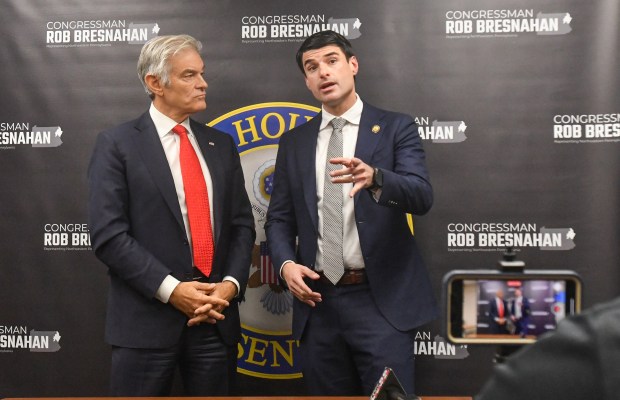 U.S. Rep. Rob Bresnahan, R-8, Dallas Twp., speaks with Administrator for the Centers for Medicare and Medicaid Services Dr. Mehmet Oz at the Geisinger Community Medical Center Professional Building in Scranton Friday, December 5, 2025. (SEAN MCKEAG / STAFF PHOTOGRAPHER)
After that visit, Democratic Scranton Mayor Paige Gebhardt Cognetti — who launched her congressional campaign last year with a goal of unseating Bresnahan in this year’s midterm elections — issued a statement blasting him over his support for Trump’s One Big Beautiful Bill Act. She equated it to a vote “for the largest cuts to Medicaid in history, ripping away care from tens of thousands of our neighbors and putting hospitals at risk of closure.”
“His cruel attempt to tout patchwork funding that represents only a fraction of the deep cuts he made is like an arsonist calling the fire department and expecting to be called a hero,” Cognetti said in the statement.
The nonprofit health policy research, polling and news organization KFF reported in August that the $50 billion in new funding delivered through the Rural Health Transformation Program “could offset a little over a third (37%) of the estimated cuts to federal Medicaid spending in rural areas ($137 billion over ten years) based on KFF analysis of CBO’s (the Congressional Budget Office’s) estimates, or about 5% of the total estimated cuts to federal Medicaid spending ($911 billion over ten years).”
In a recent statement, the National Republican Congressional Committee credited Bresnahan for voting “to deliver more than $193 million to protect rural health care in Pennsylvania.”
“That vote means hospitals stay open, care stays local, and families get the services they need without leaving their communities,” NRCC spokesman Reilly Richardson said.
Also participating in Friday’s White House roundtable was Republican U.S. Rep. Mike Lawler, who represents New York’s 17th Congressional District. Both he and Bresnahan are likely to face stiff competition this year as Democrats try to wrest majority control of the House of Representatives from the GOP for the final two years of Trump’s second term.
As of Thursday, the nonpartisan Cook Political Report’s House Race Ratings, which assess the competitiveness of all 435 House races, listed Lawler’s race as a toss up and Bresnahan’s as leaning Republican.
Races that lean one way or another are competitive, but with one party or the other having an advantage. Toss up races are the most competitive, where either party has a good chance of winning.
In addition to Cognetti, self-described “pro-life Democrat” Francis McHale of Scranton seeks the Democratic nomination in the May primary for a chance to challenge Bresnahan in November. The 8th District includes all of Lackawanna, Wayne and Pike counties and parts of Luzerne and Monroe counties.