
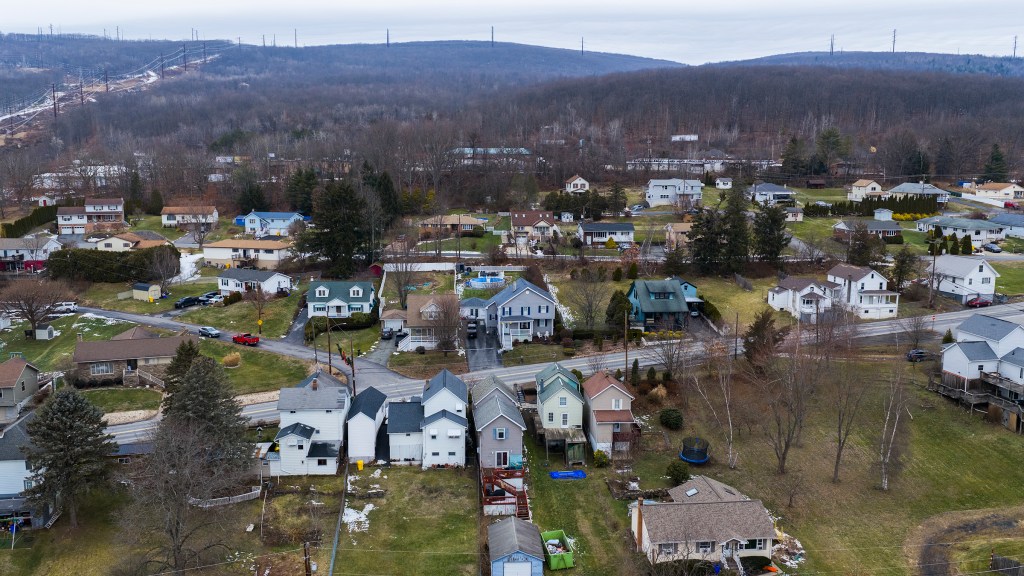
Two looming public hearings could shape Archbald’s emerging data center industry.
Archbald Borough Council will listen to testimony from residents and data center developers on Wednesday and again on Feb. 11 as officials consider conditional use applications for the town’s two largest data center proposals, accounting for nearly three dozen data centers across two campuses along Business Route 6 and Eynon Jermyn Road.
Council will hold its first public hearing for the Wildcat Ridge Data Center Campus on Wednesday at 6 p.m. in the Valley View High School auditorium, 1 Columbus Drive, for a request from Brooklyn-based Cornell Realty Management LLC to build 14 data centers along 574.2 mountainside acres above Business Route 6 and continuing up Wildcat Road, or Route 247, near Archbald’s Sturges and Eynon sections. The borough advertised the hearings in public notices published Jan. 13 and Jan. 20 in The Times-Tribune.
Two weeks later, council will hold another public hearing on Dover-based Archbald I LLC’s proposal to build 18 data centers across just shy of 401 acres between Business Route 6 and Eynon Jermyn Road, beginning just north of Archbald’s Staback Park and the Archbald Pothole State Park. The same developer also wants to build four more data centers further north near the Jermyn border, though the application under consideration in February is only for the 18 lower data centers. Council will hold that public hearing Feb. 11 at 6 p.m. at the Valley View High School auditorium, according to a public notice published Sunday in The Times-Tribune.
Both hearings will give residents and data center developers the opportunity to testify for or against the proposals. Council will then weigh that testimony when it considers approving or denying the conditional use applications, though those votes will likely occur at a subsequent date rather than at the conclusion of the hearings, which will likely pit the promise of significant tax revenue and some high-paying jobs against pleas from the community over impacts on electricity, water, noise and the environment.
Archbald applied data center overlay districts to the sites of both proposed data center campuses when council adopted a data center zoning ordinance on Nov. 24 that made data centers conditional uses in designated overlay districts, restricting where data centers can be built while also regulating them with a slew of conditions required for council to approve them. Residents largely opposed the ordinance, often asking the borough to limit data centers to land above the Casey Highway while also applying even more restrictions.
Both Cornell Realty Management and Archbald I LLC submitted their conditional use applications on Dec. 15.
Wildcat Ridge
The Wildcat Ridge Data Center Campus was Archbald’s first data center proposal in January 2025 when company representatives touted a $2.1 billion investment to build a data center campus with added commercial and retail space. The developer submitted a 777-page conditional use application to Archbald in December as it looks to construct 14 two-story data centers, each up to 80 feet tall with a 202,340-square-foot footprint, totaling 5.66 million square feet of data centers.
Just below the data centers, Cornell Realty Management plans to build 316,000 square feet of commercial space. Plans show a 50,000-square-foot grocery store with 1,800 square feet of retail space; two four-story, 85,000-square-foot buildings, with one mixed use and the other an office; and a 96,000-square-foot surface parking lot with about 360 spaces.
Every data center would also have 40 emergency generators, each with its own 1,000-gallon diesel fuel reservoir, totaling 560 generators, in addition to 60 cooling devices for computer hardware known as chillers on every rooftop. The generators and utility yards will face west up the mountain to reduce the potential for noise pollution, and the chillers would be screened, according to the application.
The master plan also depicts two substations — a 326,000-square-foot primary user substation and a 69,000-square-foot secondary user substation — a 3.75 million gallon water storage tank that would be about 101 feet in diameter, and a 33,000-square-foot admin and logistics building. Written descriptions of the water tower in the application describe it as 3 million gallons.
The site is bounded by a PPL Electric Utilities access road across to its west near the Blakely border, continuing east along Business Route 6 until its split with Wildcat Road, and then moving up Wildcat for more than half a mile.
As part of its conditional use application, the developer included letters from PPL, Pennsylvania American Water and the Lackawanna River Basin Sewer Authority that revealed the significant amount of resources needed to sustain 14 data centers.
PPL committed to servicing the data center campus with 1,600 megawatts of power — more power than the entire 1,485-megawatt Lackawanna Energy Center natural gas-fired power plant in Jessup can produce if it were directly connected to the data centers — as long the developer completes more than $93 million worth of upgrades.
Although there is no indication where the water would originate, Wildcat Ridge will use an average of 598,000 gallons of water daily, with a daily maximum of 3,310,149 gallons, according to the conditional use application. A Nov. 18 letter from PAW included in the application notes, “It is understood that this is not a commitment to reserve water, and that such amounts are subject to curtailment or other operational conditions that require PAWC to suspend or limit water sales.”
To supplement its water, which would cost more than $3.7 million annually to purchase from the utility, the developer is exploring using mine water, though the application notes it isn’t necessary for the project.
Archbald I LLC
Archbald I LLC’s proposed data center campus would place data centers 200 feet — the minimum required setback — from Staback Park, siting the facilities near both the borough park and Archbald Pothole State Park.
Each data center would be two stories and up to 90 feet tall with a 154,850-square-foot footprint, according to the 163-page conditional use application. The buildings would include equipment such as servers, storage systems, network switches, emergency backup generators, batteries, cooling and ventilation systems, and fire suppression systems, according to the application. Potential uses include telecommunications systems, storage systems, internet systems and artificial intelligence.
Each building would have a nearly 75,000-square-foot generator yard, and the campus would have three electrical substations on the northern end of the property near the high-tension power lines that will supply power to local data centers.
Although no specific tenants were secured as of mid-December, according to the application, the developer anticipates up to 30 employees on the largest shift at each building, with the data centers operating nonstop 365 days per year. The developer plans to demolish any existing structures on the property and raze the site for data centers.
The campus would have five entrances, with three on Business Route 6 and two on Eynon Jermyn Road, according to the plans.
An 8-foot-tall fence will circle the site, and there will be guard houses at the primary driveways, according to the plans.
Archbald I LLC’s application did not include specifics of how much water and electricity it will use, though it promises to provide more information during the Feb. 11 hearing. The application indicates the data centers would receive their water through Pennsylvania American Water and would not rely on a non-public source. According to the application, during the hearing, the developer will present testimony confirming that, if approved, the firm agrees to provide documentation from PAW and the Lackawanna River Basin Sewer Authority confirming they have adequate capacity and will serve the facility.
Likewise, the developer said in its application it will present testimony confirming that if it is approved, PPL will have the necessary capacity to serve the data centers.
An introduction in the application explains why the developer is looking to build data centers in Archbald.
“As more and more people, businesses and other entities incorporate and rely upon cloud-based operations for storing, managing, processing, and transmitting the vast amounts of digital data and information continuously being generated, the need for larger and more powerful data centers connected to and served by reliable sources of energy and a full range of infrastructure and utilities increases,” the company wrote. “On November 24, 2025, the Borough Council recognized these emerging trends and needs.”
The campus will be adjacent to the proposed Project Gravity data center campus, which also wants to build seven data centers between Eynon Jermyn Road and Business Route 6 just north of Archbald I’s campus. North of Project Gravity, Archbald I wants to build four more data centers near the Jermyn border.
Across the Eynon Jermyn Road, Project Boson also wants to build a 620,000-square-foot data center at the site of the Highway Auto Parts auto salvage yard.
About conditional uses
As conditional uses, data center developers are required to attend a public hearing where residents can testify while also adhering to numerous conditions established in Archbald’s data center zoning ordinance, which council adopted in November. The ordinance restricted the facilities to four data center overlays, which are designated areas that allow data centers in addition to their underlying land uses. That means if a data center doesn’t materialize, the land retains its original zoning designation without allowing any additional new uses.
To accommodate data centers in Archbald, a property must be at least 120 acres; located close to a high-voltage power transmission line or facility capable of transmitting 230 kilovolts or more; and have direct access to an arterial or collector street, according to the ordinance. Data centers are restricted to 90 feet tall, though they could exceed that as a conditional use for water and cooling towers.
The data center overlay districts prohibit the use of nuclear-, coal- and oil-powered generation for full-time electrical generators; emergency and backup generators could use diesel fuel, according to the ordinance.
Data centers are also restricted to be at least 300 feet from residential areas, and they are required to conduct a sound study approved by the borough’s professional acoustical expert, with a preliminary study as well as an “as-built” study nine months after the data center received its certificate of occupancy and at full occupancy; an as-built sound study could also be required afterward at the borough’s request, according to the ordinance. Data centers have to use public water and sewer facilities, and if a data center uses nonpublic water sources, it must conduct a water feasibility study.
Other requirements include architectural design guidelines, buffer requirements and berm requirements to minimize visual impacts, sound restrictions and requirements to abide by environmental regulators.
— FRANK WILKES LESNEFSKY