
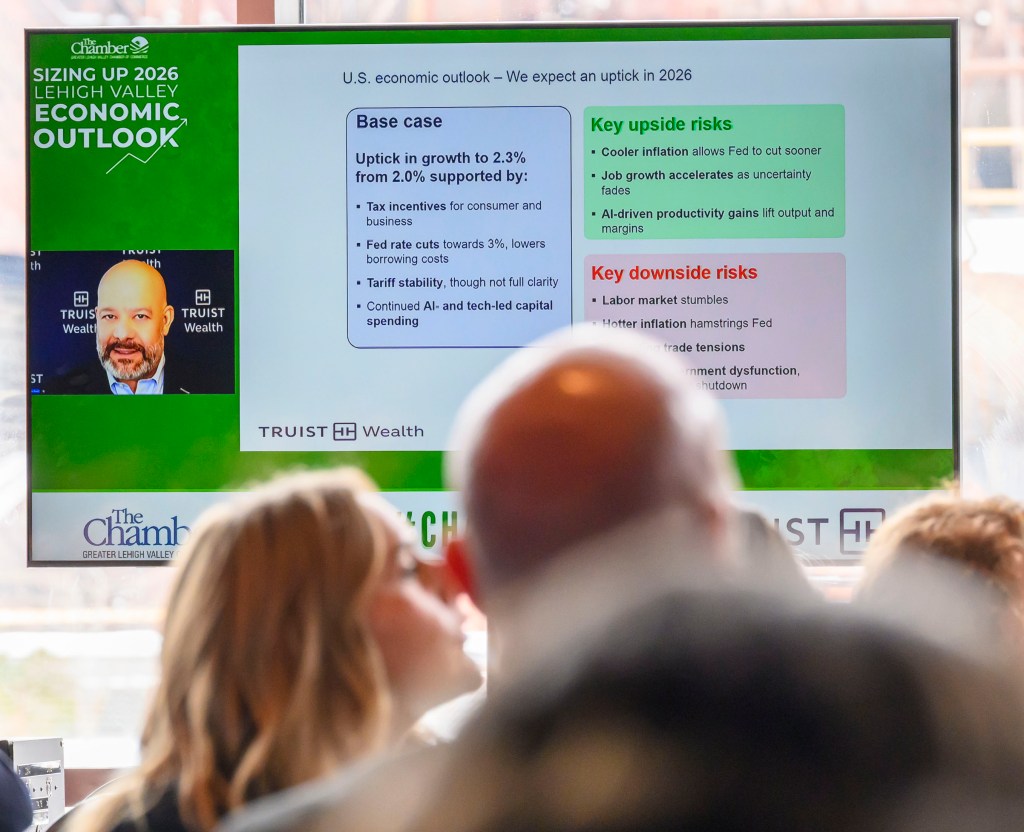
The U.S. economy is expected to grow at a rate of 2.3% in 2026, an economist from Truist bank told members of the Greater Lehigh Valley Chamber of Commerce during its annual Economic Outlook.
Speaking virtually to a sold-out audience Tuesday at ArtsQuest Center at SteelStacks in Bethlehem, the bank’s head of U.S. economics, Michael Skordeles, said the nation should expect a slight uptick this year. A rise in consumer spending with higher tax refunds along with wage growth outpacing inflation should help it rise from last year’s 2%. However, there are some potential pitfalls.
“We see a modest upward move through 2026,” Skordeles said. “But it’s not all sunshine and unicorns; there are still definitely challenges.”
That includes inflation, which is at 2.7%, creeping up as businesses continue passing tariff costs to consumers. Job creation is on the increase, but it’s not at a rate that thrills economists.
“There will be about 75,000 new jobs per month, on average, over the course of the year,” Skordeles said. “It’s not very exciting and certainly below average. We’re likely to have this low-hire, low-fire environment for a while.”
What’s driving the growth?
Skordeles said four things are driving the increase:
Tax incentives for consumers and businesses that include larger tax refunds because state and local tax caps — known as SALT — were lifted under the “One Big Beautiful Bill Act,” along with additional credits for child care and Social Security. With more money in their pockets, consumers will be spending more.
Interest rates are expected to be cut by the Federal Reserve, moving toward a 3% target, which can lower borrowing costs.
While there is some tension and uncertainty around tariffs, businesses are getting used to the landscape.
Businesses are moving forward with massive and multiyear investments in artificial intelligence, along with supporting infrastructure such as data centers and power grids.
“That’s why I think we’re going to get this upticking growth,” Skordeles said. “Many of the tax incentives are on the consumer side, but also certainly for businesses. We have the Fed continuing to cut rates. We’ve got tariff stability, but it’s not going to be full clarity. We’ve got a lot of moving parts down that front. Nonetheless, you’re not sneaking up on anybody.”
As for AI, he said, it’s probably the most impactful development for the Lehigh Valley and beyond.
“This is a big piece of the growth that we’ve seen the last couple of years,” Skordeles said.
What could go wrong?
Skordeles cautioned there still could be some “headwinds” that may push back against growth.
He termed the labor market as the “cheat code” for the economy. “As long as people have jobs, they spend money.”
It was noted that small and medium-sized businesses may pull back on hiring if they don’t see gains on AI investments. Also, there is a labor shortage in places such as the Lehigh Valley as companies struggle to find workers while bringing manufacturing back to the U.S.
While inflation is certainly a lot lower than it was in recent years, it isn’t expected to continue moving downward at a predictable rate. The reason, Skordeles said, is companies that anticipate tariffs are passing costs to consumers, especially with such products as electronics, motor vehicle parts and footwear. Also on the upswing are energy costs as data centers consume more power.
Other factors negatively affecting the economy, Skordeles said, could include government dysfunction with potential shutdowns and housing affordability. While mortgage rates are expected to fall, median home prices are still going up.
“You can’t refinance the price of the house,” Skordeles said.
Jobs update
Sarah Lutz, assistant executive director for Workforce Board Lehigh Valley, gave the yearly update on jobs in the region and which way they’re headed.
Using statistics developed with the Lehigh Valley Planning Commission, Lutz said the population will increase by 128,000 and bring in 80,000 new jobs by 2050.
The sector seeing the biggest growth is expected to be transportation and warehousing, increasing from 30,000 to 80,000 jobs in the next 25 years.
Lutz said there will be challenges fitting these new people into the Valley.
“Population growth is going to strain our core systems, our housing market will tighten, the highways and the bus stops will be crowded,” Lutz said. “We need more bus routes to get folks to and from work, we’ll have more patients that need care, more working parents that need child care and more children in our schools.”
Energy challenges
PPL Electric Utilities President Christine Martin said electricity is the “new workforce” that is powering regional expansion.
She said the Allentown utility company has invested $13 billion in improvements in the last decade and plans another $7 billion through 2028. Businesses looking to come into the Lehigh Valley want to know about the reliability of energy systems.
“Some things that we hear about more and more these days, include their storage, analytics and AI, that keep going rapidly,” Martin said.
Grid modernizations have reduced outage frequency by 30% in the past year, she said.
Morning Call reporter Evan Jones can be reached at ejones@mcall.com.