
It bears repeating: There’s no such thing as “the” Messiah.
Handel didn’t use the article in the oratorio’s title, and he repeatedly revised the work for different singers and settings. Modern performances have generally favored his later revisions.
The Dallas Bach’s Society’s 2024 performance went back to the original 1742 manuscript, in several numbers quite different from modern norms. This year, by contrast, artistic director James Richman and his singers and instrumentalists presented the complete oratorio in a version more familiar to present-day listeners.
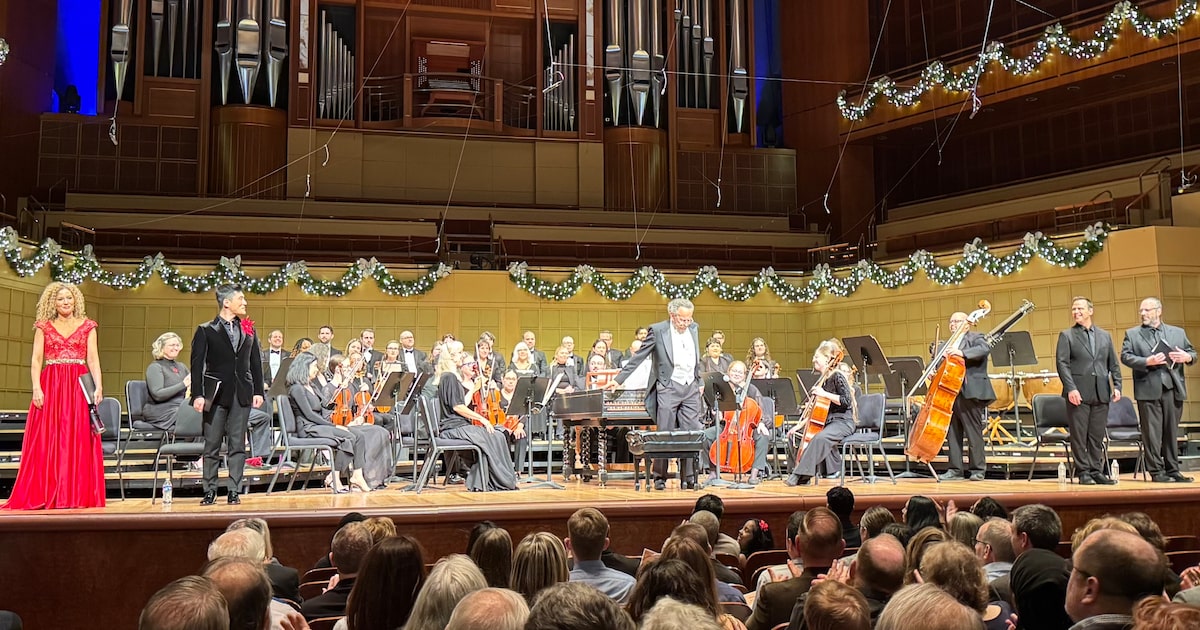
Some people still think of Messiah as an extravaganza for massed chorus and full symphony orchestra. Indeed, performances began gaining mass and weight by the later 18th century. But DBS has stuck with forces comparable to those of the oratorio’s Dublin premiere. Tuesday night’s concert, at the Meyerson Symphony Center, had a chorus of 27 singers and 23 instrumentalists (with Richman leading from one of the two harpsichords).
News Roundups
Baroque music rarely ventures far from dance rhythms, and Richman had obviously coached his forces in lively, well-sprung tempos. (The huge slowdown at the end of the “Amen”s, though, was more Victorian than baroque.) With instruments of baroque style, the playing was generally smart and stylish, although challenges of the valveless baroque trumpet were rather too evident in “The trumpet shall sound.”
Of the continuo contingent I heard only a couple of chords from the harpsichords and a couple big twangs from the theorbo (a bass lute). The lack of a chamber organ was unfortunate, but Richman explained the difficulty of borrowing or renting one for the occasion.
Since baroque instruments, even trumpets, are far gentler than modern counterparts, singing needn’t be forced. The chorus sang alertly and vividly, dispatching busy writing with aplomb. But even in singing, the word “lamb” should be pronounced with a short “a,” not, as here, a pompous “ah.”
The tenor soloist gets some of Messiah’s most dramatic words. With face and body as communicative as his voice, Dann Coakwell served up clarion tones and suave croons as appropriate. “Thy rebuke hath broken his heart” was truly heartbreaking, but there was no missing the threat of “Thou shalt break them.”
David Grogan is the rare baritone with both top and bottom notes for the bass solos, plus a gloriously firm and focused tone — and agility where called for. He could cover the earth with darkness in Part One and raise the dead, stirringly, in Part Three. This was first-rate singing.
Haley Sicking supplied a radiant soprano and fluent delivery. The virtuoso 4/4 version of “Rejoice greatly” would have been better at a less frantic pace, but she nimbly dispatched its scurries. Countertenor Haolun Zhang had a voice of impressive power and clarity, but shifts between head and chest voice weren’t always well worked out, and too many vowels weren’t quite right.
Richman’s comments at the start confused the audience as to when applause was appropriate — it should be held until after each of the oratorio’s three parts. So people clapped willy-nilly here and there, spoiling the dramatic progressions — and Richman’s carefully worked-out tempo relations among recitatives, arias and choruses. Sigh. His post-intermission commentary rambled interminably.