
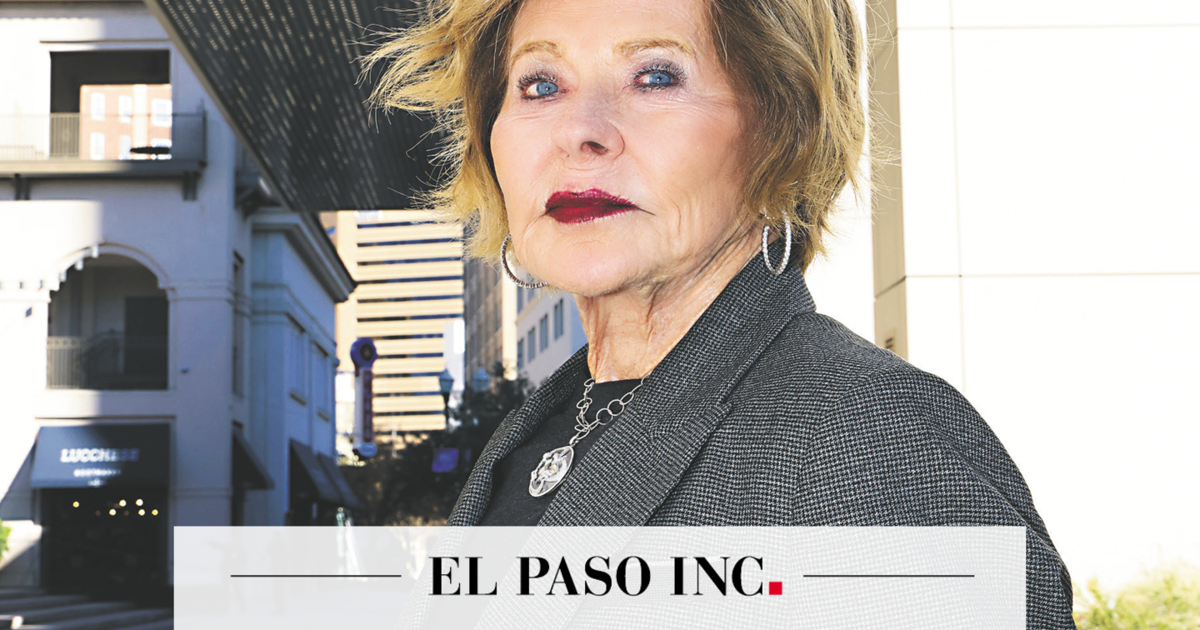
Judy Robison is an educational vagabond.
After studying art, English and drama in California, that’s the nickname she earned from her husband, Kirk. And after moving to El Paso in the early 1970s, Robison has added arts patron pioneer to her résumé.
Robison is the 2025 El Paso Inc. El Pasoan of the Year for her community leadership and championing of the arts in El Paso, including Star Ceiling, a large, custom-built installation by international artist Leo Villareal.
Star Ceiling officially turned on for the first time in January after a year of construction and more than half a decade of planning. The outdoor terrace was also renamed in honor of Robison, who helped raise the nearly $6 million in private funding needed to design, construct, install and permanently maintain the project.
“Judy Robison’s visionary leadership brought Star Ceiling to life,” said Tracy Yellen, CEO of the Paso del Norte Community Foundation. “She understood the importance of creating a signature work by world-renowned, El Paso-born artist Leo Villareal in Arts Festival Plaza – and then mobilized the people and resources needed to turn that vision into reality. Judy leads with purpose, generosity, and an unwavering belief in El Paso and the transformative power of the arts.
“Since its debut in January 2025, Star Ceiling has become a defining feature of Downtown El Paso – a true landmark and living part of the city. We are grateful to Judy for her leadership and generosity.”
From the El Paso Museum of Art to Villareal’s Brooklyn studio, Robison has earned a reputation for having a sharp eye and willingness to collaborate and work to raise funding and support for many borderland art endeavors.
“When Judy Robison decides to do something, you learn quickly that you either get on board, or get out of the way,” said Ben Fyffe, the city’s quality of life managing director. “Her energy, drive and passion for the arts and other causes that directly shape so many El Pasoans’ lives have truly changed this community – particularly for youth.”
A native of Southwestern Oklahoma, Robison moved to El Paso with husband Kirk in the early 1970s. Kirk was working with Weinerschnitzel and had an opportunity to buy El Paso franchises.
Pull quote
“People my age have talked about the brain drain for years, but it’s changing. It is. I feel it.”
-Judy Robison
The two raised their children here and own Pizza Properties, a restaurant group that includes Peter Piper Pizza, Applebee’s, Boss Chicken and Weinerschnitzel.
“I’ve known her and Kirk since they moved to El Paso. She represents, as does he, the best of people who did not grow up here, came here and have contributed tremendously, financially and with time,” said businessman Tripper Goodman. “Working with her on the Star Ceiling project, we saw a leader in motion who was passionate about her project. It carried on to the rest of us who helped her.”
Robison spoke to El Paso Inc. on a recent afternoon under the glittering patterns of the Star Ceiling.
Q: What was your path to El Paso in the ‘70s?
I grew up in a tiny little town called Altus. My dad was a farmer. My mother was a homemaker, and I had two brothers, one older, one younger. We graduated from high school there, and at that point, my family moved to California, and I went to the University of California in Riverside. I would have been one of the first graduating classes had I stayed there. But my dad couldn’t afford for me to stay there, so I went to a junior college in Inglewood, Calif., where they lived.
I worked while I was going to college, and I met my husband 64 years ago. He was at San Jose State. He was great, and would be graduating that spring. So I went there for just one semester, and we married that summer, in 1961.
I enrolled at Los Angeles State College, which is where I graduated. I was a speech, English and drama major, and did a little bit of acting everywhere. My husband calls me an educational vagabond, which is true.

Ruben R. Ramirez
We moved to San Bernardino, which is where Kirk had grown up. I taught at Eisenhower High School in Rialto, and went to Claremont Graduate School to get my counseling degree in educational psychology.
I taught for two years. It was a really happy time in my life. I loved teaching, and I loved what I was teaching. I went to graduate school, got my degree in counseling and I was a counselor for a year. By this time, we’d been married five years. So, we decided it was time to have a baby. Our eldest daughter was born in 1968 in Houston.
We moved to Houston to build Weinerschnitzels there, and Amy was born there. And then we moved to Virginia with Weinerschnitzel, and then we moved to Chicago with Wienerschnitzel, which is where our second daughter, Jill, was born.
Kirk went to the owner, John Galardi, who’s now deceased, and said, “I don’t want to work for you the rest of my life or anybody else. I’d like to buy a franchise.” He said, “Well, the Weinerschnitzels in El Paso, Texas, are open.” And I said, “Where’s that?” And, so we moved to El Paso.
So we’re 50 years later, living in El Paso with Peter Piper Pizza and Applebee’s and Boss Chicken. El Paso has been really good to us, which is one of the reasons we give back to the community – for lots of reasons, but that’s certainly one of them.
Q: What were some of your first experiences that brought visual art into your life?
I did a little bit of acting when I was in college, which I really loved. And I did some in high school, too. If someone had asked me what I was going to do when I graduated from high school, I would have said, “Well, I think I’ll just go to New York and play in parts for a while.” I had no idea what I was talking about. I had never been to New York, I had never seen a show, but all I knew was what I had done in high school and the fact that it really was interesting.
Ruben R. Ramirez
When we moved to El Paso, we were raising two daughters. They were 5 and 7 when we came, and one was in band. I became very involved with the El Paso Symphony. That’s kind of where my art career, so to speak, started. I was on that board for about 15 years or so. During that time, I just became involved and interested in all the other arts agencies.
At that point, El Paso didn’t have a lot of art happening. I mean, now we have the opera and the ballet and Pro Musica and the symphony, and the museums have multiplied. I’m very proud to say that I’ve been a part of all of that, in building it and then paying attention to the fact that it could continue.
Q: How did Leo Villareal and his art get on your radar?
I saw his art, and then I had become a member of the board of the El Paso Museum of Art Foundation. As a foundation board, we were discussing what we could do to reinvigorate the museum because attendance was down.
We decided that we needed to have a piece of art that would bring people in. I suggested Leo’s work, and we first talked about it being on the outside of the building, because in New York, and other places, many of his pieces are on the sides of buildings. Okay. And others are just huge installations in front of large buildings.
Leo came here on our request, and he spent a couple of days just walking around Downtown because he hadn’t really been back in a while. Around the building, he saw these pillars and said, “This is the place. It’s outside, it’s free. It’s open to everyone, and it will draw attention to the museum, and that’s what you want to get people to walk in the door.”
He is one of the loveliest people that I’ve ever worked with. He has no ego, and his goal is to please, so it was a very interesting, loving experience to make this happen.
Q: What was the process like for you, spearheading and drumming up the community support needed to bring it to life?
I have been on probably 35 boards. My husband counted them. That’s the only reason I know. Most of them have been arts boards, and I’ve become very involved in women’s and children’s causes. Those things kind of all work together for me because I got to know a lot of people, and I got to know how different parts of the city function and what people liked to do and what people would do, and how to get them to do what you wanted them to do with it.
In the meantime, our girls had graduated from high school and gone to college, so that’s what I did. I didn’t have to work, which was fortunate.
About 10 years ago, when things started happening Downtown, that was when we all realized the people that I knew and appreciated what their values were, and we all loved El Paso. We wanted the best for it, and I guess it kind of started with the San Jacinto Plaza. They renovated the park to bring people Downtown, and Rick Francis and Woody Hunt built the West Star Building and Paul Foster did the Plaza Hotel, and all of a sudden it was just, boom.
And then we did this. It’s all those things, and all the people that I was able to work with and all those boards. We all had the same values and the same goals to make El Paso a better place and a great community to live. From coming here in the ’70s, it’s just totally different from that.
We have great restaurants Downtown. We have beautiful hotels. We have Lucchese and La Nube. Oh, my goodness, that’s state of the art. I am so proud just to be a little part of what has happened to El Paso. It makes me very happy.
Q: When they renamed the terrace after you, what was your reaction upon learning that?
I was very touched. I’ve never been one to want my name on buildings. That’s not my style and has never been a goal in fundraising for me, but I was very appreciative and I was very honored and I have a very large place in my heart for Ben Fyffe. He does a terrific job and is very appreciative of what has worked for him and for us.
Q: What’s your advice for others who are on boards or getting started and want to do something that will positively impact El Paso?
I worked on this committee to do this installation with Dana Frank, Stacey Hunt Spier, Caroline North and Will Harvey. I hate to name names because I’m always afraid I’ll leave somebody out. But that was pretty much our committee. Those young people are going to do exactly the things that I and many other people in the community my age have done for years. There’s lots of good people coming up. It’s exciting.
People my age have talked about the brain drain for years, but it’s changing. It is. I feel it. Sometimes it takes a little bit of time. It can get frustrating if you don’t see results right away, but then you look back and you’re like, it’s actually happening.
Q: Is there anything that you think El Paso and Downtown are still missing or can improve on or something that we need to address?
I probably don’t have very good judgment about that because I’ve seen it grow so much and have been so pleased with the way it has grown. The next world is going to be a tech world and an AI world, which is completely out of my world. I’ll get there as well as I can, but it can never take me over. But I’m really happy. I can’t really think of anything at this point in time except to just keep growing and bringing the smart young people back to El Paso to live and work.
Q: How about fostering and supporting the next generation of El Paso artists?
We have to support them. We have to give them our time and our money, and our skills. We need to work with them, and give them the skills to make the most of their talent because they have a God-given talent. It’s not something that they just picked up along the way. To make them proud and to make El Paso proud, I think is what we need to do for them.