
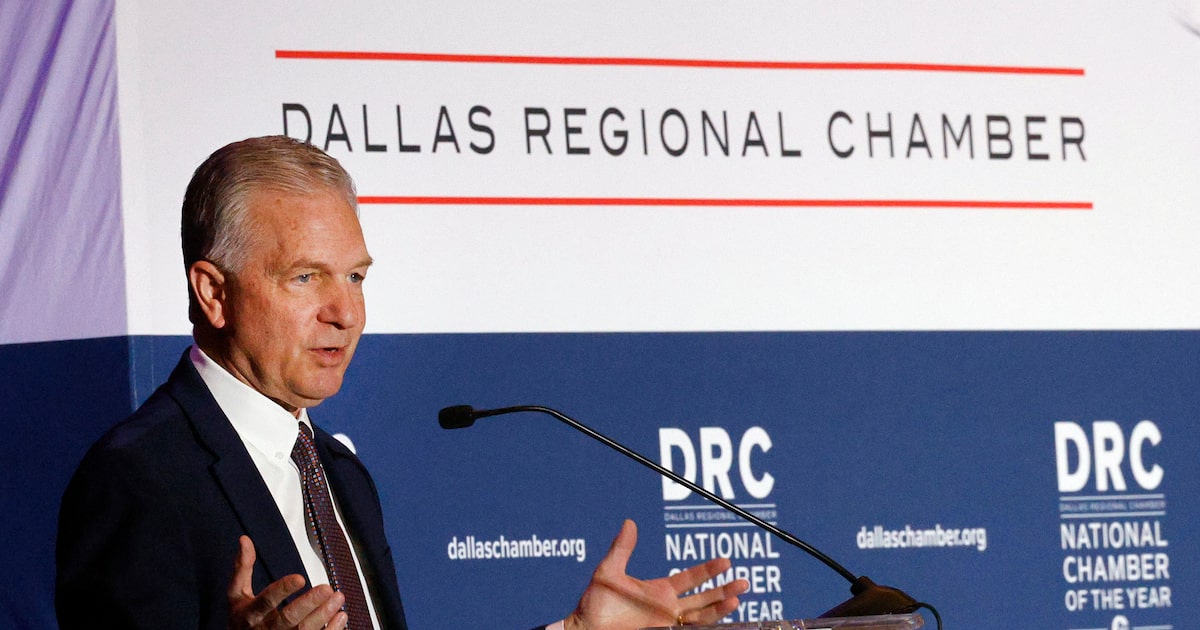
At the end of the year, Dale Petroskey will step down as president and chief executive of the Dallas Regional Chamber after 12 years. There will be plenty written and said about his important work promoting Dallas and our region as a business center.
But I want to tell a story about his service that risks being forgotten if we don’t record it here. And, to my mind, it is more critical to our future than landing any corporate headquarters.
It’s important to remember the history here. In 2009, when I was a young teacher attending my first Dallas ISD board meetings, I became concerned about the direction of our schools. I didn’t think that the tone or culture of the district’s government would enable us to embrace necessary reforms needed to stabilize DISD. If the institution was defined by chaos and churn, we wouldn’t ever progress. And if we didn’t progress, Dallas couldn’t progress.
Thankfully, elements of reform began to emerge and, by 2015, we were making real strides in the right direction. Early childhood education had expanded, new school choice models were implemented, stronger financial stewardship was in place, and, most consequentially, the overhaul of educator effectiveness systems were beginning to take hold.
Opinion
Dallas ISD had begun implementing a comprehensive redesign of teacher and principal evaluations and a performance-based compensation system. These reforms touched nearly every classroom and represented some of the most ambitious human capital changes attempted in any major district in the country.
But progress, especially reforms that challenge long-standing norms, is fragile. And in DISD back then, political storms had a way of rolling in just as sunlight was breaking through.
That year, following a tense confrontation between a trustee and Superintendent Mike Miles, I wrote publicly about our need to summon the better angels of our nature. It was a plea for stability, unity and a recommitment to students.
Then came the night that tested whether we meant it.
A special board meeting had been called, one the entire city was watching, to determine whether Miles would stay on at DISD to cement the reforms he had pushed through with great effort or whether he would go and those reforms would disappear with him.
Newspaper columns and TV stations questioned whether the reforms he championed, particularly the educator evaluation and pay redesign, would survive the night. Trustees floated succession plans while the superintendent still sat in his seat. It felt like another unraveling in a long history of DISD disarray.
And into that tense auditorium walked Dale Petroskey, very early in his tenure at the chamber. I still remember where I sat that evening, at the center of the dais, gavel in hand. As the hours stretched on and emotions sharpened, I noticed Dale rise and walk toward the microphone.
He did not have to be there. He did not owe us anything. And yet he came.
From my vantage point, I could see what it meant for him to step forward, new in his role, representing an influential institution, taking a public stand in a politically fraught moment when many preferred to sit still. It was an act of courage that carried risk, and I felt the weight of it as I watched him speak.
When the time finally came to vote, Mike Miles survived, 6 to 3. It was not inevitable. It was not easy. But in that razor-edged moment, the city chose stability over chaos, continuity over churn, and the future over the past. A decade later, the results speak for themselves, with student achievement rising, school quality improving, and national observers recognizing Dallas as a model for what sustained reform can accomplish.
Part of what steadied us that night was the willingness of leaders like Petroskey and others to show up, speak plainly, and remind us what was at stake.
His leadership that night was not an anomaly. It was the beginning of a pattern.
Over the next decade, Petroskey ensured that education was not tangential to the chamber’s work. It was central to it. Under his leadership, the chamber made education a strategic priority, elevated the State of Education event, sustained Principal for a Day, convened a Superintendent Kitchen Cabinet, advocated in Austin for meaningful reform, and infused education into nearly every message he delivered. He also served on boards like Educate Dallas and the Commit Partnership, shaping systems that expand opportunity for children.
He did not treat public education as a talking point. He treated it as a civic responsibility.
Some leaders measure impact in outcomes. Others measure it in moments. Petroskey’s legacy is both.
He demonstrated that leadership is not about position, but about the courage to act and the commitment to stand firm when the future hangs in the balance. That responsibility continues to rest with the civic, business and philanthropic leaders who shape our region’s future. If we speak when silence feels safer, and if we commit our influence to the success of every child, Dallas will move forward with strength and unity.
Let us meet this moment with the same resolve Petroskey brought to the work, and continue building a city that rises to the full measure of our shared potential.