
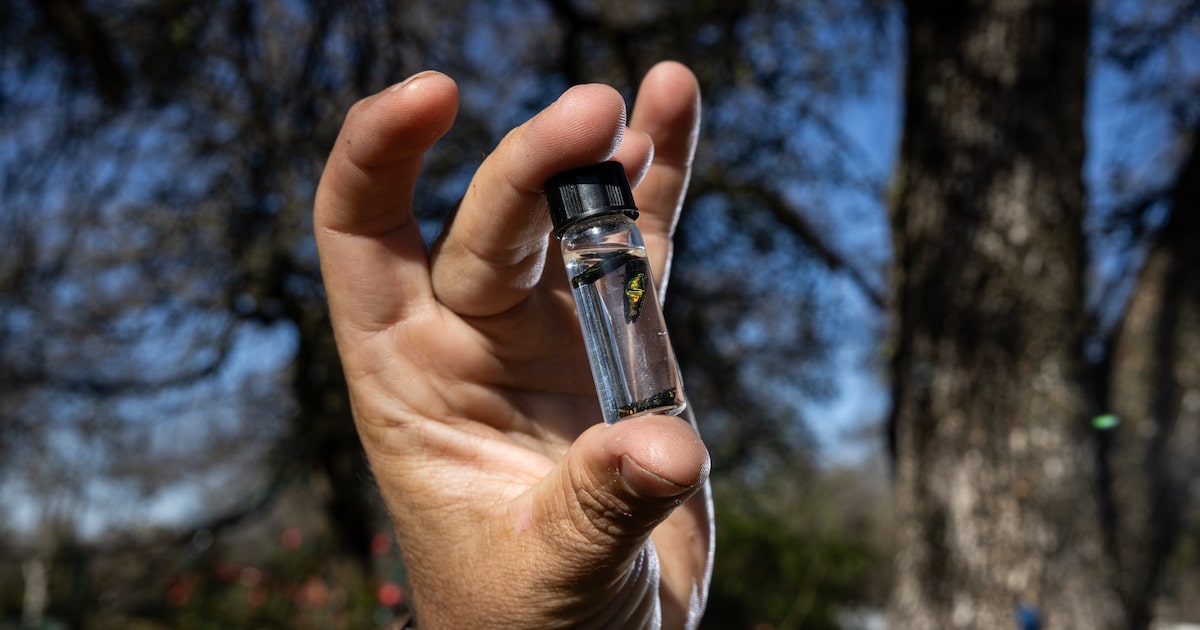
Picture this: You’re walking along White Rock Creek, surrounded by the dense canopy of green. In that canopy, you see the majestic ash trees. One day, a tree gets removed. Maybe you don’t notice. Then, another gets removed. The cycle continues until you start noticing the trees disappearing.
The culprit? A small beetle.
The emerald ash borer — a shiny, green wood-boring beetle that can be deadly to ash trees — has been actively spreading in North Texas for over eight years, eating away a significant part of the region’s urban forestry.
At the Martin Weiss Recreation Center in Dallas, some ash trees are being treated, and there are some that are going to be removed due to the damage caused, in part, by the beetle.
Breaking News
“If these trees right here all disappear in a two- or three-year time period, notice how much more noticeable that would be,” said Brett Johnson, conservation manager at the Dallas Park and Recreation Department, pointing at the ash trees in the park during a field visit on Nov. 25.
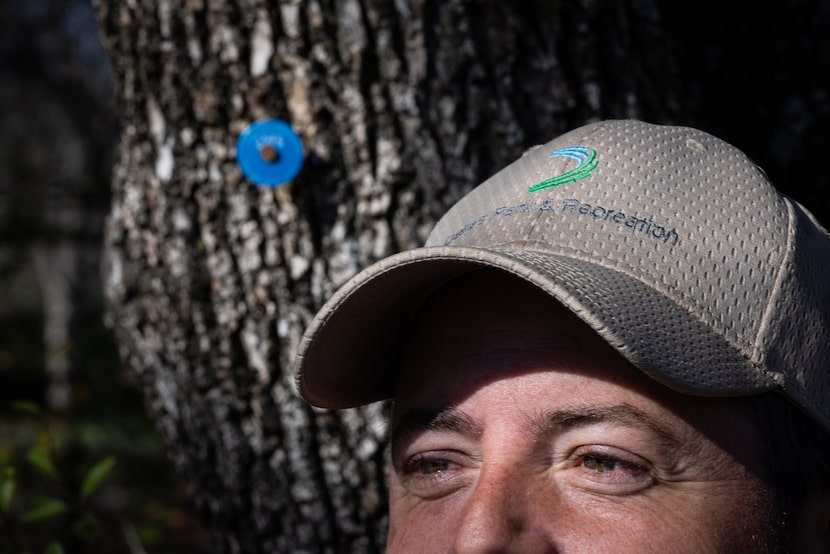
Christopher Morris, an urban biologist with the Dallas Park and Recreation Department, talks about the emerald ash borer beetle and the impact the invasive species is having on the city’s ash trees on Tuesday, Nov. 25, 2025, at Arcadia Park in Dallas. Ash trees make up roughly 20% of the city’s urban tree canopy.
Angela Piazza / Staff Photographer
A native of Asia, this beetle made its way to the United States in the early 2000s and years later, arrived in the North Texas region. The boring beetle is an invasive species that eats through the stems of the ash trees, weakening the trees and ultimately killing them. The harm caused by the pest to the local ecology and economy is multipronged.
“They are roughly the size of a penny,” said Christopher Morris, an urban biologist with Dallas Park and Recreation. “These guys are very hard to see when they are in flight.”
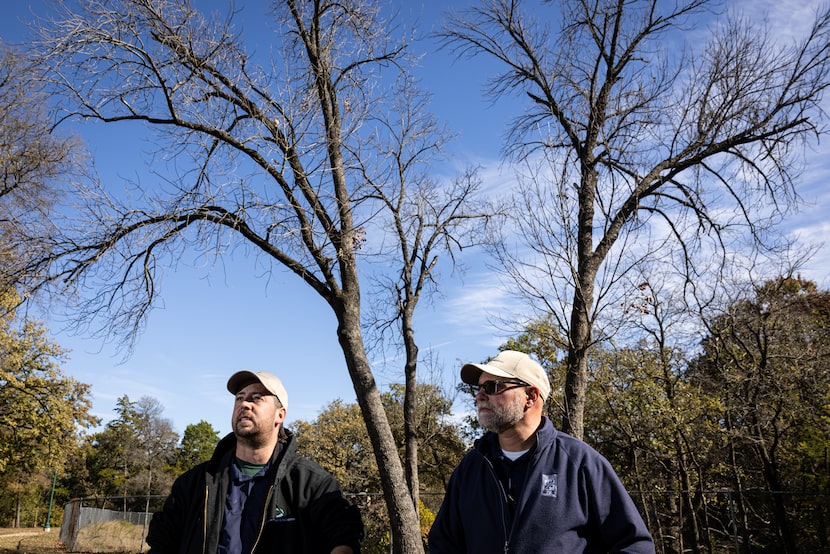
The Dallas Park and Recreation Department’s Christopher Morris (left), an urban biologist, and Jared Farley, a city forester, stand in an ash tree grove on Tuesday, Nov. 25, 2025, at Twin Falls Park in Dallas. A tree behind them was treated for emerald ash borer beetles. The treatment should spread to nearby trees through intertwined root systems.
Angela Piazza / Staff Photographer
The beetle was first detected in the U.S. in 2002 in Detroit, according to the Texas A&M Forest Service website. The beetle has now spread to about 36 states — including Texas, where it was first detected in Harrison County in 2016.
In North Texas, the beetle was first discovered in Tarrant County in 2018 by a 10-year-old boy when he took a photo of the bug in his family’s back yard. Since then, the beetle has rapidly spread to other parts of the region.
The Texas A&M Forest Service captured the beetle in several areas within Dallas County and the city limits in 2022. Two years later, the emerald ash borer was detected in the Great Trinity Forest in Dallas. About 40% of the canopy cover in the Great Trinity Forest is dominated by ash trees, which makes the green pocket extremely vulnerable to emerald ash borer infestation.
The forest service website says as of July, the wood-boring beetle has been detected in 31 counties in Texas including several in North Texas — Dallas, Denton, Ellis, Cooke, Collin, Tarrant and more. The beetle has killed millions of ash trees across the country.
How the beetle kills the ash trees
Adult beetles lay eggs in the bark of the trees in late summer and the larvae, the younger form of the insect, find shelter in the bark during the winter months, according to the forest service website.
The larvae then burrow into the bark as they feed, causing disruption in the flow of nutrients within the tree. The emerald ash borers weaken the trees in the winter, ultimately killing them in the summer.
The Texas A&M Forest Service says there are visible symptoms of an infestation:
Dead branches near the tops of the treesStems and leaves sprouting from the trunkSplits in the bark showing S-shaped larval galleries, tunnels engraved into the wood by the insectExtensive woodpecker activityD‐shaped exit holes in the trees
Owing to the fact that the beetle is an invasive species, ash trees do not have any natural defenses against them.
“Once an ash tree is infested with EAB [emerald ash borer], it is likely it will die,” the forest service’s website said.
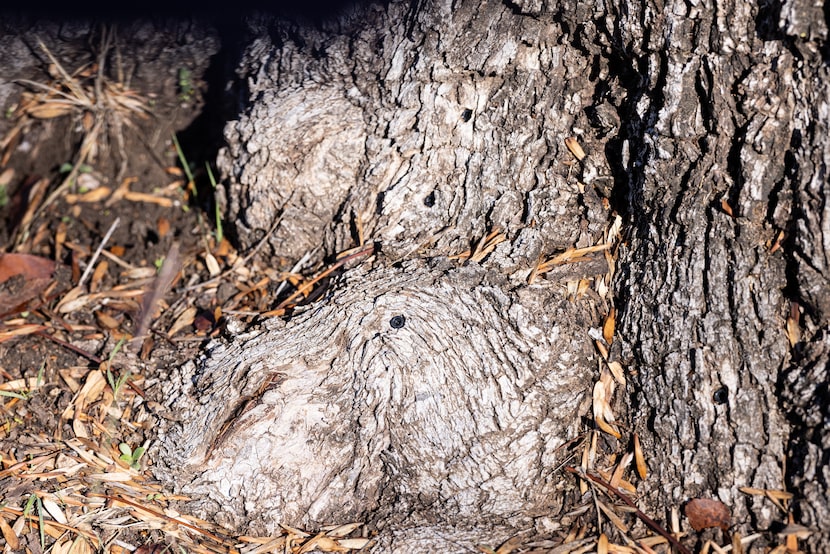
Treatment ports, or small holes, are seen near the base of an ash tree on Tuesday, Nov. 25, 2025, at Martin Weiss Recreation Center in Dallas. The tree was treated for emerald ash borer beetles by the city. For treatment, airlines are run into the tree and filled with pesticide which kills both pests and pollinators. Not all ash trees will be treated due to cost and the pesticide’s indiscriminate effect on other wildlife.
Angela Piazza / Staff Photographer
There is, however, some hope for recovery. The answer is one word — insecticides. But it’s not as simple as it sounds.
The treatment can be administered with soil injections, trunk injections, trunk sprays and a variety of other techniques, the forest service website says. These insecticides can protect a tree for two to three years — either from future infestation or in treating an active one.
“Systemic insecticides that list emamectin benzoate as the active ingredient are recommended in areas where EAB is present,” the website said.
Citywide efforts to contain or reverse the infestation
Morris said the Park Department is surveying the trees that comprise the urban forests in the city of Dallas to have a comprehensive inventory. Special tags are placed on the ash trees that indicate whether a tree infested by the emerald ash borer has received treatment through insecticides.
These insecticides not only kill the emerald ash borer beetle but also other insects that live on ash trees, which is one of the reasons the department is not leaning toward a mass treatment of trees, Morris said.
“In addition to the ecological cost is the economical cost,” Morris said.
Each tree takes about $200-$400 to treat and that would add up to huge costs if the department were to treat every single tree.
“I have got ash in parks where I have got over a hundred trees,” Morris said. “I certainly don’t have the money for that and I certainly wouldn’t, you know, propose that we would save that many trees.”
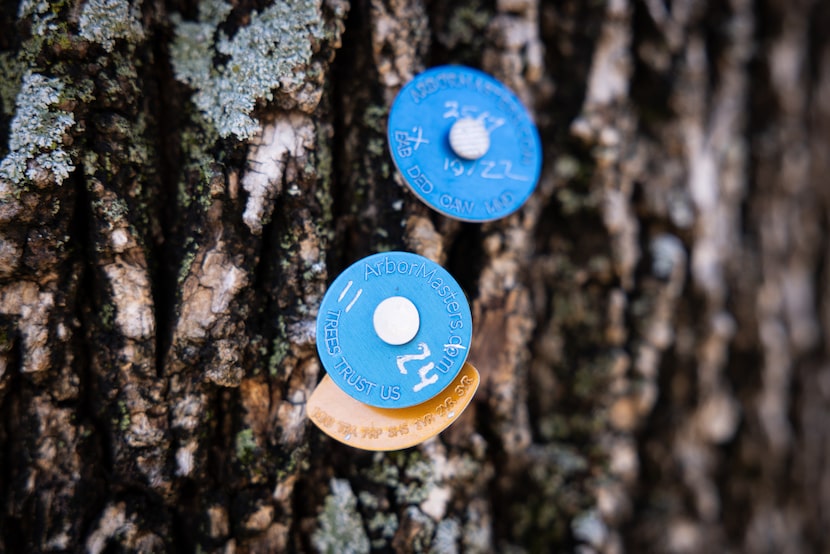
Tags on an ash tree indicate that it has received two biennial treatments for emerald ash borers on Tuesday, Nov. 25, 2025, at Twin Falls Park in Dallas.
Angela Piazza / Staff Photographer
Some trees are beyond saving. The ones that cannot be treated or saved are generally removed because the almost-dead ash trees can act as a “reservoir” for the beetles, Morris said.
“They are still just enough alive that an infestation can get into it and multiply and knock out the rest of the trees,” he said. “We would proactively remove several ash trees to limit the spread of the beetle.”
Removing ash trees can be expensive, according to the Texas A&M Forest Service. The best way to remove the trees is to hire a trained professional.
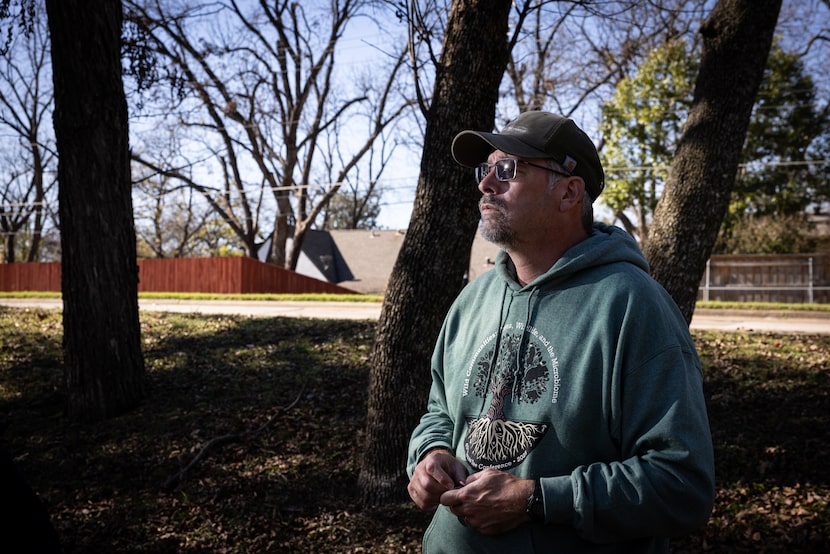
Brett Johnson, superintendent of environmental quality and conservation manager with the Dallas Park and Recreation Department, talks about emerald ash borers in an ash tree grove on Tuesday, Nov. 25, 2025, at Twin Falls Park in Dallas.
Angela Piazza / Staff Photographer
The forest service website says it is important to dispose of the infested wood properly to avoid spreading the insect to other trees, because the beetle can survive in the wood of a dead tree for years.
“It is important you burn, bury, or chip the tree where it is, rather than transport it somewhere else,” the website said.
The cost to ecology and economy
Over 100 different species of insects rely on ash trees for their survival and sustenance, according to the forest service. These include caterpillars, butterflies and other types of beetles, Morris said.
If the ash trees disappear, the ecosystems reliant on them would be impacted.
Additionally, ash trees provide shade and keep the air clean. They help in maintaining the soil quality and help prevent stormwater runoff, the forest service website said.
Ash trees make up 5.8% of Texas urban forests, which is about 29 million trees in the state, according to a fact sheet by the Texas A&M Forest Service. Removal costs statewide could climb up to $7.2 billion with an estimate of $250 per tree.
The fact sheet estimates treatment for all ash trees in the state could cost up to $1.4 billion annually. The cost of treatment is projected to exceed $29 billion in 20 years — an estimate of the maximum potential cost.
In a more likely scenario, where every ash tree is not removed or treated, the total cost in two decades is projected to be around $19 billion statewide. That accounts for replacing nontreated trees.
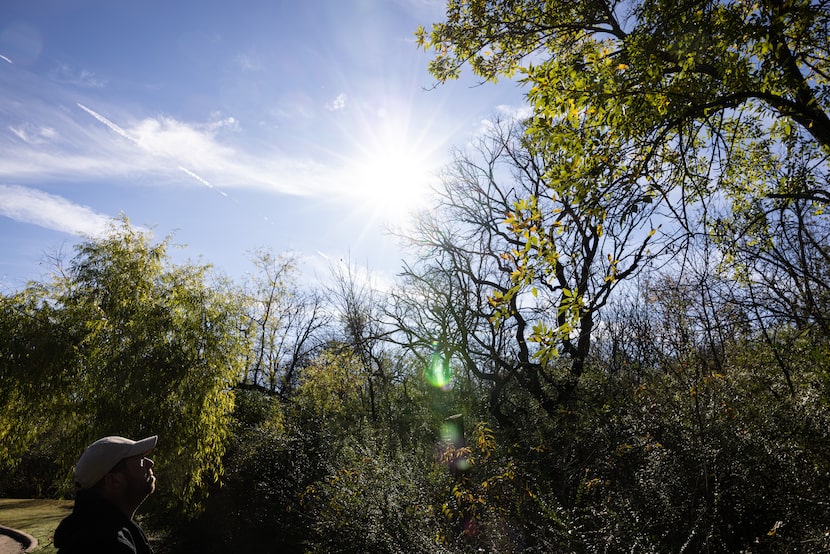
Christopher Morris, an urban biologist with Dallas Parks and Recreation Department, looks up at an ash tree canopy on Tuesday, Nov. 25, 2025, at Arcadia Park in Dallas. The tree is showing signs of early damage from an invasive beetle called an emerald ash borer. Without treatment, the tree will die.
Angela Piazza / Staff Photographer
In Dallas, choosing depends on certain factors. Morris said the city department considers the historical significance of the tree, the size of the tree and the park where it is located. Additionally, if a park has a sizable ash population or only ash trees, that would make the area worth focusing on.
“We have to make some tough calls,” Morris said. The department is not able to save every ash tree, so they have to choose.