
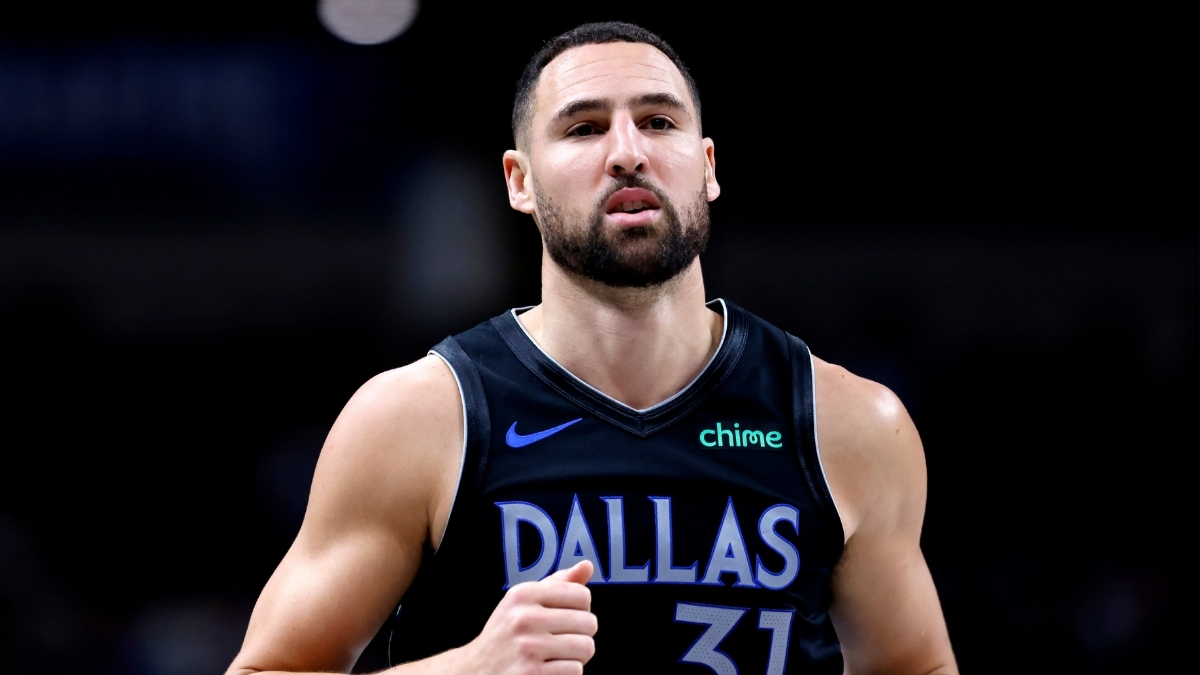
The Dallas Mavericks and San Antonio Spurs are approaching the NBA trade market from opposite ends of the competitive spectrum, yet their interests intersect in a way that makes a Klay Thompson deal increasingly logical.
San Antonio sits at 23-8, second in the Western Conference, even after Saturday’s 127-114 loss to Utah snapped an eight-game winning streak. Victor Wembanyama returned to the starting lineup with 32 points, seven rebounds, and five blocks, reinforcing the Spurs’ belief that they can contend now while still building sustainably.
Dallas, meanwhile, is 12-21 and has lost four of five, most recently a 113-107 defeat at Sacramento despite 23 points from Cooper Flagg. The Mavericks’ current position has pushed the front office to evaluate moves that prioritize flexibility and asset gathering over short-term wins.
That contrast frames a clean, CBA-compliant trade proposal centered on Thompson, whose role and contract now align more naturally with a contender like San Antonio than with a Dallas team recalibrating its timeline.
NBA Trade Proposal: San Antonio Spurs Acquire Klay Thompson
San Antonio Spurs Receive
Klay Thompson
Danté Exum
Dallas Mavericks Receive
Dallas sends out approximately $18.96 million and takes back about $15.7 million, trimming roughly $3.2 million from its 2025–26 payroll. With a projected team salary north of $200 million and second-apron concerns looming, that reduction is meaningful. The Mavericks also removes Thompson’s $17.5 million commitment for 2026–27, restoring flexibility without touching long-term control assets.
San Antonio absorbs the additional $3.2 million, moving to roughly $185.5 million in team salary—still below the tax line and both aprons—making the deal legal and manageable under the 2025 CBA.
Why the San Antonio Spurs Do the Deal
From San Antonio’s perspective, the cost is real but contained. Kelly Olynyk is an expiring, non-core veteran averaging 4.0 points in limited minutes, while Lindy Waters III is a fringe rotation player on a lightly guaranteed contract. Taking on Thompson’s two-year money—and Danté Exum’s injured contract—does not require the Spurs to surrender draft capital or the coveted 2030 Dallas swap.
What San Antonio gains is role clarity. Even in decline, Thompson remains one of the league’s most respected off-ball threats. He is averaging 11.1 points in 22.1 minutes across 30 games this season, primarily off the bench, and continues to command defensive attention simply by occupying space.
For a Spurs team built around Wembanyama’s interior dominance, Thompson’s shooting gravity creates cleaner driving lanes and reduces the load on young creators. Just as importantly, Thompson’s profile fits postseason basketball. He does not require on-ball usage, understands spacing and defensive rotations, and has more than 100 playoff games of experience.
Exum’s inclusion is a manageable cost. He is out for the entire 2025–26 season following a second knee surgery, effectively dead money. San Antonio can afford to waive him outright or keep him through rehab without jeopardizing flexibility.
Thompson’s salary becomes expiring in 2026-27, which could be used as a salary-matching mechanism for the Spurs next league year if he proves to be a player the team wants to move on from.
Why the Dallas Mavericks Do the Deal
For Dallas, the logic is rooted in timing. Thompson was brought in as part of a veteran push to compete immediately, but the Mavericks are no longer operating strictly in that lane. With Flagg emerging as the franchise’s focal point, Dallas’ priorities have shifted toward flexibility, optionality, and assets that scale with a younger timeline.
Financially, the move is significant. Shedding Thompson’s $16.7 million in 2025–26 and $17.5 million in 2026–27 trims future commitments while keeping Dallas compliant with hard-cap restrictions. Offloading Exum’s $2.3 million injured salary further cleans the books for a team operating near second-apron thresholds.
The return is modest but purposeful. Olynyk gives Dallas a short-term stretch big, who can function as a pick-and-pop option and connective passer, particularly valuable with Dereck Lively II out for the season following right-foot surgery. At age 34 and on an expiring deal, Olynyk carries no long-term risk and preserves future maneuverability around Anthony Davis and Daniel Gafford decisions.
Waters’ contract adds another layer of flexibility. Only $500K of his 2025–26 salary is guaranteed, with the remainder becoming fully guaranteed if he is not waived by Jan. 10, 2026. That structure gives Dallas a built-in cap lever—retain him as low-cost depth or clear additional room and a roster spot to react to injuries or pursue other moves.
Viewed collectively, the trade allows Dallas to convert a declining veteran contract into expirings and optionality, strengthening its ability to gather assets and pivot as Flagg’s development clarifies the franchise’s next competitive window.