
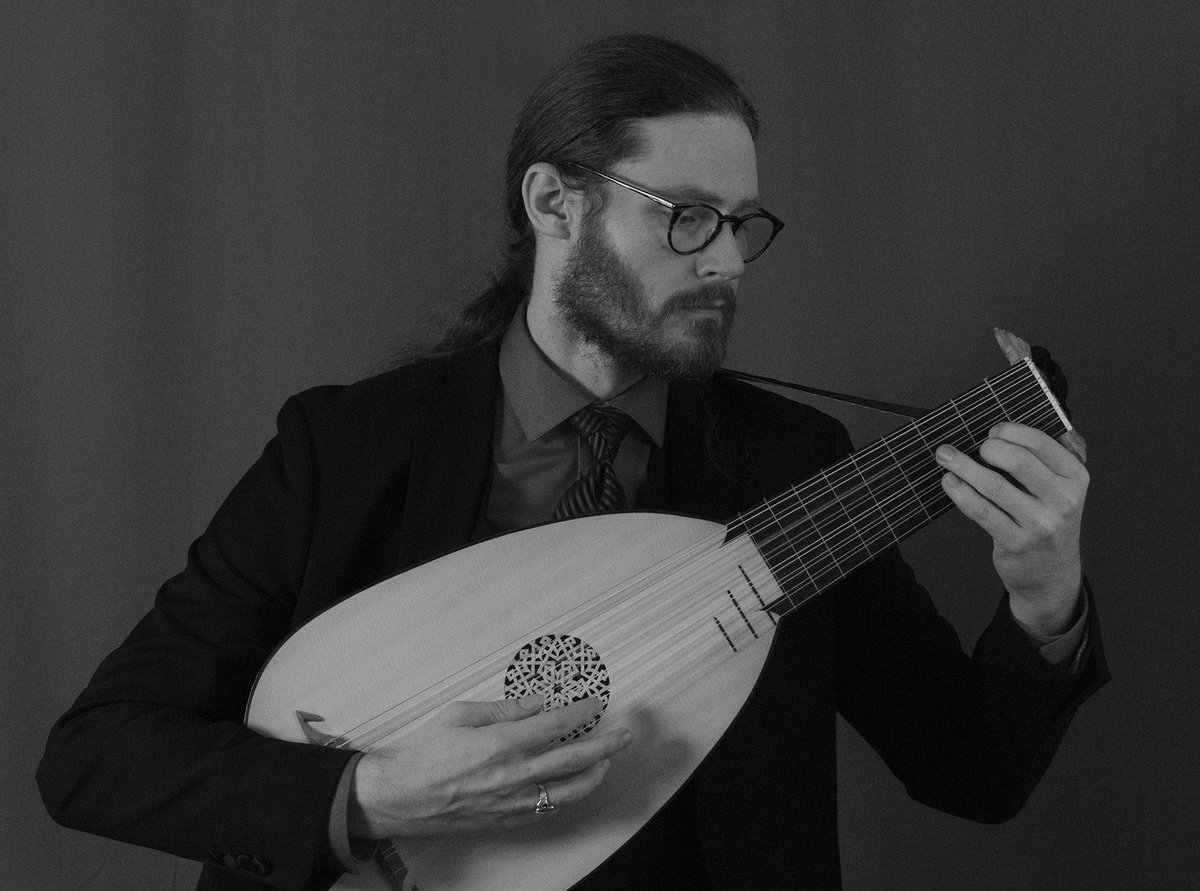
Backstage at a Fort Worth concert hall, before a single note reaches the audience, DFW-native Jacob Johnson is already listening. He’s watching hands hover over strings, faces settle into concentration, instruments waiting to speak. Instead of reaching for his own instrument, Johnson raises a camera to capture the moment when music exists everywhere except in the air.
Those quiet, charged moments form the backbone of “Songs Without Words,” a multidisciplinary project that earned Johnson grants from the Greater Denton Arts Council and the City of Lewisville. The funding supports his first solo photography exhibition, a companion photobook, and a new EP for classical guitar — three interlocking pieces that explore how music can be experienced visually, even in silence.
Shot almost entirely in black-and-white, the photographs focus on candid backstage encounters with musicians just before they perform. Instruments rest against chairs, fingers test the strings, and dark shadows indicate which sound is being presented. “In this context, as a musician,” Johnson explains, “most of my opportunities to take unique photographs, things that not everybody gets to see, are backstage.” The images aren’t meant to document celebrities so much as atmosphere—the suspended moment before sound.
That access is hard-earned. Over the past two years, Johnson has photographed an unlikely roll call of world-class guitarists passing through the DFW area, including Grammy winner David Russell, Andy McKee, Manuel Barrueco, Marko Topchii, Andrea Gonzalez Caballero, plus more, often during concerts presented by the Allegro Guitar Society. Rather than chasing spectacle, Johnson looks for resonance. “It’s a mix of portraits of musicians and explicitly musical photographs,” he says, “along with photos that aren’t explicitly musical, but might have a unique rhythm or timbre. Those are things we can pick up on visually as well.”
The scope of “Songs Without Words” reflects a habit Johnson has cultivated over a lifetime — blending interests until they are inseparable. “Really, anything that I become interested in,” he says, “I have a history of trying to mix my interests.”
Music came first. Johnson began piano lessons at age four, switched to trumpet in elementary school, and eventually gained early recognition as a soloist with the Wind Symphony of the Greater Dallas Youth Orchestra after winning its concerto competition. He entered college as a trumpet performance major, but one hallway encounter changed everything. “I heard a student practicing the guitar,” Johnson recalls. “They were playing something with several melodies happening at the same time. I’d heard that on recordings, but I’d never seen somebody do it in person. And I was like, ‘I need to learn to do that.’”
The classical guitar offered independence and portability. “A classical guitar can accompany you to the top of a mountain,” he says. “If you play the piano, good luck.” He left the trumpet department and committed fully to strings, eventually expanding backward in time to the lute. That decision, too, was driven by sound, or rather, authenticity.
“I was looking at this 16th-century music and thinking it can’t sound the same on a modern instrument. It just can’t,” Johnson says regarding why he chose the lute.
His curiosity has taken him far afield, with performances at the Collegiate Peaks Guitar Retreat in Colorado, for the Utah and Sacramento Guitar Societies, and at Lute Society of America LuteFest West, while remaining rooted in North Texas. Along the way, he has taught privately, composed and arranged music, published essays, and worked with nonprofit arts organizations. That last experience led him back to school for a graduate degree in arts organization management. “Artists don’t tend to have a lot of business training,” Johnson says. “And so these arts organizations, they tend to struggle because of that.”
Photography entered the picture almost accidentally. After completing his debut album, “The Ghosts of Dawn,” released June 21, 2023, Johnson was exhausted. The album, which features “Astrolabe,” a suite written for him by Dallas composer Eddie Healy and inspired by a medieval astronomical calculator, had consumed more than a year of focused work. “I needed some kind of a creative outlet that wasn’t musical,” he says. “And I found my grandmother’s old Kodak Brownie camera, and I took it out just to have some fun.”
What began as decompression became obsession. Johnson started developing his own film, partly out of necessity and partly out of control. “Especially the one-hour photo places,” he says, “you don’t even get your negatives back. The people developing it have very little actual experience. They’re not out shooting film themselves.” Building a darkroom was inevitable. “Watching an image come out after you have a blank page,” he says, “there’s something really special about that.”
“Songs Without Words” grew organically from years of carrying a camera everywhere. “I wasn’t initially thinking of a project,” Johnson admits. “It was just something I had fun with. After a while, I realized I had so much that was musically related that maybe I could do something around that.” The title, borrowed from the 19th-century musical form popularized by Mendelssohn, felt inevitable.
Johnson hopes to pair the exhibition with live performance, photographs on the wall, music in the air, and conversation in between. “Ideally, I’d like to have an exhibition and play the music too,” he says. “Play about twenty minutes of music and just hang out and chat. If people have questions about photography or music, it’s nice to interact.”
Johnson’s solo exhibition will run at the Lewisville Grand Theater from July 18 through August 15, 2026.