
What we know about the New Year’s Eve sports events in Dallas and Arlington
New Year’s Eve brought a festive sports buzz to North Texas, including a Dallas Stars game at American Airlines Center in Victory Park and the College Football Playoff semifinal at AT&T Stadium in Arlington. While the coverage highlighted game action, fans, and holiday excitement, it did not report any specific injuries. Even so, these major events draw large crowds, heavy traffic, and late-night celebrations across Downtown Dallas, Victory Park, the West End, Uptown, the Design District, and the Entertainment District in Arlington. That mix can raise the odds of slips on wet concourses, escalator or stair mishaps, parking lot collisions, pedestrian strikes near crosswalks, or altercations when alcohol enters the picture.
If you were near Victory Plaza by the Victory Station DART stop, across Olive and Houston Streets, or navigating the I-35E and Woodall Rodgers interchanges after midnight, you know how quickly the environment can become crowded and fast-moving. The same went for leaving AT&T Stadium via Collins Street, Randol Mill Road, SH 360, or the I-30 corridor. This article explains how injuries around these venues can happen, what Texas law generally says about them, and where to obtain official records if a loved one was hurt or worse. It also offers practical guidance grounded in local processes and Texas law, along with resources from government sites you can consult for clarity.
Why large sports celebrations can lead to injuries in Dallas-Fort Worth
Holiday games concentrate thousands of people into a tight space. Add brisk temperatures, spilled drinks, last-minute crowd surges to catch fireworks at Reunion Tower, and lots of rideshare traffic, and risks can rise quickly. Common patterns we see during New Year’s Eve around Downtown Dallas and Arlington include the following.
Slips, trips, and falls: Wet concourses, food or drink on stairs, polished entryways near revolving doors, and dim lighting in parking structures can create hazards if not promptly addressed.
Escalator and stairway incidents: Congestion on escalators or missteps on staircases may lead to falls, especially when crowds are hurrying to beat traffic or catch the train.
Crowd movement and surges: Bottlenecks at exits, chokepoints near security screening, or sudden celebrations can push people unexpectedly.
Negligent security concerns: Inadequate staffing, poor visibility in parking lots, or delayed responses to known risks may heighten the chance of confrontations or assaults.
Alcohol service and overservice: Holiday parties and tailgates can produce overservice concerns that implicate Texas dram shop laws if a provider serves someone who is obviously intoxicated and that person causes harm [1].
Parking lot and roadway crashes: Congested egress traffic and rideshare pickup zones near the arena or along Collins Street by the stadium can lead to fender benders or more serious collisions. Dallas car accident risk can spike right at closing time when everyone leaves at once.
Pedestrian strikes: Crossing near Victory Plaza, the West End, or the entertainment blocks around AT&T Stadium can be hazardous if drivers are distracted or impaired.
In these environments, timely maintenance, clear warnings, adequate lighting, and well-staffed security can make the difference. When they are missing, Texas premises liability rules and dram shop law may become relevant. Individuals sometimes look for seasoned premises liability lawyers to evaluate what happened and whether the facility or vendor failed to meet a duty of care under Texas law.
Common injury scenarios around American Airlines Center and AT&T Stadium
While every incident is different, certain patterns recur around the two venues and nearby blocks.
American Airlines Center and Victory Park
Wet or slippery flooring on concourses and near concessions if cleanup lags while crowds surge between periods.
Escalator slowdowns as fans crowd onto moving steps, sometimes with bags or beverages in hand.
Stairwell falls in sections with steep stairs during late-game exits when lights dim or fans rush.
Sidewalk hazards near Victory Plaza, Olive Street, and the DART Victory Station platform where surfaces may be uneven.
Parking structure issues including poor lighting, blocked sightlines, or confusing traffic flow at peak exit times.
AT&T Stadium and the Arlington Entertainment District
Tailgate areas with debris that can cause trips, especially after dark.
Rideshare and shuttle loading zones where pedestrians, buses, and cars mix in tight spaces.
High-volume vehicle exits onto Collins Street, I-30, and SH 360 where congestion may invite rear-end crashes.
Lots and walkways with variable lighting and uneven surfaces that can pose hazards if not maintained.
Injury claims can turn on small details: a missing handrail, a long-standing spill that was not cleaned, or escalator maintenance records. Because those details fade or get lost quickly, documenting conditions promptly is often pivotal.
Immediate steps after an injury at a Dallas arena or stadium
Safety first, then documentation. Even when adrenaline is pumping, several actions can protect health and help preserve facts.
Seek medical care immediately: On-site first aid is a start, but prompt evaluation at a clinic or ER creates a medical record that connects symptoms to the event.
Call 911 for serious injuries: Emergency response triggers dispatch records that can be requested later through the Public Information Act [5].
Report to venue staff: Ask for an incident report number and the name or badge of the staff member who documented it. Photograph the scene and any visible hazards before conditions change.
Collect witness information: Names, phone numbers, and seat or section numbers matter. Note the time, section, and closest landmark.
Preserve items: Keep tickets, parking receipts, clothing, and footwear unwashed. These can help show what happened.
Avoid recorded statements: Insurance adjusters may call quickly. What someone says can be cited later. Consider consulting counsel before speaking at length to any insurer.
Notify your insurer if a vehicle is involved: For parking lot crashes or pedestrian strikes, crash reports are typically obtained through TxDOT’s system by parties to the crash or their representatives [2].
Consider contacting an attorney first: Initial legal guidance can help avoid missteps with insurers and ensure preservation letters go out quickly. Individuals often rely on premises liability lawyers to assess scene hazards, locate video, and identify responsible parties.
Getting official records and reports in Dallas County and Arlington
Several public records may exist after an arena or stadium injury, especially if police, EMS, or fire personnel responded. These records help establish what happened and when.
Police and crash reports
For motor vehicle crashes in Texas, the state’s process for obtaining crash reports is administered by the Texas Department of Transportation. Parties can request crash reports and records through TxDOT’s platform following the agency’s steps and eligibility rules [2].
For non-crash police incidents, records may be available through a public information request under the Texas Public Information Act. The Texas Attorney General explains how to make a request and what agencies must provide [5].
Autopsy and coroner records in potential wrongful death cases
In tragic cases involving fatalities, autopsy authority and inquest procedures are governed by Texas law. The Texas Code of Criminal Procedure contains the inquest statutes that explain when a medical examination is required and how records may be handled [6]. Families often begin by contacting the county’s medical examiner office to understand next steps, identification, and record requests. Requirements for release can vary based on the relationship to the decedent and the status of any investigation.
EMS and fire department records
Emergency medical services and fire departments generate run reports and patient care records. These are generally requested through the relevant city’s public information process, subject to privacy laws. The Texas Public Information Act framework and medical privacy rules guide what may be released [5].
911 recordings and CAD logs
Calls to 911 and dispatch logs provide timing and response details. Under the Public Information Act, certain information is releasable, though portions may be redacted based on ongoing investigations or privacy protections [5]. It helps to include the date, approximate time, location, and any known incident or case number in your request.
Venue incident reports
Private venues frequently create internal incident reports. These are not public records, but they can sometimes be obtained through requests by a party or their representative. When an attorney is involved, a preservation letter may be sent quickly to prevent deletion of relevant video or documents.
The Texas legal framework that often applies
Texas law sets out several civil-law concepts that commonly arise after a stadium or arena injury. While each case turns on its own facts, these are the building blocks that frequently guide the analysis.
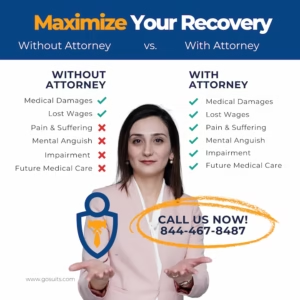
Premises liability duties to invitees
Patrons attending a game are generally invitees, meaning the property owner or occupier owes a duty to use ordinary care to make the premises reasonably safe, including by fixing or warning about unreasonably dangerous conditions the owner knows about or should know about through reasonable inspection. What qualifies as reasonable depends on the circumstances, the foreseeability of harm, and what steps the owner took to discover and correct hazards. For an in-depth look at how warning duties can work on dangerous conditions, see Property Owner Duty to Warn of Hidden Dangers.
Dram shop liability for overservice of alcohol
Texas dram shop law may apply when an alcohol provider serves a person who is obviously intoxicated to the extent they pose a clear danger to themselves or others, and the intoxication is a proximate cause of harm. The obligations and safe-harbor provisions appear in the Texas Alcoholic Beverage Code, Chapter 2 [1]. This can be relevant to fights, assaults, or crashes tied to overservice.
Statute of limitations
Texas has general two-year limitations for personal injury and wrongful death civil actions, subject to specific exceptions. The baseline timing appears in the Texas Civil Practice and Remedies Code Section 16.003 [3]. Timely action matters because evidence like surveillance video, maintenance logs, or third-party records may be routinely overwritten or discarded.
Wrongful death and survival claims
When a fatal injury occurs, Texas law permits certain family members to bring a wrongful death claim and the estate representative to bring a survival claim. The Texas Civil Practice and Remedies Code Chapter 71 outlines the structure for these actions [4].
Comparative responsibility
Texas uses proportionate responsibility. If a claimant is more than 50 percent responsible, recovery is barred. If the claimant is 50 percent or less at fault, any recovery can be reduced by the claimant’s percentage of responsibility. The rule is set out in Section 33.001 of the Texas Civil Practice and Remedies Code [7].
Insurance realities after a venue or parking lot injury
Several insurance layers may come into play depending on where and how an injury happened. Understanding these can help people avoid pitfalls that slow claims or undercut valid losses.
Commercial general liability policies: Venues and contractors may carry CGL coverage that responds to bodily injury claims arising from premises hazards or operations. Notice obligations and cooperation provisions can be strict.
Liquor liability or dram coverage: If overservice is alleged, a vendor’s liquor liability policy may be implicated alongside CGL. Texas dram shop law provides the liability framework [1].
Auto coverage for parking lot and roadway crashes: These claims typically involve liability coverage for the at-fault driver and, when available, uninsured or underinsured motorist coverage on the injured person’s policy. Crash reports are often retrieved through TxDOT’s process [2].
Medical payments or personal injury protection: Some policies include limited no-fault benefits that can help with immediate bills, regardless of fault. Terms and exclusions vary by policy.
Reservation of rights letters and delays: Insurers sometimes send reservation of rights letters while they investigate or ask for broad records. Consumers can review guidance from the Texas Department of Insurance on resolving claim disputes and complaints [8].
Insurance representatives may request recorded statements or medical authorizations very early. That can feel routine, but statements can be used to narrow or contest claims later. Many people consult counsel before giving any statement, and when premises conditions are involved, seek help from seasoned premises liability lawyers who understand how evidence is gathered and preserved in these cases.
Data snapshot: Crowd size and risk context in North Texas on holidays
Holiday travel and drinking patterns are associated with elevated crash and injury risk nationwide. While local game attendance and traffic counts vary by event, federal safety agencies have reported higher rates of impaired driving fatalities during holiday periods. NHTSA’s resources on drunk and impaired driving outline these seasonal concerns and the critical role of enforcement and planning [9].
Separately, managing crowds safely takes planning and coordination. Federal public health guidance discusses elements of safe mass gatherings, including crowd movement, emergency access, and communication. Those principles translate to stadium exits, rail platforms, and rideshare zones after the final horn or fireworks show [10].
At the city level, Dallas and Arlington adapt traffic control with lane closures, police direction of intersections, and designated pedestrian routes. Even with those measures, late-night congestion along Victory Avenue, Olive Street, and the I-35E frontage roads, or around Collins Street and Nolan Ryan Expressway, can create tight conditions that demand extra caution.
How claims typically unfold in Texas civil cases
While every matter is unique, a typical progression after a venue or parking lot injury looks like this.
Initial investigation: Gathering photos, witness contacts, medical records, and any incident numbers. Preservation letters to the venue or vendors ask that video and maintenance records be secured.
Liability analysis: Reviewing whether a hazardous condition existed, how long it persisted, whether the owner knew or should have known, and if warnings were adequate. For overservice, evaluating visible intoxication evidence and provider policies under Texas dram shop standards [1].
Demand and negotiation: A demand may outline medical care, lost income, and other harms. Negotiations with insurers can involve causation debates and proportionate responsibility arguments under Texas law [7].
Filing suit if needed: If negotiations stall, a petition may be filed within the limitations deadline. Litigation brings formal discovery, depositions, and potentially mediation before trial.
Resolution: Many cases resolve via settlement, but some go through trial. Damages, if awarded, can be reduced by any assigned percentage of responsibility under the comparative responsibility statute [7].
What to know before speaking with any insurance adjuster
Conversations with insurers can feel informal, but they are part of a structured process. Statements are recorded or summarized and can be compared later to medical records, social media, or surveillance footage.
Consider legal guidance first: Early advice helps avoid comments that are incomplete or taken out of context. What someone says can be used to challenge causation or minimize harm.
Be cautious with blanket authorizations: Broad medical releases can open unrelated history to scrutiny that an adjuster may argue undermines the claim.
Keep communications organized: Save letters, claim numbers, and emails. Note dates and names of adjusters.
Understand the timeline: The two-year limitations baseline in Texas is important [3]. Venue videos may be overwritten in days or weeks absent a preservation request.
Community-minded safety suggestions for future big games downtown
North Texans love big game nights. A few simple steps can reduce risk for everyone when the Stars take the ice or a bowl game comes to town.
Plan transit and parking early: Consider DART to Victory Station or pre-booked parking to avoid last-minute rushes.
Choose well-lit routes: Stick to marked crosswalks around Victory Park and the Entertainment District, especially after midnight.
Wear grippy footwear: Floors can be slick near concessions, especially in cold weather.
Watch the stairs and escalators: Hold rails, keep distances, and let crowds pass rather than rushing.
Use designated pickup zones: Rideshare queues exist for a reason. They separate vehicles from foot traffic as much as possible.
Know the weather: North Texas can turn cold and damp quickly. Wet shoes and steps are a risky mix.
Look out for one another: A quick word to report a spill or hazard can prevent a bad fall for the next fan.
Time-sensitive steps to consider now
Several actions tend to make a meaningful difference in the weeks following an arena or stadium injury. The benefit is straightforward: clearer facts, better medical recovery, and fewer surprises from insurers down the line. The urgency is real because evidence disappears quickly and legal timelines keep moving.
Document conditions promptly: Video and maintenance logs are often retained for short windows. Requests to preserve evidence should go out as early as possible.
Obtain official records: Crash reports through TxDOT, dispatch logs, and EMS run sheets anchor the timeline [2][5].
Prioritize medical follow-up: Early imaging and specialist visits can catch injuries that do not appear immediately. Delays can complicate both health outcomes and claims.
Organize expenses and time off: Keep receipts, mileage, and notes about missed work to quantify losses later.
Be thoughtful with insurance communications: Adjusters move fast. Statements given without context can be used later to minimize claims. Many find it prudent to seek a free consultation before engaging at length with any carrier.
Track your timeline: The two-year limitations baseline under Texas law means waiting too long can forfeit rights [3].
Commentary from Gosuits Dallas, Texas Personal Injury Attorney
Our hearts are with every fan and family who faced an injury during what should have been a night of joy. The discussion here is educational and general in nature. Big celebrations like a New Year’s Eve matchup at American Airlines Center or a playoff game in Arlington bring energy and pride to the community, but they also bring legal questions when hazards are not addressed or when alcohol service crosses the line. In our view, crowd and facility safety are not optional. Reasonable maintenance, well-trained staff, and good lighting go a long way toward preventing avoidable harm. When those basics falter, Texas premises and dram shop laws provide a structure for accountability.
Insurance companies and large corporations understand these rules well. They also understand how fast early statements, incomplete records, or missing video can shift the narrative. It is common to see recorded statements requested immediately, preservation issues arise, and responsibility arguments surface. Knowledge gaps can be exploited in ways that reduce what an injured person might otherwise be entitled to under Texas law.
A no-cost initial consultation helps clarify options, spot deadlines, and decide what to do next without pressure. It also helps level the playing field when speaking with insurers and requesting crucial records. Taking that step early can make a meaningful difference in protecting rights and ensuring a thorough, fair review of what happened.
References
Texas Alcoholic Beverage Code, Chapter 2 Dram Shop Liability – Texas Legislature Online
Crash Reports and Records – Texas Department of Transportation
Tex. Civ. Prac. & Rem. Code § 16.003 Limitations Periods – Texas Legislature Online
Tex. Civ. Prac. & Rem. Code Chapter 71 Wrongful Death – Texas Legislature Online
How to Request Public Information – Office of the Texas Attorney General
Texas Code of Criminal Procedure Chapter 49 Inquests – Texas Legislature Online
Tex. Civ. Prac. & Rem. Code § 33.001 Proportionate Responsibility – Texas Legislature Online
Resolve an Insurance Complaint – Texas Department of Insurance
Drunk Driving – National Highway Traffic Safety Administration
Mass Gatherings Guidance – Centers for Disease Control and Prevention
This article is provided solely for general informational and educational purposes. It is not intended as legal advice and should not be relied upon as such, particularly by individuals affected by the incident discussed. Reading this article does not create, nor is it intended to create, an attorney–client relationship.
An attorney–client relationship with our firm can only be established through the execution of a written contingency fee agreement signed by both the client and the law firm. If you are a victim of this incident, you should not interpret the information herein as legal advice. Instead, we strongly encourage you to contact an attorney of your choice to obtain a proper consultation tailored to your specific situation.
Some or all of the information found on this site maybe generated by AI. Images of the scene of the incident are not real images and are created by AI. We do not guarantee the accuracy of the research and infromation found here. You agree to indemnify, defend, and hold Gosuits and the affliated companies harmless for damages or losses caused by you or another party due to any access to or use of the Services on this website or any information contained therein whether authorized or unauthorized. We will not be liable for any information or access caused by unauthorized disclosure of your information by any third party. You agree to notify us in writing immediately if you suspect any unauthorized use of or access of your information from this website by a third party.
We rely on the information found on the net and do not always have first hand knowledge of the matters. If you find any information here inaccurate or offensive contact us and we will have it immediately removed.
By using this website you are agreeing to these terms and conditions along with our terms and conditions on our disclaimer page. https://gosuits.com/terms-use-disclaimer/
If you would like this article removed, please call 800-972-4355 and ask for Sean Chalaki, who will assist you with your request.