
Through joining the Voice of Intercollegiate Esports, Texas Tech will expand its existing esports programs and facilities, bolstering opportunities for the university and prospective students.
VOICE, a nonprofit organization that focuses on advocating for and advancing electronic sports on college campuses across the United States, invited Tech President Lawrence Schovanec to become a member of its Presidents Advisory Council roughly a year ago.
After the invitation was announced on Nov. 5, 2025, Schovanec said Tech realized other schools have already been active in expanding their esports programs.
“There was an active group of universities already involved in esports and competing, as we had students competing here, but there was greater structure around the whole concept of esports,” he said.
VOICE already encompasses several national colleges, such as Syracuse University and the University of California, Los Angeles. Many of these members also have dedicated scholarship programs or increased student enrollment due to their esports resources.
By seeing the success of these schools’ expanded esports programs, Schovanec said Tech decided to join to provide students with those same opportunities and a chance to pursue an interest similar to other offerings like student organizations or clubs.
“Look at many of our academic services we offer to students, and we put a lot of money into those programs that support their success, their retention and their graduation,” Schovanec said. “This is another example.”
Yet, catching up to the already established programs at other schools is not the only contributing reason, said Vice President of Enrollment Engagement Jamie Hansard.


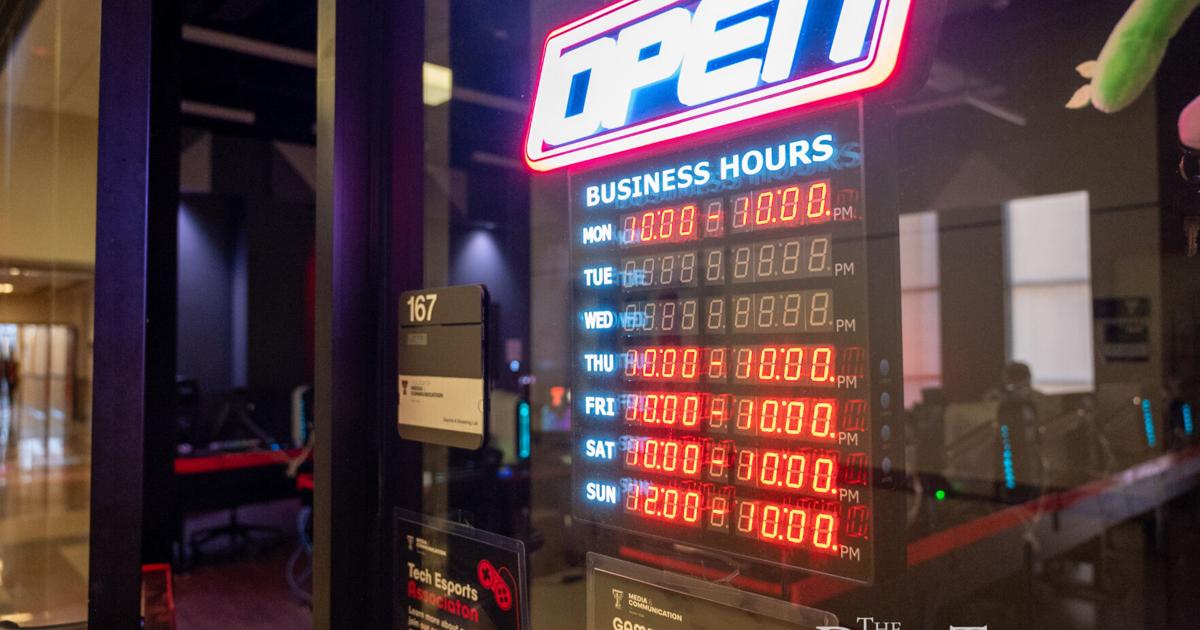
The esports lab located on the first floor of the College of Media and Communications sits ready for students to use Dec. 2, 2025.
Jadon Chesnutt
She said Tech has received inquiries from prospective students basing their choice to attend off available esport programs.
“We’re getting students now, when we’re out recruiting in high schools, and some of the community college students are asking, ‘Well, what do you have for esports? Do you offer a major in esports?’” Hansard said.
To meet these needs, Hansard said Tech plans to bolster the current esports facility, which currently sits in the College of Media and Communication, in the following years. Though no specifics have been decided yet, she said the university plans to either expand the current facility or build an entirely new, bigger one.
In addition to this, she said Tech also is looking into the development of a bachelor’s degree related to esports to coincide with existing certificates and courses tailored towards video game development and competition.
By making these changes and improvements, Hansard said she hopes more students will attend Tech, bringing more academic interest to various fields.
“When you think about all of the different academic areas in esports, you have the engineering, the programming component, the computer science, but you also have art in the graphics,” Hansard said.
She also said the expansion will help prepare students for careers beyond graduation, as the esports industry has continued to prosper.
“They’re hiring the students that are graduating, that are creating the games. Then you have the people that are hosting the centers,” she said. “ … They’re hiring staff as part of their team to go in and manage because now it’s becoming such a commercial business.”
Shortly after VOICE invited Tech to join, Brian Rose, a fourth-year general studies major from Salado, contacted Schovanec to encourage the university to expand its current esports program to reap rewards for both the college and students.

A keyboard in the esports lab sits ready to be used by any student who may walk into the first floor College of Media and Communications lab Dec. 2, 2025.
Jadon Chesnutt
Rose, a player for the Tech Esports Association’s Rocket League team, said these changes will expand the horizon for potential students who want to be involved in more competition but not traditional sports.
“It gives a lot of kids that want to be competitive and maybe aren’t athletic, or were athletic in my situation and then went into esports, a place to actually play collegiate athletics,” Rose said.
He also said an expanded esports program will offer new roles for students to be involved in, as well as learn new skills that can be applied across career paths.
“You have to do streaming, broadcasting, online, social media,” Rose said. “Those are all roles that can be filled by students and should be filled by students.”
Similarly, Schovanec said it’s unlikely Tech will add other NCAA Division I sports due to financial challenges or other limitations. Yet, he believes this has created an opportunity for activities such as esports to excel.
“Given the way we have to manage our budget now because of revenue share and such, it’s unlikely we’ll be adding any more sports,” Schovanec said. “And I think now, in this environment, club sports and things like esports will become more important.”