
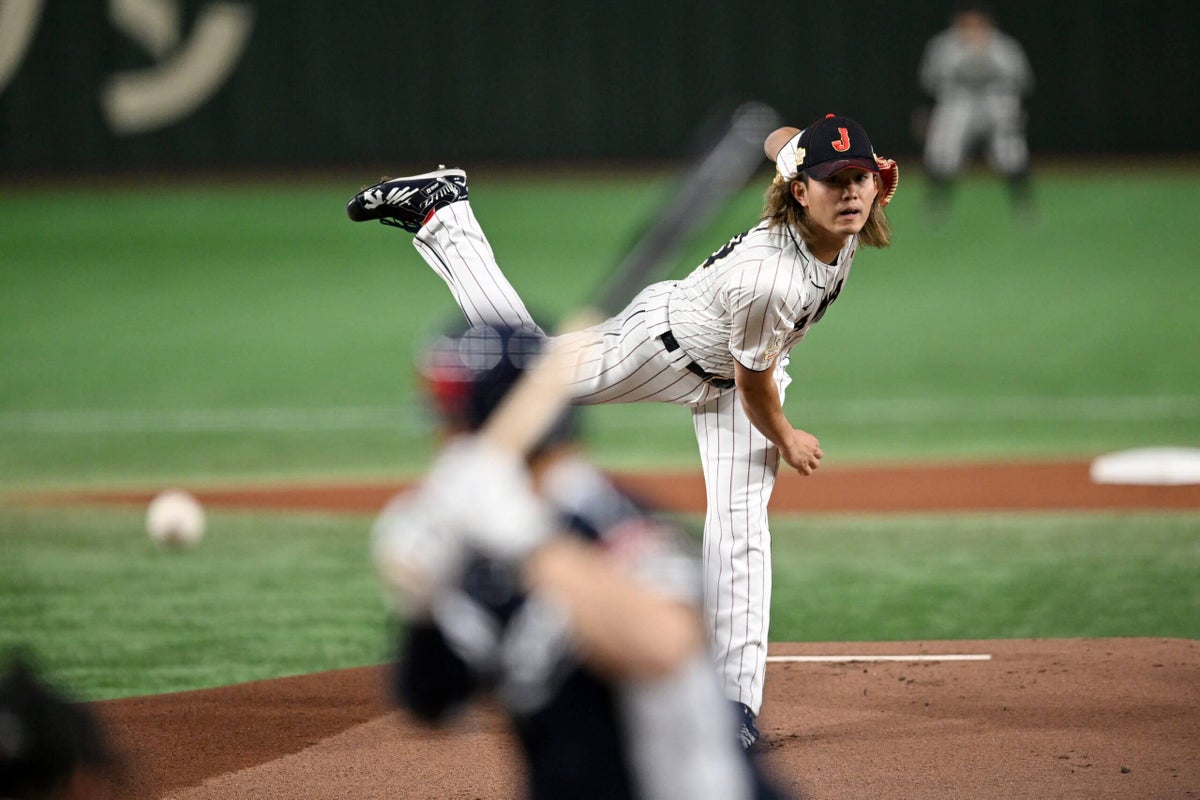
HOUSTON — The Houston Astros started 2026 in stunning fashion, solidifying their starting rotation with a splash unlike any other in their golden era. Agreeing to a three-year contract with Tatsuya Imai augments a rotation bracing for the loss of Framber Valdez while leaving a footprint in a market this franchise rarely explores.
“In a way, I want to experience that sense of survival,” Imai said in November. “When I come face-to-face with cultural differences, I want to see how I can overcome them on my own — that’s part of what I’m excited about.”
Coming to a team with championship aspirations — and a previous lack of any Japanese presence — fulfills Imai’s expectations. Here are seven thoughts on Houston’s soon-to-be-official deal with the 27-year-old right-hander:
1. Even after acquiring Mike Burrows and signing Ryan Weiss, an uneasy feeling remained within the Astros organization about the gap between ace Hunter Brown and the rest of Houston’s rotation. Brown is a bona fide ace who just finished third in American League Cy Young voting, so some separation between him and teammates is expected, but team officials still sought to narrow what they perceived as a large chasm.
Imai will help to close it, but it is perhaps too early to anoint him a frontline starter. The contract he received is indicative of skepticism within the industry of how Imai’s game will translate to MLB, though few have questioned the upside Imai brings. One National League evaluator told The Athletic that “on the right team, he’s like a No. 3, probably like a really good No. 4.” The Astros could benefit from either. Imai will raise the floor of a rotation that, before his arrival, felt top-heavy.
2. An introductory news conference is expected sometime next week, but Imai has already endeared himself to Astros fans with his comments about the Los Angeles Dodgers during a November interview with Daisuke Matsuzaka on the “Hodo Show.”
“Of course I’d enjoy playing alongside (Shohei) Ohtani, (Yoshinobu) Yamamoto and (Roki) Sasaki,” Imai said, “but winning against a team like that and becoming a world champion would be the most valuable thing in my life. If anything, I’d rather take them down.”
Imai is coming to a franchise and fan base that would love nothing more.
3. The contract Imai has agreed to will have an average annual value of $18 million on Houston’s luxury tax payroll, two league sources said Thursday. Adding that $18 million will leave the Astros around $4.2 million under the first luxury tax threshold, according to Cot’s Contracts. Imai can earn a maximum of $21 million if he throws 100 innings next season, but the $18 million is what will count against the team’s luxury tax number. The posting fee Houston will pay to Imai’s NPB team, the Seibu Lions, is not a factor in CBT calculations.
Multiple team sources still insist that owner Jim Crane is wary of crossing the luxury tax threshold for a third consecutive season, but splurging on Imai is evidence enough that Crane is comfortable spending money if it nets a meaningful upgrade. It should be noted, too, that signing Imai is a reinvestment of the estimated $15.6 million Houston cut from its payroll by trading utilityman Mauricio Dubón to the Atlanta Braves and releasing Chas McCormick, Luis Garcia and Ramón Urías.
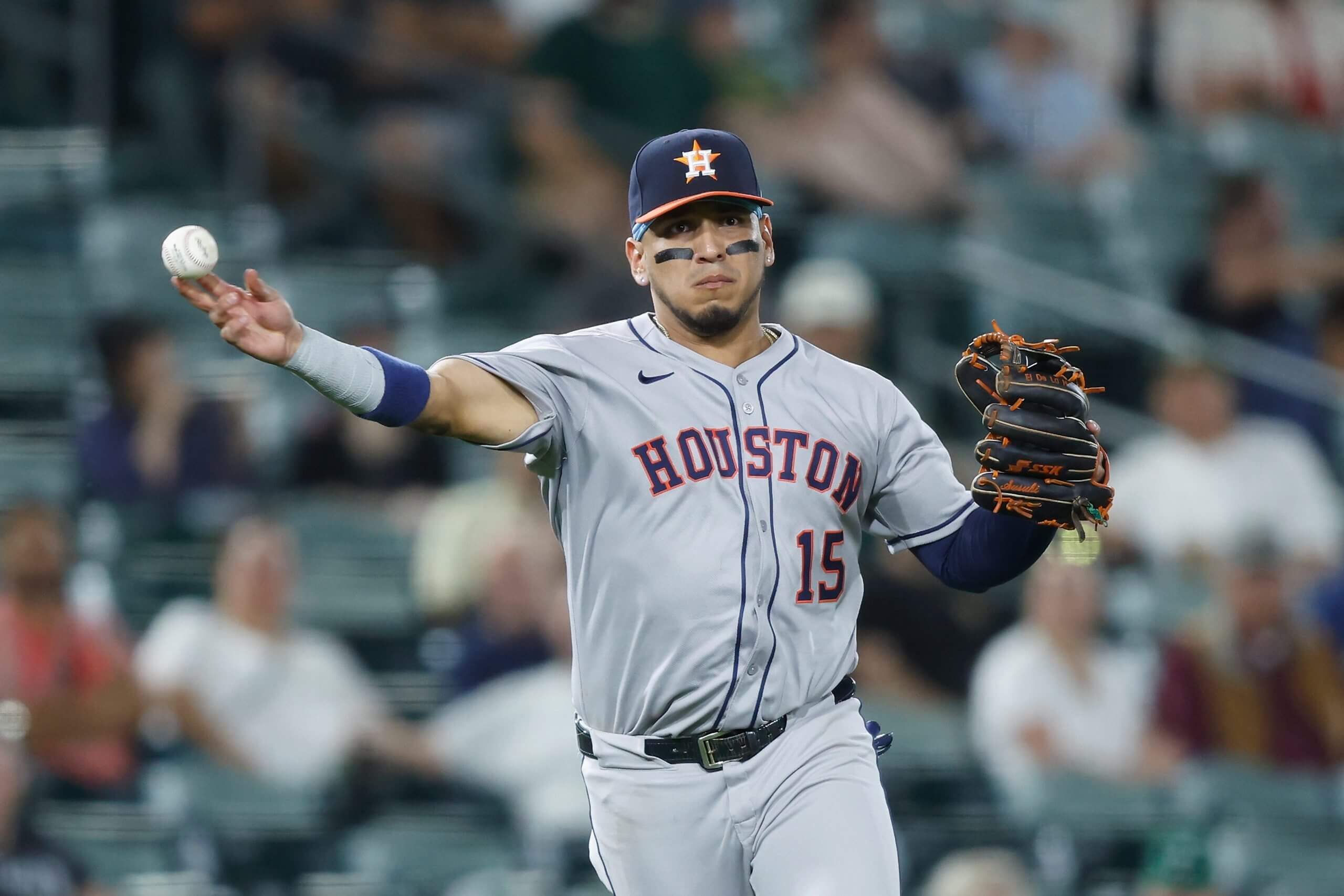
Will the Astros look to move Isaac Paredes to free up room under the luxury tax threshold? (Lachlan Cunningham / Getty Images)
4. The Astros are still in need of a backup catcher and could benefit from another left-handed bat, prompting one to wonder if another trade is possible to create some payroll space. A similar situation unfolded last season after Houston signed Christian Walker and stood about $3 million over the luxury tax threshold. To get back under, the Astros traded most of setup man Ryan Pressly’s $14 million salary to the Chicago Cubs.
This year, Houston might be best served trading from an infield surplus that will squeeze either Walker or Isaac Paredes out of everyday at-bats. Walker’s $20 million salary, coupled with his limited no-trade clause, will make him more difficult to move than Paredes, whom MLB Trade Rumors projects will earn $9.3 million in arbitration.
Last month, general manager Dana Brown said he is comfortable with Houston’s infield surplus but acknowledged he will listen to any offers as part of the front office’s due diligence. The Boston Red Sox are among the teams that have an interest in Paredes.
If Brown doesn’t want to disturb that overcrowded infield, attention could again turn to Jesús Sánchez, who disappointed after he arrived at the trade deadline and is set to earn an estimated $6.5 million in arbitration. Whether Houston wants to pay that within an outfield already overflowing with cost-controlled, young players is a legitimate question.
5. Adding Imai only accentuates how competitive spring training will be for the final rotation spots behind him and Hunter Brown. Cristian Javier should have a place secured, and based on the prospect capital Houston traded for him, so should Burrows.
The Astros open the season by playing 25 games in 27 days, which is conducive to the six-man rotation Houston carried at similar points last season. That means Weiss, Spencer Arrighetti, Lance McCullers Jr., Nate Pearson, Colton Gordon, Jason Alexander and AJ Blubaugh could be battling for two remaining spots.
On major-league track record alone, Arrighetti and McCullers profile as the most prominent candidates to open in Houston’s rotation, though neither inspired much confidence last year with their performance or availability. Weiss has a contract with copious incentives based on innings pitched and, in no uncertain terms, told the “Crush City Territory” podcast he does not want to be a reliever.
The ability for Pearson or Blubaugh to function as a swingman and pitch out of the bullpen should enhance their candidacy for the opening-day roster, which could feature one less reliever if Houston deploys a six-man rotation.
6. Imai’s agreement with the Astros arrives almost one year after Daikin — a Japanese-based HVAC manufacturer — purchased the naming rights to the Astros’ ballpark. Dignitaries from the company traveled to Houston for the renaming ceremony and were spotted at Daikin Park at times throughout the season as Crane’s guests.
In negotiations for naming a building or signing a ballplayer, money and years matter more than anything. It’s unlikely Imai picked the Astros because their ballpark bears the name of a Japanese company, but the rebranding expanded the franchise’s footprint into an area where it wasn’t strong. Adding Imai will only strengthen that presence in Japan and, perhaps, lead to more exposure in a place the Astros had yet to explore.
7. Imai is believed to be the first NPB player ever signed by the Astros. The team had not signed a Japanese free agent since Kaz Matsui in 2008 — after Matsui had already played parts of five major-league seasons with other teams.
Though Houston hasn’t been active in Japanese free agency, the team did acquire Yusei Kikuchi at the 2024 trade deadline and put its heralded pitching development infrastructure on display. Kikuchi had a 2.70 ERA, 0.93 WHIP and 150 ERA+ in his 60 innings as an Astro, authoring a two-month display of dominance that he parlayed into a three-year, $63 million free-agent deal with the Los Angeles Angels.
Kikuchi, like Imai, is represented by agent Scott Boras, who spoke highly of how Houston homed in on Kikuchi’s strengths after the trade. Kikuchi and Imai are not identical — they throw with different hands, after all — but there are similarities in their arsenals and how they attack hitters. Perhaps Boras made Imai aware.