
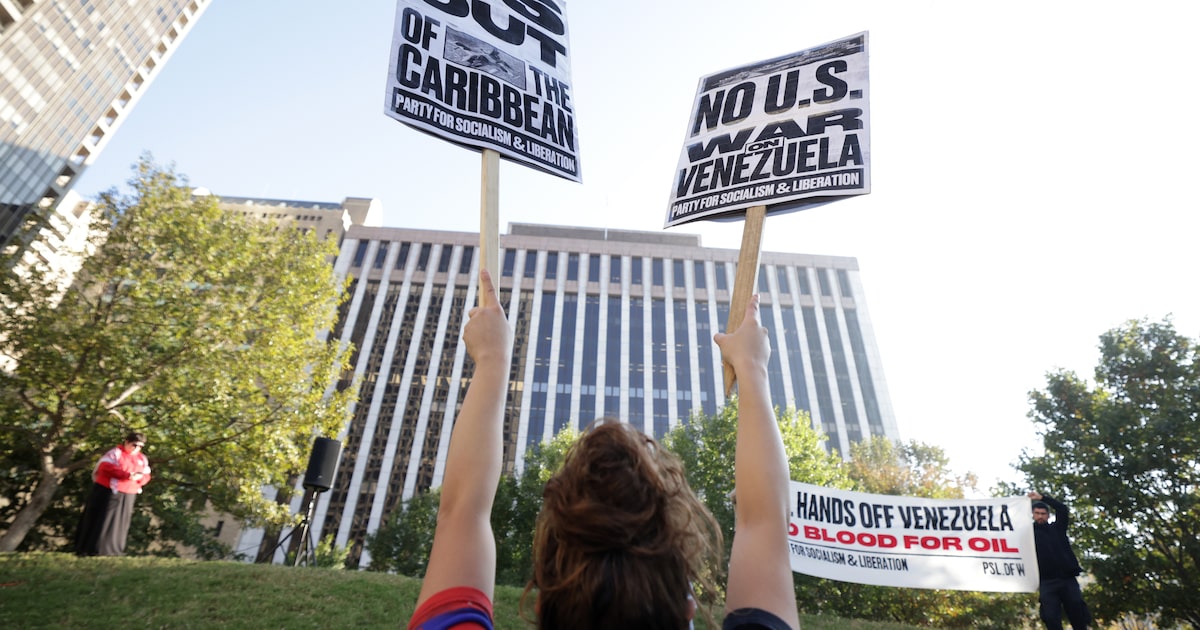
Nicole Díaz says she has no memory of a peaceful or democratic Venezuela.
“I’m 29 years old, and in my memory there is no other government,” Díaz said. “There is no ‘good Venezuela.’ I don’t know it.”
Venezuelans in North Texas, like Díaz, watched the news of a U.S. military strike in their home country on Saturday with a mix of relief, gratitude and deep uncertainty, emotions shaped by years of political turmoil that forced many to leave.
Related
Breaking News
Díaz was arriving home in Lewisville late at night when she began seeing reports of a U.S. military strike in Venezuela.
With family living near the capital of Caracas, including relatives close to Fort Tiuna, one of the military installations that was bombed, she stayed awake through the early morning hours, refreshing news updates and trying to reach loved ones.
She finally went to bed at 2 a.m., but woke up again at 4:30 a.m. to find that Venezuelan President Nicolás Maduro and his wife, Cilia Flores, had been arrested by the U.S. government.
“Joy, fear, frustration, everything at the same time,” Díaz said. “So much damage has been done to Venezuelans that you don’t even know what you’re supposed to feel.”
Díaz left Venezuela 10 years ago. She said she grew up witnessing shortages, protests, tear gas and gunfire, and watching her parents struggle through election after election that brought no change.
“I never voted in my country,” she said. “I never had that right. I would go with my parents at 3 in the morning to stand in those long lines, wait all day, wait for the vote count, and many times the opposition would win and still the regime would announce victory.”
She said those moments shaped her decision to leave.
“I didn’t see a future,” Díaz said. “I wanted to study, to grow, to feel safe walking down the street. In Venezuela, that felt impossible.”
The news of the strike resurfaced memories, she said, that never entirely leave.
“I thought about the hunger, the children without medicine, the sick people who had nothing to eat,” Díaz said. “I thought about my family coming home scared. I lost my grandfather while I was here in the United States, and none of us could go back to say goodbye.”
‘Small breath of freedom’
For Díaz, the events unfolding now feel like “a small breath of freedom,” but one mixed with fear. “It’s not over,” she said. “I don’t want innocent people to suffer more. That’s what worries me.”
That same mix of hope and uncertainty was echoed by Néstor Cuevas, 43, and his wife, Yexi Mileno, 40, a Venezuelan couple living in Lewisville. Their family learned of the strike in the middle of the night.
“My daughter woke me up and said, ‘Mom, get up. Something is happening in Venezuela,’” Mileno said. “From that moment on, we didn’t sleep.”
When the news was confirmed, Mileno and Cuevas said emotions overflowed.
“We started shouting and thanking God,” she said. “I kept saying, ‘My God, the freedom of Venezuela is close.’”
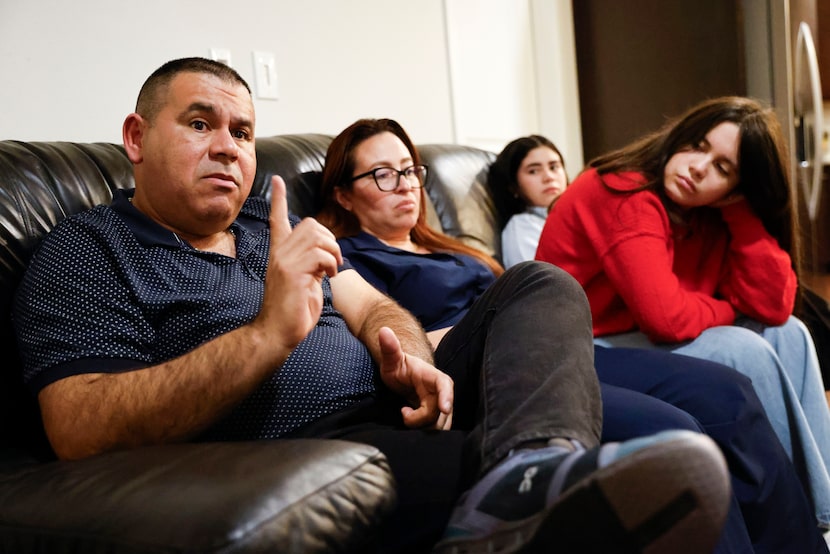
From left, Néstor Cuevas, originally of Venezuela, with his wife Yexi Carolina Mileno, daughters Daila Cuevas, 12, and Aida Cuevas, 18, talks about the impact of the end of TPS and what they hope to do with their immigration status, on Wednesday, Feb. 5, 2025 at his residence in Lewisville. The Cuevas family is seeking out options they have as President Donald Trump cracks down on immigration.
Shafkat Anowar / Staff Photographer
Cuevas and his wife, who arrived in the U.S. in 2022, used to co-own an industrial recycling company in Venezuela, but they decided to leave after they were threatened for refusing to pay “monthly fees” to the military, he said.
Now, he said, the possibility of change brings hope of returning someday.
“When Venezuela finally has the government that was elected, we won’t be afraid to go back,” Cuevas said. “We won’t be scared to see our family or friends anymore.”
Deep uncertainty
Still, he acknowledged deep uncertainty about what comes next, particularly the role of foreign involvement.
“We want change. We want a cleanup of terrorist, rebel and drug trafficking groups that have taken control of the country,” Cuevas said. “But Venezuela is a sovereign nation. We don’t know how a foreign administration would work, or whether it would respect our laws.”
Related

Díaz shared that concern. “I worry about who will take control and how,” she said. “I want to believe it will be positive. I have hope. But after so many years, hope is also fragile.”
The question that lingers is deeply personal for Díaz after only knowing one government.
“I ask myself, what will Venezuela be like after this?” Díaz said. “Because I don’t have a memory of anything different. I just want to go back, but to a different Venezuela.”