
A flock of dark-eyed juncos felt rather social one December morning in Memorial Park.
The gray and white-bellied, round little sparrows hopped and chirped around the base of a tree. They come from coniferous and deciduous forests in the north, but don’t mind the mix of native Chihuahuan Desert and non-native trees found in El Paso.
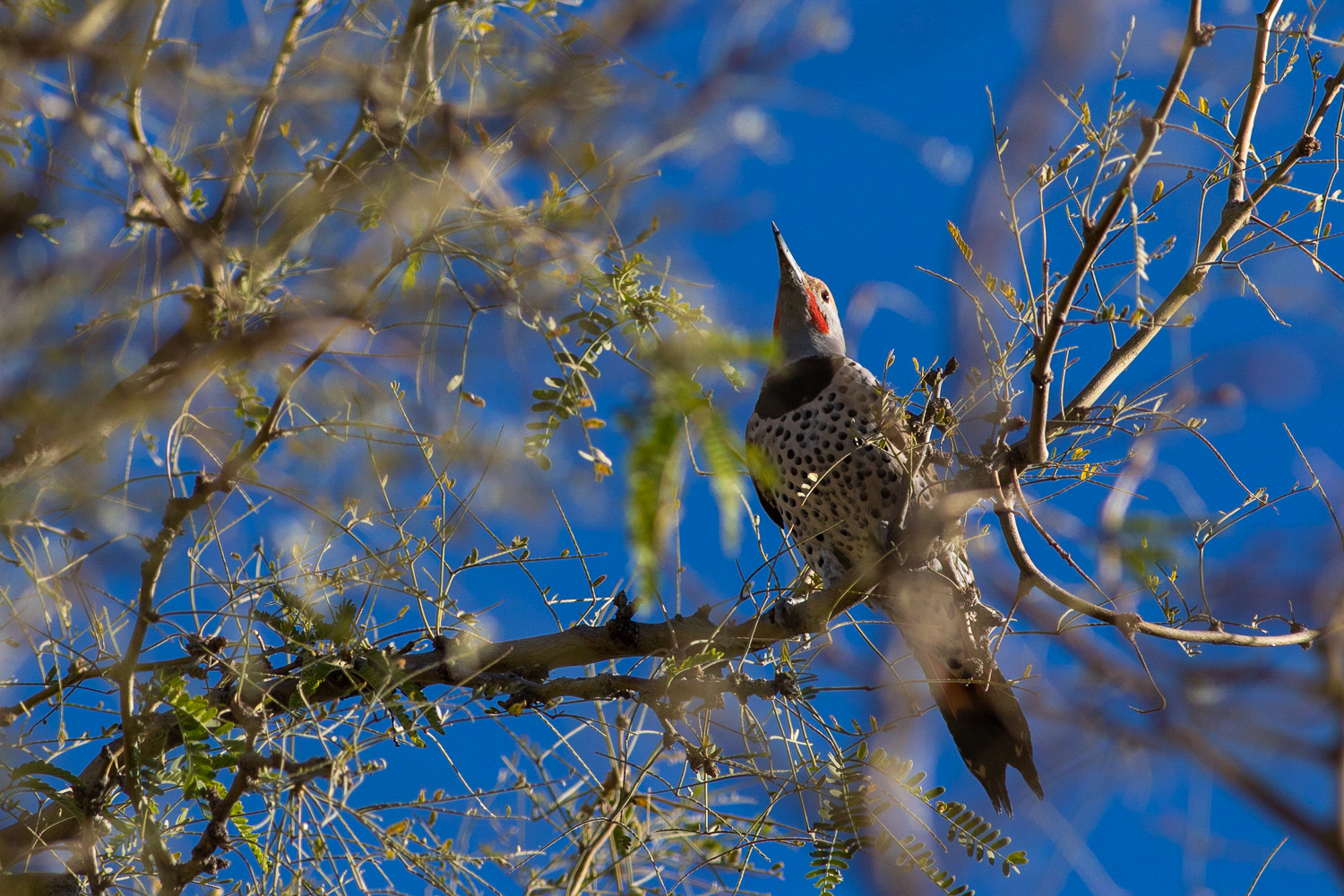
After taking a moment to admire the juncos, Estrella Posada made her way down the Central El Paso park with a pair of binoculars and a DSLR camera slung over her shoulders, a well-thumbed copy of “The Sibley Guide to Birds” in one hand. Posada, a field trip coordinator for the El Paso/Trans-Pecos Audubon Society, followed a flash of vermillion – the northern flicker, a type of woodpecker, landed on a honey mesquite tree.
Posada later spied a tiny, ruby-crowned kinglet. Sometimes a bird’s name is self-explanatory.
“They have a red crown on their head and they don’t always show it,” Posada said. “So a goal for photographers is to get a picture with the red of its head showing.”
The juncos and flickers and kinglets will fly north in the spring, returning home after basking in the warmth of sunny El Paso in the winter. They are among the nearly 300 species of birds that visit El Paso every year – mostly migratory birds, as well as what the Centennial Museum’s ornithology curator Scott Cutler calls “accidental visitors.”
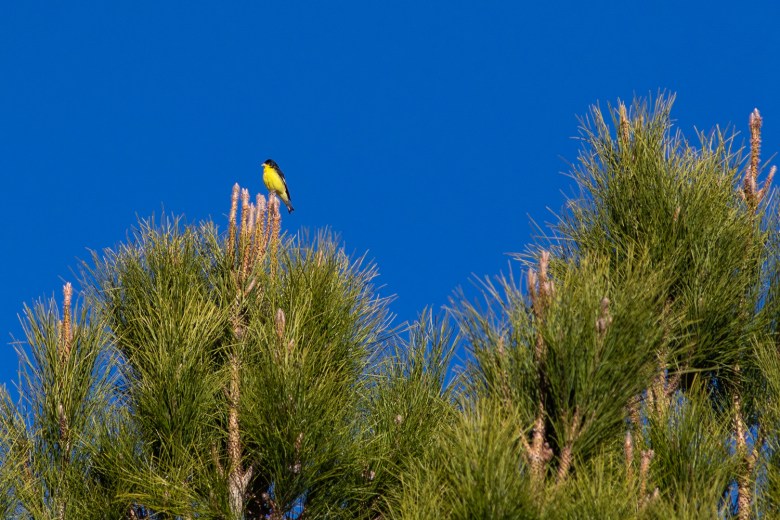 A goldfinch sits atop a pine tree at Memorial Park, Dec. 6, 2025. (Corrie Boudreaux/El Paso Matters)
Migration has long been embedded in the landscape of the borderland – and birders say it’s one of the reasons that make El Paso a special place for bird-watching.
“I actually just started getting into birds earlier this year,” Erica Esparza, a local birder, said. “I started taking lots of walks, like leisurely walks, not to track birds or anything, just for enjoyment. And with that I was able to start noticing. What’s existing around us?”
Esparza recalled hearing a sound she had never heard before, like a rattling hiss, on a walk through Chamizal National Memorial in April. That’s when she found herself staring into the face of a burrowing owl.
SEE ALSO: First desert bighorn sheep lambs born in Franklin Mountains
The ground-dwelling owl is native to the Chihuahuan Desert and active during the day. They imitate the sound of a rattlesnake to scare predators from their burrows.
“Just like that, I started to think if I’m not actually looking, then I’m missing so many things,” Esparza said. “Like those owls have probably been hanging out the entire time that I’ve been walking there. I just wasn’t looking down at my phone. I was taking my headphones out to just kind of listen to the environment around me.”
Bird-watching community blossoms in El Paso
Posada has noticed a growing interest in birding, also known as bird-watching.
eBird, an online project where people can submit bird sightings, clocked 122,000 new users last year. Merlin, an app for identifying bird species by sound recording, counted 7.5 million new users.
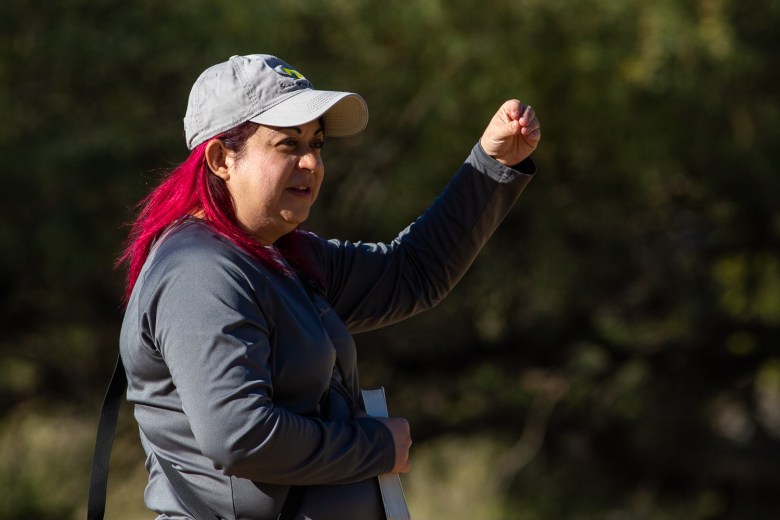 Estrella Posada, a local birding expert and owner of a bird tour company, teaches about the habits and calls of several bird species at Memorial Park, Dec. 6, 2025. (Corrie Boudreaux/El Paso Matters)
“Birding was primarily a male-dominant field, but I feel there’s a lot more females and female bird guides as well in the birding community, not just in the U.S., but I’ve also noticed in my travels to Central and South America,” Posada said.
In November, the Audubon Society partnered for the first time with Programa de Aves Urbanas in Ciudad Juárez to organize a bird tour in Parque Central. Posada, who translated the tour, said it was an opportunity for everyone to learn the names of birds in Spanish and English. She hopes more events like this will build the binational relationship between the cities’ birding communities.
“A lot of birders who don’t speak English or their English isn’t the greatest sometimes feel like they can’t come to our bird tours, our bird walks,” Posada said. “But being able to bird together, regardless of whether you speak English or Spanish, just brings a community closer.”
Locally, the El Paso Audubon Group on Facebook has more than 2,600 members. About 40 people joined the group just the week before Christmas. In addition to the El Paso/Trans-Pecos Audubon Society, new bird-watching groups formed in El Paso this year: Sun City Queer Birders and the El Paso chapter of Feminist Bird Club, where Esparza serves as an officer.
A Feminist Bird Club is an inclusive space for people interested in birds, but also supporting people in less privileged scenarios, said Lillian Smith, local club president. She noted the network’s recent collaboration with Birders of Palestine, a fundraising project led by Lara and Mandy Sirdah, sisters in Gaza who bird-watch and document wildlife. The network raised more than $81,000 to support Palestinian bird-watchers.
While bird lovers don’t need to necessarily talk about politics, policies everywhere affect both birds and birders, Smith said.
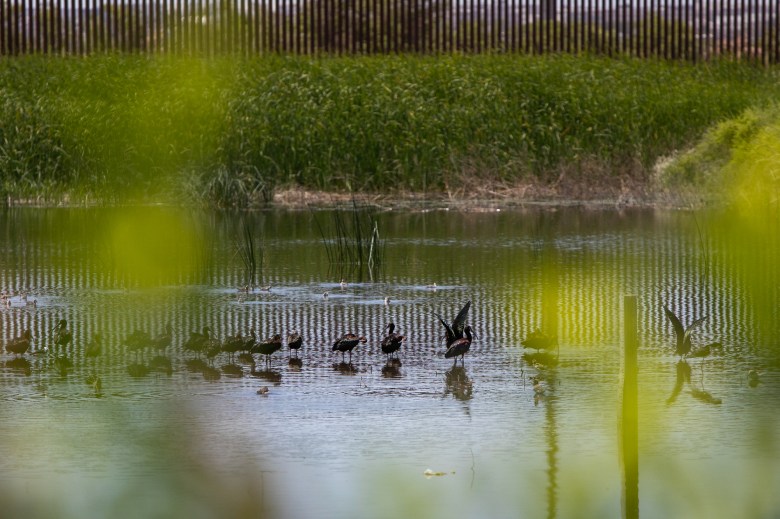 A flock of white-faced ibis rest in a wetland cell at Rio Bosque Wetlands Park, May 3, 2024. (Corrie Boudreaux/El Paso Matters)
In El Paso, the border wall looms in the background of Rio Bosque Wetlands Park and Ascarate Park, both hotspots for local and seasonal birds, while development such a proposed highway expansion could threaten migration corridors. Climate change and prolonged drought also impact bird habitats, food sources and migration patterns.
“You peer onto the border wall, you’ll see a lot of reptile hawks perching there looking for prey and you might even hear them call,” said Collin Lyle, a postdoctoral ecology student at the University of Texas at El Paso. “But right now they’re actually working on putting more barbed wire up there, and that’s going to really hinder them from stopping the rodent populations.”
Getting started: Tips for first-time bird-watchers
So what makes a person a birder? Anyone who has an interest in observing birds, Posada said.
Some of the thrill comes from chasing a bird you’ve never seen before, she said. She remembered one year when someone on Facebook posted a picture of a flammulated owl in a mesquite shrub in Downtown El Paso. Online sleuths were analyzing the photo to identify the location and finally staked out a location by the Main Library, Posada said.
That owl should have been in Mexico at that point, but was a little late in its journey, she said. Birders from all over Texas came to El Paso to catch a glimpse of that owl, small enough to fit in the palm of a hand.
READ MORE: Scientists try to identify Franklin Mountains’ mystery hummingbird
Posada’s favorite birds are vultures, with turkey vultures the most common in the greater El Paso region and black vultures a rare sighting. Posada, who leads private birding tours to Central and South America, hopes to one day see some of the Old World vulture species in Africa and the Middle East.
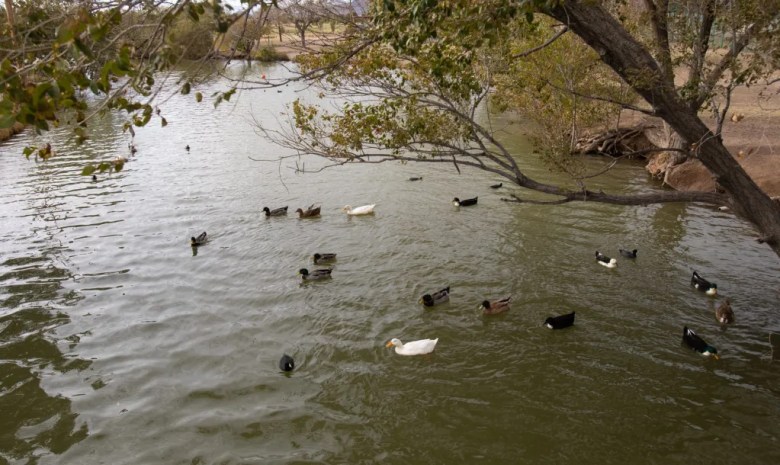 A flock of ducks, both wild and domesticated, swims at Ascarate Lake on Nov. 13, 2023. (Corrie Boudreaux/El Paso Matters)
But for a first-timer, birding can be as easy as a stroll around Ascarate Lake, where visiting water fowls mingle with native and domestic ducks.
“It’s open space, so it may be easier for beginners to be able to focus on one bird without the distraction of trees and pine cones,” Posada said.
Other tips include:
Follow bird clubs. Groups such as the El Paso/Trans-Pecos Audubon Society and Friends of the Rio Bosque offer free resources and guided bird tours led by experts. Bird walks are for people of all skill levels and the groups welcome beginner birders.
“They love to yap about birds,” Smith said. “And they will take any question. I’ll even email, ‘I don’t know what this bird is. Can you help me?’”
Get equipped. Posada recommended several tools people can use to identify birds: a pair of binoculars, recognition apps such as Merlin and a field guide, either a physical book or app such as the Audubon Bird Guide. They don’t have to be the fanciest, most expensive binoculars either, Posada added. She uses a pair that cost less than $250.
“An early mistake I would consider, I didn’t want to buy binoculars,” Esparza said. “I was, like, that’s gonna be so weird. Like, what if somebody sees me out in the world and is, like, ‘You don’t even know birds.’ I don’t think I’ve actually encountered anyone who’s interested in birding who would have that approach to a new birder.”
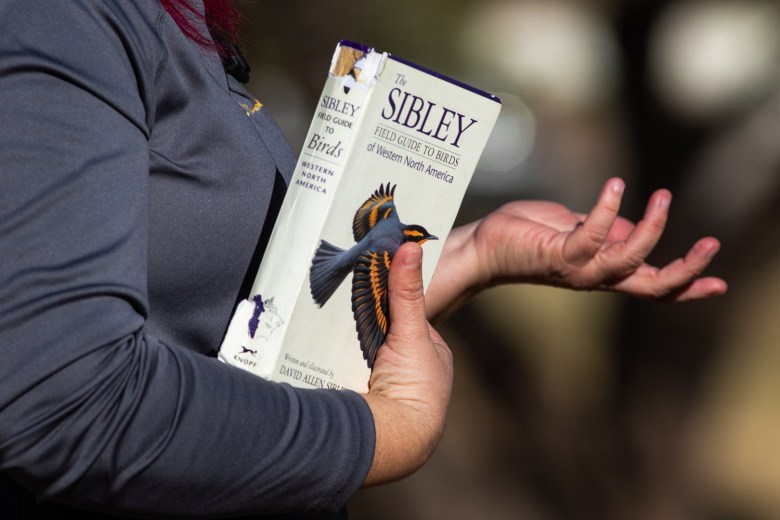 Birding expert Estrella Posada recommends “The Sibley Field Guide” as a resource for identifying bird species and morphs, the variations that may occur within male, female and juvenile birds of the same species, Dec. 6, 2025. (Corrie Boudreaux/El Paso Matters)
Merlin is only a starting point, Smith warned. The app can sometimes misidentify birds and it’s best to check with visuals and other song and call recordings on the app, she said.
Find bird sightings on websites such as eBird, which can be narrowed down to city and hotspots, and UTEP’s list of recent birds at Rio Bosque.
Watch your step – and your neck. Lyle recommended going with a buddy because it’s easy to trip and fall when using binoculars, looking for birds but not necessarily where you’re stepping. That’s why guided group tours are also helpful so people can look out for each other, he said. Lyle serves as an officer for Friends of the Rio Bosque, which organizes bird walks.
Birders spend a lot of time looking up at tree tops and can also get “warbler neck,” a neck pain condition from straining the neck for extended periods.
Start in your own backyard. Even urban and residential neighborhoods attract birds, from great-tailed grackles to white-winged doves.
“Try to see nature where you are,” Esparza said. “I think sometimes we can get bogged down with, oh, I have to go to this location to bird-watch. I’ve actually these last two weeks been really trying to just learn the birds that are by my apartment.
Birding Meetups in El Paso
El Paso/Trans-Pecos Audubon Society: The Far West Texas chapter of the National Audubon Society. Leads birding field trips and habitat restoration workdays at Feather Lake, a wetland and bird sanctuary in the Lower Valley that has gone dry. More info: Facebook, Website.
Friends of Rio Bosque: A volunteer support group for the Rio Bosque Wetlands Park. Leads guided walks, including birding tours with park volunteer assistant John Sproul. More info: Instagram, Website.
PAU Ciudad Juárez: The Juárez chapter of the Programa de Aves Urbanas, a project in Latin America to connect people to birds and nature. Leads bird tours in Juárez and other places in Chihuahua. Follow them on Instagram.
Sun City Queer Birders: A birding group for queer birders and allies. Leads monthly bird walks. Follow them on Instagram.
Feminist Bird Club El Paso: The El Paso chapter of Feminist Bird Club, a multinational group that promotes inclusivity in birding while fundraising for social justice causes. More info: Linktree.
Related
LISTEN: EL PASO MATTERS PODCAST