
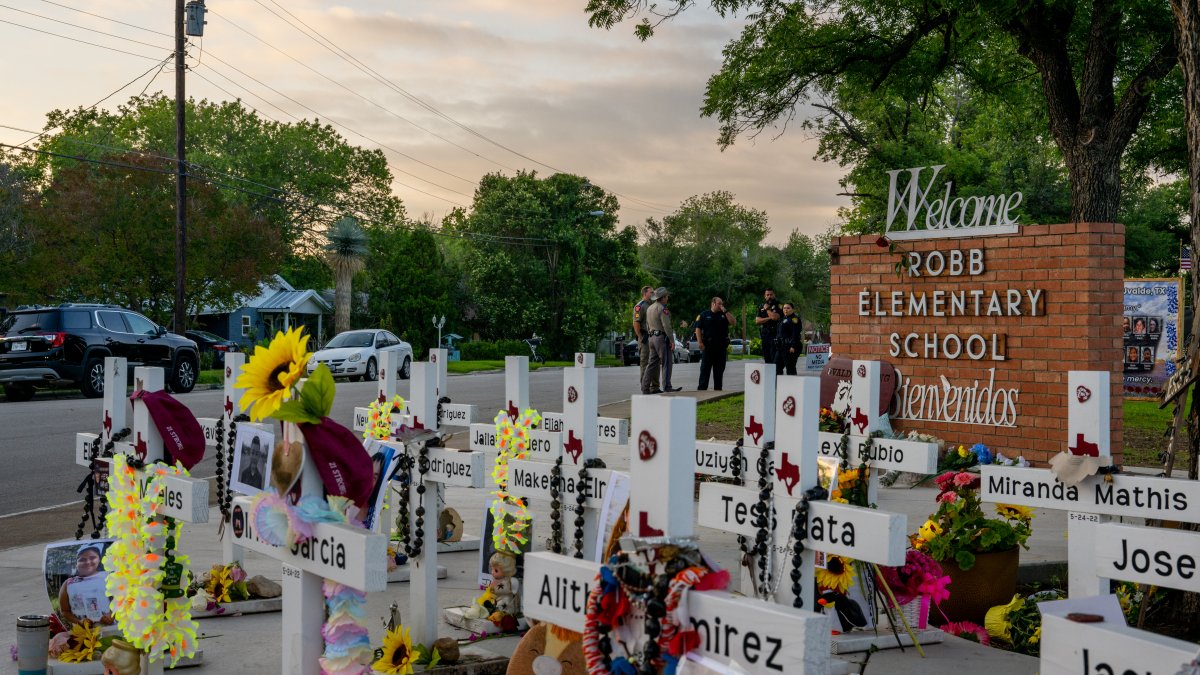
Jury selection begins Monday for a former Uvalde school police officer charged in the Robb Elementary School massacre.
Former Uvalde County ISD police officer Adrian Gonzales pleaded not guilty to 29 counts of abandoning and failing to protect children during the May 2022 rampage, where almost 400 responding officers waited for over an hour before confronting the gunman.
The attack left 19 students and two teachers dead and several others injured.
Gonzales is expected to stand trial at the Nueces County Courthouse in Corpus Christi.
A judge previously granted a change of venue for the high-profile case where emotions and anger are palpable.
NBC 5 asked legal and law enforcement experts to weigh in.
Dallas defense attorney Russell Wilson is also a former prosecutor who is not associated but has been following the tragic case.
“In general, when police officers respond to incidents, even if they do so poorly or incorrectly, it’s very rare that they are prosecuted criminally for their failure to accurately respond,” he said. “Given the magnitude of what happened, I think there was substantial pressure for somebody to try to do something. If you find a jury that follows the law here, though, I think that the issue becomes distinguishing poor police performance from criminal acts, and presumably these officers showed up with no particular animosity toward any particular child and having sworn to uphold the law and enforce the law, but to try to attempt to do so in a way that does not jeopardize their own lives, and so I don’t know that a jury would find that the officer faced with the imminent death of other individuals must engage in conduct that puts himself in death’s way.”
Wilson agreed to share what he anticipates will be the arguments presented on both sides, while emphasizing that he is not privy to the evidence the state may have gathered against Gonzales.
The prosecutor, he says, could state: “you’re aware that there are gunshots being fired and you’re aware that you not taking action could result in these children being harmed. Therefore, you have committed the offense of child endangerment… But I think the defense will say that the duty to defend or protect the public does not require the officer himself to jeopardize his own life.”
Former California police officer Scott Savage founded Savage Training Group and trains law enforcement across the country.
When asked if he uses the massacre in Uvalde in his trainings, Savage says “We show a photo of the little kids that were killed in the Uvalde incident and then displayed over the photo is the numbers 376, representing the number of officers there and then the number 77, which is the number of minutes it took for the officers to get in there.”
How does Savage describe the actions, or inaction, of law enforcement that day?
“I think what the officers did is awful and I think it is inept,” said Savage. “However, it’s a different decision to say is what they did criminal?”
Savage says from what he has seen in this case, while law enforcement officers were confused and lacked direction, their actions are not criminal.
He points to two other high-profile mass shootings that also called into question officers’ inaction: the Pulse Nightclub Shooting in 2016 and the Parkland High School shooting in 2018.
“So while tragic, while awful and while very uncomfortable to think about, we need to separate the moral obligation and the emotional aspect of this with the actual cold, hard facts of the law, and I’m just not sure how the prosecution in this case is going to prove care, custody and control… Unless those kids and the victims were in the care, custody, and control of the police officers, there’s no special relationship, meaning what they did while tragic, while inept, while probably a product of terrible training, may not be criminal.”
The rampage, however, does prove a glaring problem, he says. The country’s conventional training for active shooting is nowhere near what police must actually encounter in real life.
“The way that the police are trained conventionally to respond to active shooters is in no way preparing them for the reality of what they face,” he said. “I think we need as a society to look at how are police officers are actually being trained. As a person who’s on the inside, who literally sees how police officers train, I’m telling you right now, it’s not the way you think it is. And some officers may perform admirably in these situations, despite their training.”
Just about every officer in training says he would never stand back like officers did in Uvalde, according to Savage.
“If we all just throw our hands up and say, there’s 376 officers there and they were all cowards, if that’s what we’re believing, how did 376 people all suffer from the same personality flaw? I actually think it’s much more complex than that,” said Savage. “I think the way cops are being trained is actually today not going to prevent this from happening again.”
Wilson agrees prosecutors will face an uphill battle in the case against Gonzales and encourages the public to try to set aside the horrifying nature of the tragedy.
“The magnitude and nature of the tragedy or whether or not there was a tragedy is not really what’s on trial here,” said Wilson. “I think the key for the public would be trying to focus in on the inactions and probably really maybe in the back of our minds. Do you want your law enforcement officers, to what degree do you want them, subject to prosecution for their bad acts?”