
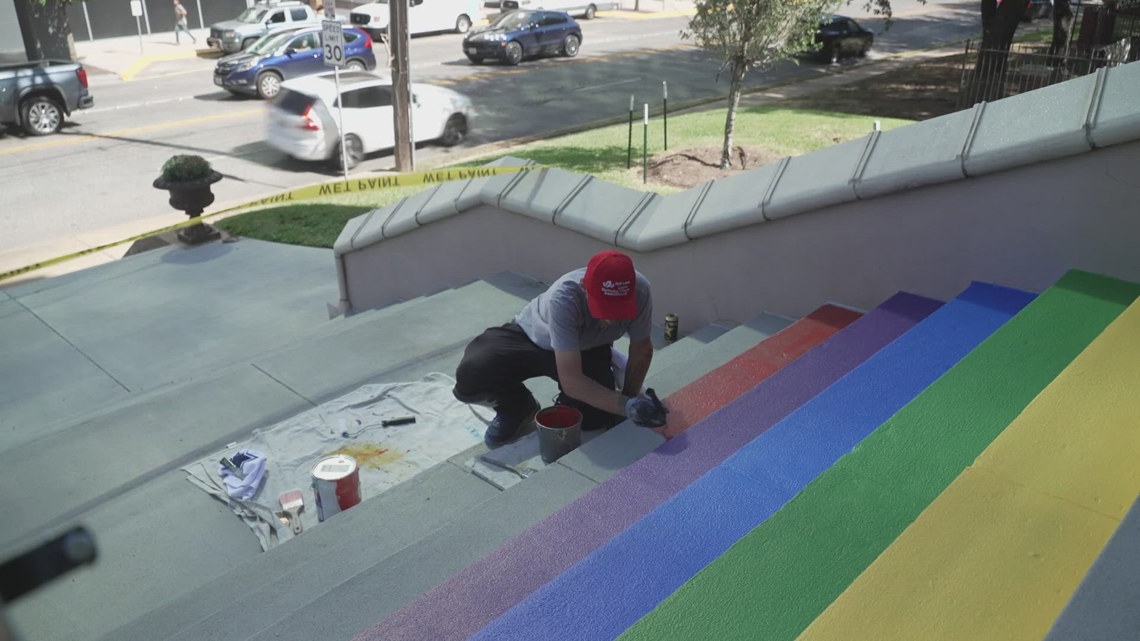
Dallas’ Landmark Commission will decide Monday whether the historic Oak Lawn United Methodist Church can keep its rainbow-colored steps.
DALLAS — Dallas’ Landmark Commission will decide Monday whether the historic Oak Lawn United Methodist Church can keep its rainbow-colored steps.
The church at 3014 Oak Lawn Avenue’s steps were painted in rainbow colors this past fall after Texas Gov. Greg Abbott’s order directing cities to remove rainbow crosswalks and other pavement designs that have “political” or ideological messaging. Abbott said the move was intended to keep roads “safe and free from distraction” and warned that cities that don’t comply are at risk of losing state or federal transportation funding.
Oak Lawn United Methodist Church was designated a Dallas landmark in 1984. Changes to the exterior appearances of landmark-designated properties require approval from the Landmark Commission.
In a statement shared on the church’s Facebook page, church leadership invited people to speak in favor of keeping the rainbow-painted steps at the Landmark Commission meeting at 1 p.m. Jan. 5 at Dallas City Hall.
“Silence is not neutral,” said Senior Pastor Rev. Rachel Griffin-Allison in the statement. “Painting our steps in the colors of the rainbow is a visible witness to the gospel we preach—that every person is created in the image of God and worthy of safety, dignity, and belonging.”
According to the Landmark Commission meeting agenda, staff recommended that the painted steps be approved as a temporary art installation, while a task force recommended they be denied, saying they don’t comply with city code regarding paint color changes.
The City of Dallas in November requested an exception from Abbott’s directive.
Dallas City Manager Kimberly Bizor Tolbert’s request to the TxDOT argues that safety data for the locations of the impacted crosswalks shows that they haven’t presented public safety issues, and removing them would require funds not included in the city’s recently passed budget. If the city’s request for an exception is denied, the request letter notes that the city asks for a 90-day extension from the date of the denial to implement a plan to remove the crosswalks.
“The city’s decorative crosswalks are a form of government speech, expressing civic values and community identity through design in a manner that is consistent with the city’s authority to manage and maintain its streets. The state’s demand for removal intrudes on that local authority and raises concerns under the unconstitutional conditions doctrine, as it conditions continuing access to roadway funding on the suppression of lawful municipal expression,” Tolbert’s letter reads.