
HOUSTON — Last summer, Jim Crane took a contingent of his Houston Astros employees to Japan. Crane’s business presence there dates back 40 years. His logistics company still has an office in Tokyo. Crane’s baseball club carried no such cachet, caught behind the times in a country that can produce premier talent.
Still, Crane negotiated a new 15-year naming rights deal for his downtown ballpark with Daikin, an HVAC company based in Osaka. It took effect at the beginning of 2025, but still spurred a visit to the company’s headquarters. Officials took Crane and his delegation around the country, touring manufacturing plants and, along the way, some of the countless baseball stadiums.
“It did wake my eyes up … We weren’t as focused as we should have (been),” Crane said on Monday. “We had some people going in and out of there, but I knew we weren’t getting the job done recognizing talent and getting in front of it.”
Upon his return, Crane started to course correct. He ordered more scouts to be hired in Tokyo, Seoul and Taiwan. They attend games, ascertain who may be interested in moving to Major League Baseball, analyze data and advance the Astros’ footprint in an area where it barely felt visible.
“We went all in,” Crane said.
Doing so bred hope for more days like Monday, when an overflow crowd stood inside a stuffy press conference room to witness, perhaps, the beginning of Crane’s vision.
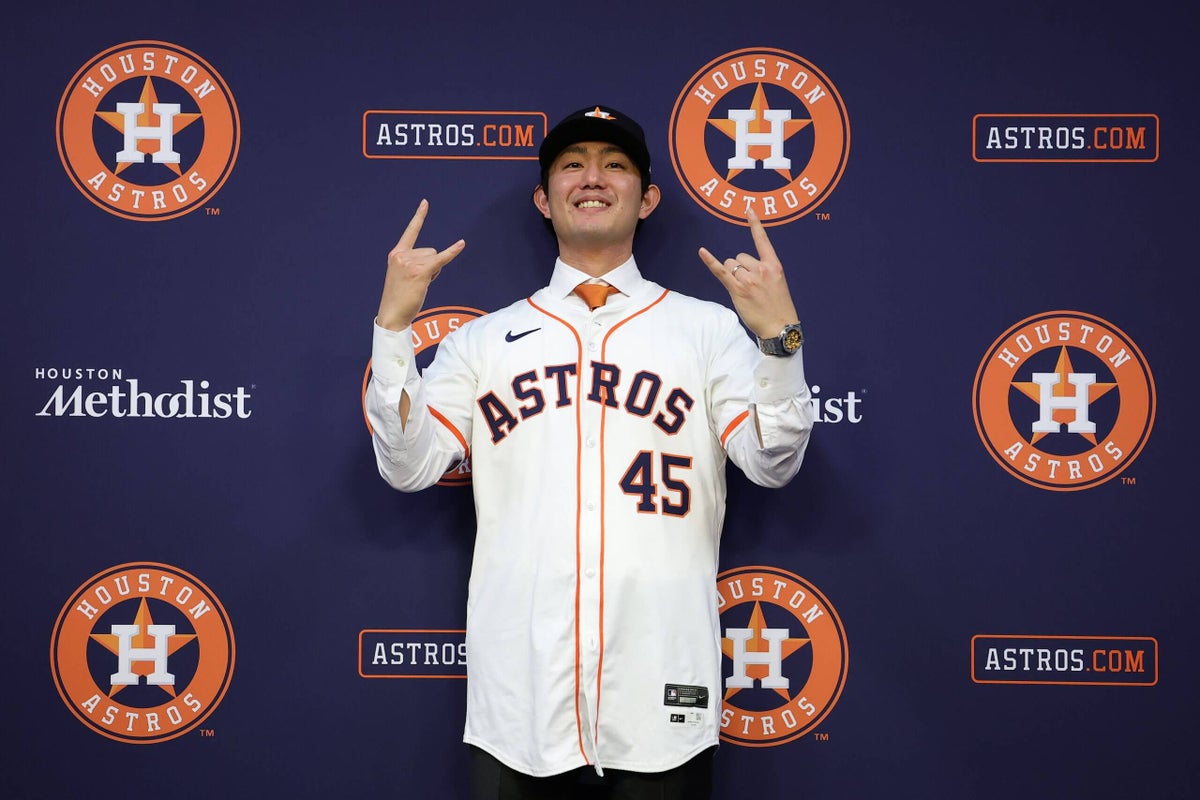
Right-hander Tatsuya Imai buttoned a white Astros jersey over his black suit, tucked his long hair inside a navy cap and, after putting pen to paper, became the first Astros player ever signed straight from an Asian professional league.
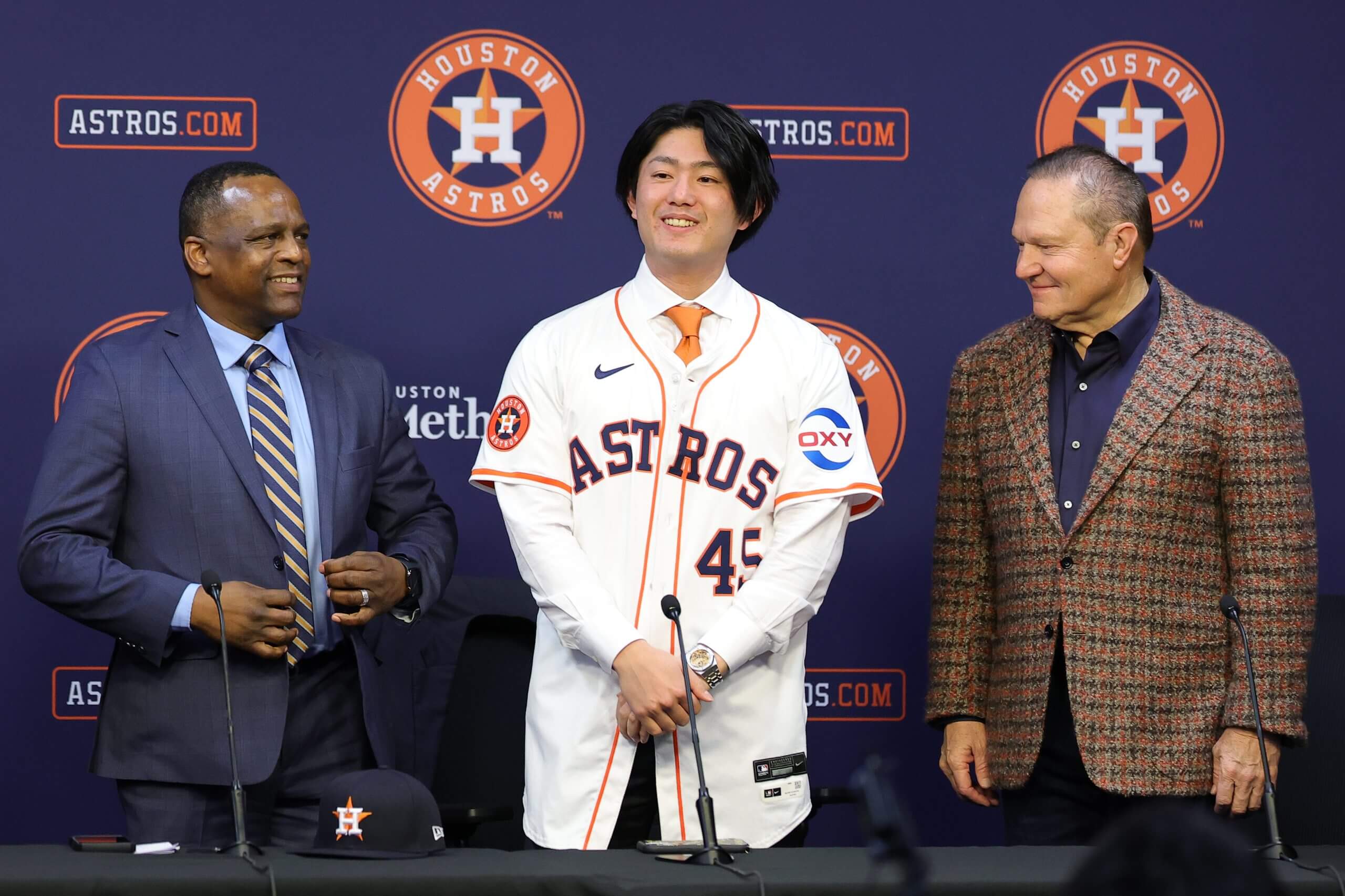
Dana Brown (left) helped Tatsuya Imai put on an Astros jersey as agent Scott Boras (right) looked on. (Alex Slitz / Getty Images)
If Crane has his druthers, he will not be the last. The team’s partnership with Daikin has accelerated the Astros’ progression into an area where they had little traction. The company’s chief marketing officer, Takayuki Inoue, attended Monday’s news conference, received recognition from Crane and posed for photographs with Imai afterward.
“We’ll be moving pretty fast in Asia and continue to focus on that and evaluate all the talent over there so we can hopefully get some more of them over here to play and deepen the team,” Crane said.
“I think you can really see (in) the Asian market, the players coming out of there are really equivalent or better than some of the guys we have here. It was kind of untapped, I think, until we had the Ohtani effect and I think a lot of people focused on it. We’ll be laser-focused moving forward.”
When Imai debuts in March, he will be the fourth Japanese player in franchise history. Each of the other three — Kaz Matsui, Nori Aoki, Yusei Kikuchi — was acquired or signed after spending time with other major-league teams.
“I’m just very excited to go after and chase a world championship here and perform for a great organization like the Astros. That’s why I made the long, 12-hour trip to be here,” Imai said through an interpreter.
“I had the privilege to have a couple of other offers on the table, but at the end of the day, I truly believed that Houston, here with the Astros, I’d be able to seriously take a shot at the World Series and make a run. I thought that would be the best fit for myself.”
Houston’s irrelevance in the Asian or Pacific Rim market made its signing of Imai a stunning one, but in hindsight, the team does offer all that Imai desired. He twice mentioned chasing a championship and thrice added his desire for a World Series. Only the Los Angeles Dodgers have won more World Series in the past decade than the Astros — and Imai’s thoughts on the Dodgers are quite clear.
“Winning against a team like that and becoming a World Champion would be the most valuable thing in my life,” he said in November. “If anything, I’d rather take them down.”
Imai’s candid comments in November projected a player who would not be daunted by a lack of Japanese presence either in the community or clubhouse. He will face both realities in Houston. That the Astros’ last Japanese pitcher paid it no mind — and parlayed it into something prolific — didn’t hurt, either.
“We had a great experience here with Kikuchi coming both on an internal and external basis in the community,” said agent Scott Boras, who represents both Imai and Kikuchi. “We got a chance to tell Tatsuya all about that and the comfort he had here and the support he received from this staff in coming here and improving as a player, how well he pitched in the ballpark.”
Kikuchi and Imai are an inexact comparison. Kikuchi had five and a half seasons of MLB experience before being traded to Houston, a stretch in which he had already confronted and conquered all of the typical troubles pitchers have when transitioning from NPB. Imai must do that within an organization that has never experienced it. He said he will not pitch in the World Baseball Classic to “prioritize getting used to things in my first year.”
Manager Joe Espada said he and pitching coach Josh Miller, who attended Monday’s news conference, have already begun formulating Imai’s spring training plans. Espada acknowledged “you’ll see a six-man rotation more often this season,” in part, because of Imai’s familiarity with pitching on five days of rest.
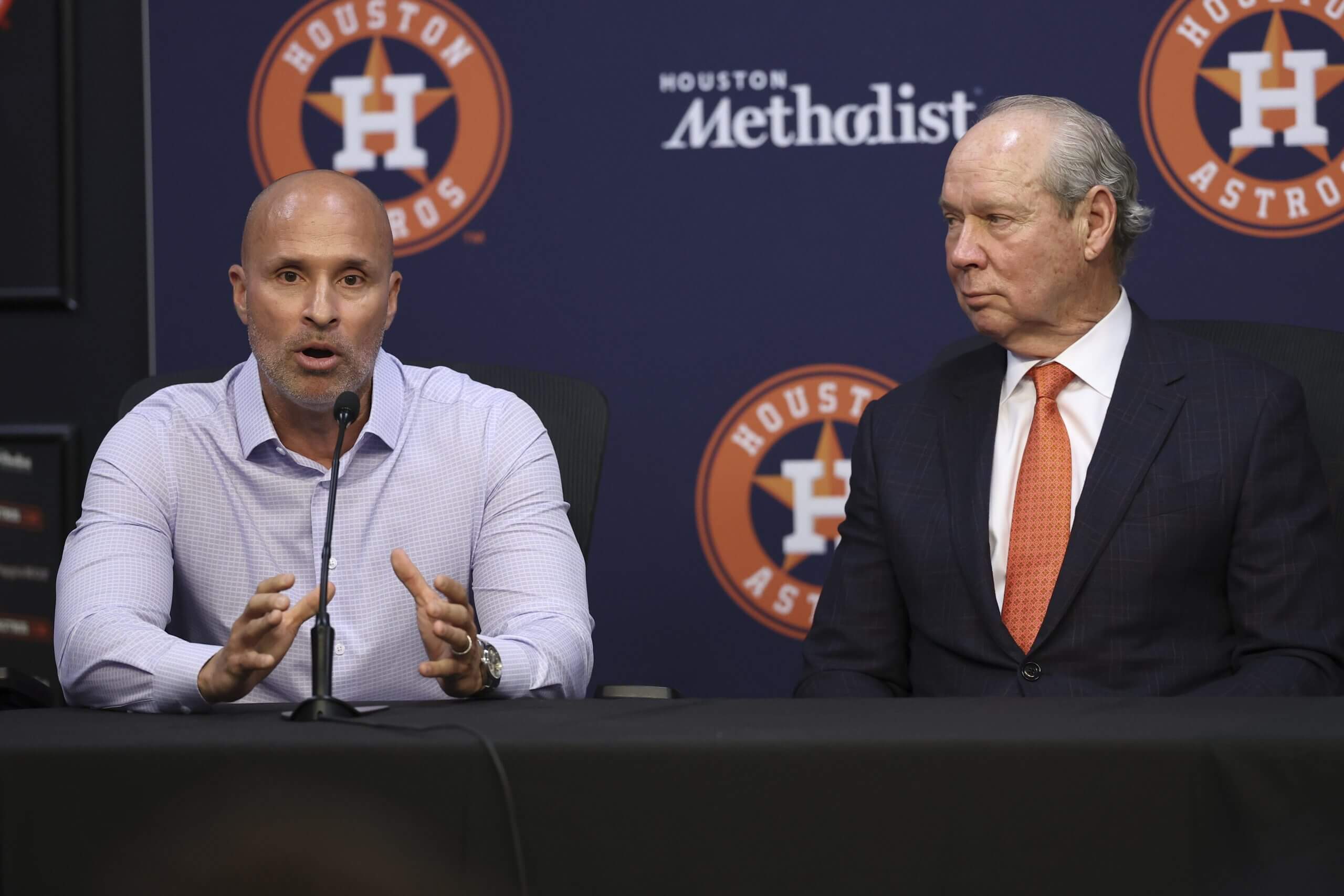
Joe Espada speaks during Tatsuya Imai’s introductory news conference, where Jim Crane said his team will focus on targeting more players from Asia. (Troy Taormina / Imagn Images)
For guidance, Espada said he intends to call players who’ve spent time in NPB and other major-league managers who’ve had Japanese pitchers come over. New York Mets manager Carlos Mendoza, one of Espada’s close friends, comes to mind as a potential sounding board. Los Angeles Dodgers manager Dave Roberts can offer obvious insight.
“I don’t have any history here in MLB. I almost feel like I have nothing to lose,” Imai said. “I just need to go out there and take it on as a challenge. I feel like my style of pitching — being aggressive, attacking hitters and going after these guys — is my best trait. I definitely want to keep that. And I look forward to showing the fans here in Houston my style of pitching.”
If he does, Imai could change the entire calculus of his career. The market for his services did not manifest as most predicted — The Athletic’s Tim Britton projected Imai would get an eight-year, $190 million contract — and, as a result, he accepted the sort of contract Crane is always willing to give. Pitch well, and he’ll price himself out of Crane’s comfort zone.
Including opt-outs after this season and next is out of character for Crane, but the owner acknowledged, “I guess that’s what it took to get it done.” Boras said, in part, that sometimes “you take a contract form that allows for observation and evaluation on both parties.”
Perhaps nothing better encapsulates this union between two parties few would’ve put together when the winter began. For Imai, Monday began a 10-month audition for the megadeal he sought this winter but could not get.
For the Astros, it can be likened to a soft launch of their renewed focus in Asia and the Pacific Rim. Even if they can only keep Imai for one season, it will provide proof of concept and — more importantly — publicity and a perception change in an area where the Astros want to devote more attention.
So, by itself, signing Imai is not evidence of the Astros’ newfound advancement into Asia. On one occasion, Crane even acknowledged the new infrastructure “probably didn’t have much to do with this one.”
“But,” he added, “it will have a lot to do moving forward.”