
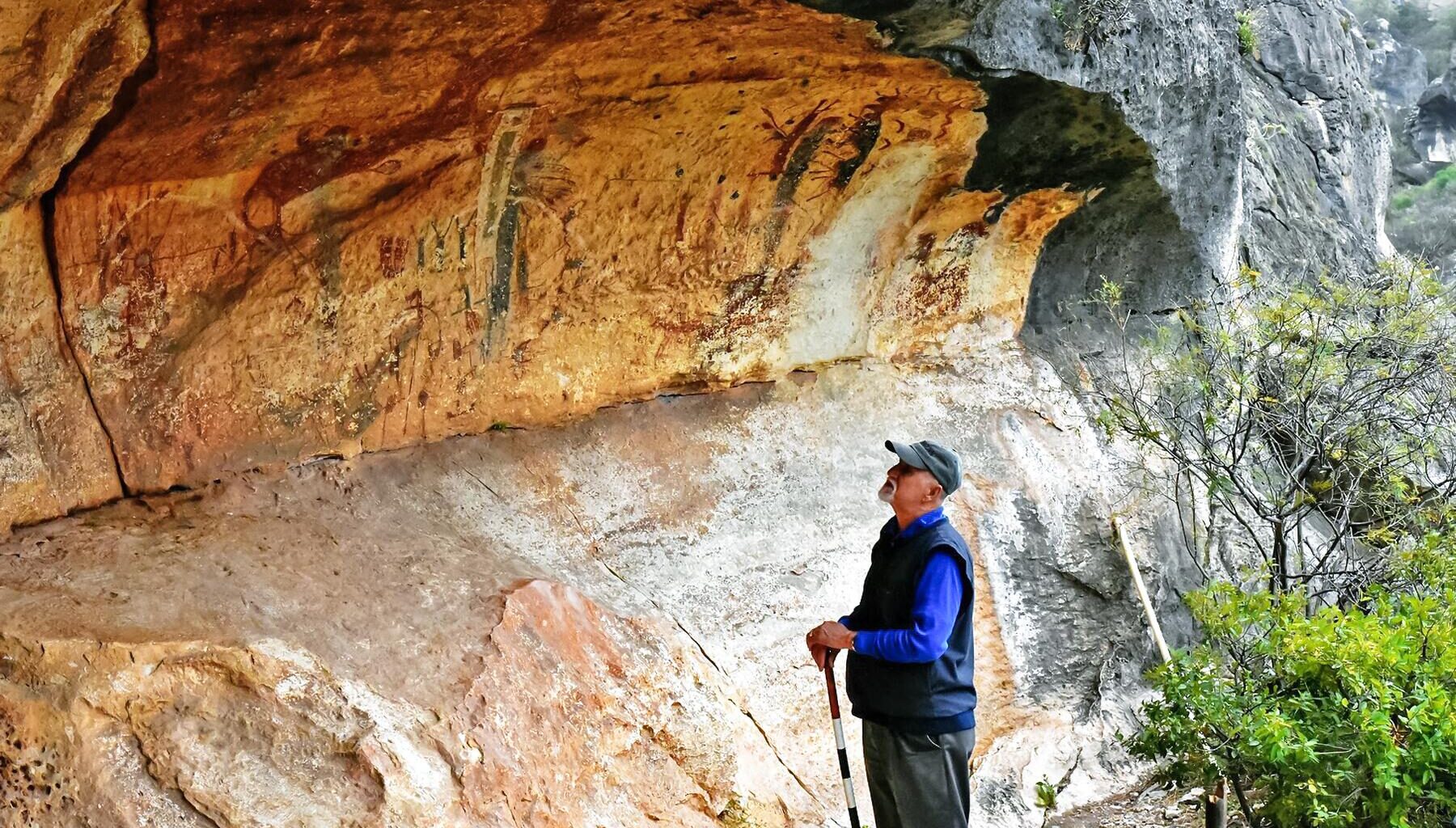
The White Shaman Preserve in the Lower Pecos Canyonlands showcases 4,000 years of Indigenous rock art—offering insight, mystery, and awe along the Texas-Mexico border.
Behind a dusty entrance off US-90, along the Texas-Mexico border, lies “one of the most significant archaeological sites in North America.” Most people, myself included, might assume visiting places with archaeological significance requires a passport and jet lag. However, it only took a six-hour drive west of my hometown of Houston and a required reservation (which you can make online) to visit the White Shaman Preserve.
Even as a lifelong Texan, the discovery of the Lower Pecos Canyonlands Archeological District, a National Historic Landmark, was a surprise. The Gulf Coast feels like the other side of the world compared to the desert terrain of the Chihuahuan Desert. I stumbled upon this gem when my reservation for another tour at the nearby state park was cancelled due to rain and I lucked into an open spot to see the incredibly well-preserved rock art.
Only available to those ages 12 and up, my husband and two kids dropped me off at the gate. Turns out it’s a good mile (or more) from the gate to start the walk, so thankfully my tour guide, Aimée Spana, director of the White Shaman Preserve, had space for me in her vehicle. Note to fellow travelers: make sure you have access to a car for the length of your tour.
Continue Reading Article After Our Video
Recommended Fodor’s Video
The line of cars slowly drove to the site, single file. Away from the highway and any other sign of modern life, it was easy to imagine the land as it was 6,000 years ago, before colonization, overgrazing from ranching, and floods eroded the land and the culture of the original inhabitants.
A Look into the Past
For 4,000 years, forager societies living in the Lower Pecos River painted murals with the same colors, figures, and themes. Sitting on a 400-acre natural wildlife habitat, White Shaman Preserve is a unique look into their past. The 1.5-mile hike to see the site begins at two bronzes cast by a forensic artist, perfectly preserving the mummified faces of people of the Pecos. The first showcases a shaman, who has since been reburied thanks to NAGPRA (Native American Graves Protection and Repatriation Act), and the strong visual remains especially striking against the arid landscape.
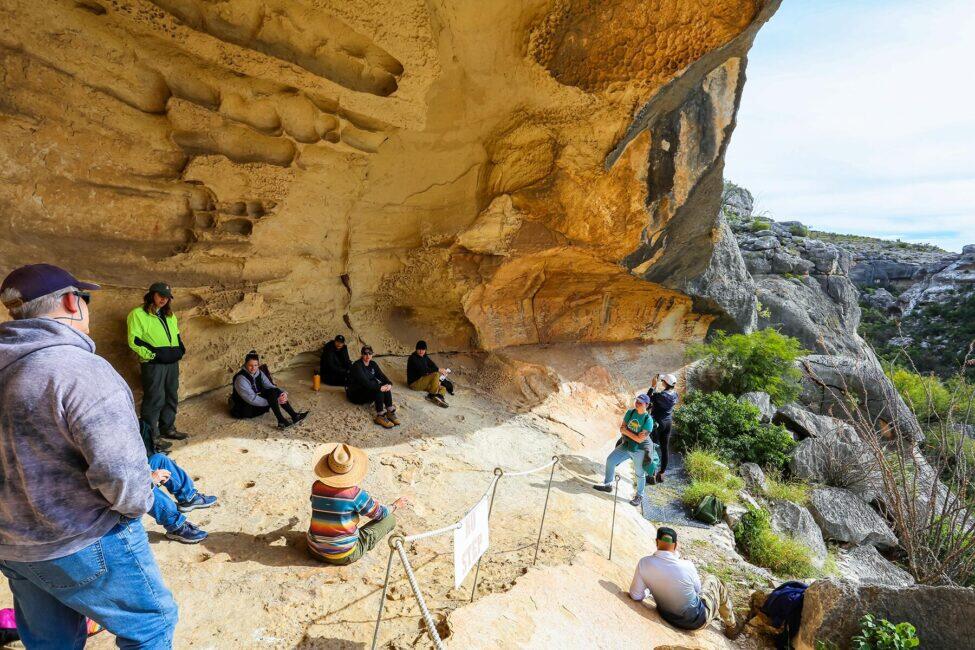
Defined as “very strenuous,” I was a little nervous about the hike, but for those who enjoy a nature walk, it was ideal. We lucked into a cloudy day. (The shadeless voyage might be less pleasant under the unrelenting sun.) As we trekked towards the namesake mural, we stopped to smell Mexican oregano and spotted an osprey flying overhead. In this distance is a stunning vista of the towering Pecos River Bridge. The last stretch requires the ascent (and later descent) of steep, narrow stairs. I cautiously took each step, anxious to preserve my knees. Once I got my bearings at the top, I faced the dizzying layering of imagery at the sacred site.
 Courtesy of Witte MuseumAncient Library
Intricately painted in the bowl of a shelter, the 26-foot-long and 13-foot-high rendering includes a towering caterpillar-like figure hovering above the namesake white shaman, a deer-like geometric anthropomorph. The image, comprised of the four distinct colors, black, red, yellow, and white, emblematic of the Pecos River style rock art, maintains remarkable clarity despite thousands of years in the elements. While science has been able to provide definitive dating and the reason behind the sturdy paint composition, its meaning remains a point of mystery.
Research from Dr. Carolyn Boyd and the Shumla Institute with Huichol elders has concluded that the story being told is a creation narrative. Others are unsure whether this site offers definitive wisdom about the origin of the universe. In 2022, Gary Perez, active in the Lipan Apache Native American Church, co-authored a paper with Eric A. Schroeder stating the sacred site is an ancient map of Texas, highlighting a peyote pilgrimage. Whatever the reason for this carefully orchestrated image, there is no question that it was intentional. At the winter solstice, the shadow cleaning demarcates (some might say decapitates) the White Shaman figure’s head.
The wonder at the mural seems to only grow the more people are able to see it. “Being in the presence of this ancient mural in the splendor of its natural landscape high above the Pecos River, with birds flying above, and the Serranías del Burro mountains off in the distance can be transformational. The mural never ceases to reveal itself. Every time you visit the site, especially during different seasons, you are certain to see something new or see something in a different way as light illuminates the mural,” Spana shared.
Embracing the Mystery
Tours are offered at 12:30 p.m. on Saturdays, September through May ($40 a person), drawing visitors with interests as diverse as the flora and fauna around them. Geologists, art historians, birders, and those of us who defy any categorization. Other visitors had questions based on extensive knowledge. I came with no preconceived notions or expectations and left gently lifting my jaw off the dusty floor. My fellow travelers, many returning, asked me what I thought. The trite saying, “I have no words,” never felt more appropriate. It was more than I could process in a single sitting.
Thankfully, I had another opportunity to visit the site when I joined the Witte’s annual Rock Art Rendezvous, the only weekend of the year visitors are allowed to camp in White Shaman Preserve, and includes the opportunity to trek to other rock art in the region, including exclusive tours to pieces preserved on private land. The second visit brought new appreciation but no more insight. I was okay with that.
“I think our society thinks we have to know and we have to understand everything, and we don’t have to know. We don’t have to understand everything.” Eddie Reyes, volunteer with the Witte Museum, reflected on my first tour. I could not agree more. I too was moved by the mystery.