
Justin Doud/Houston Public Media
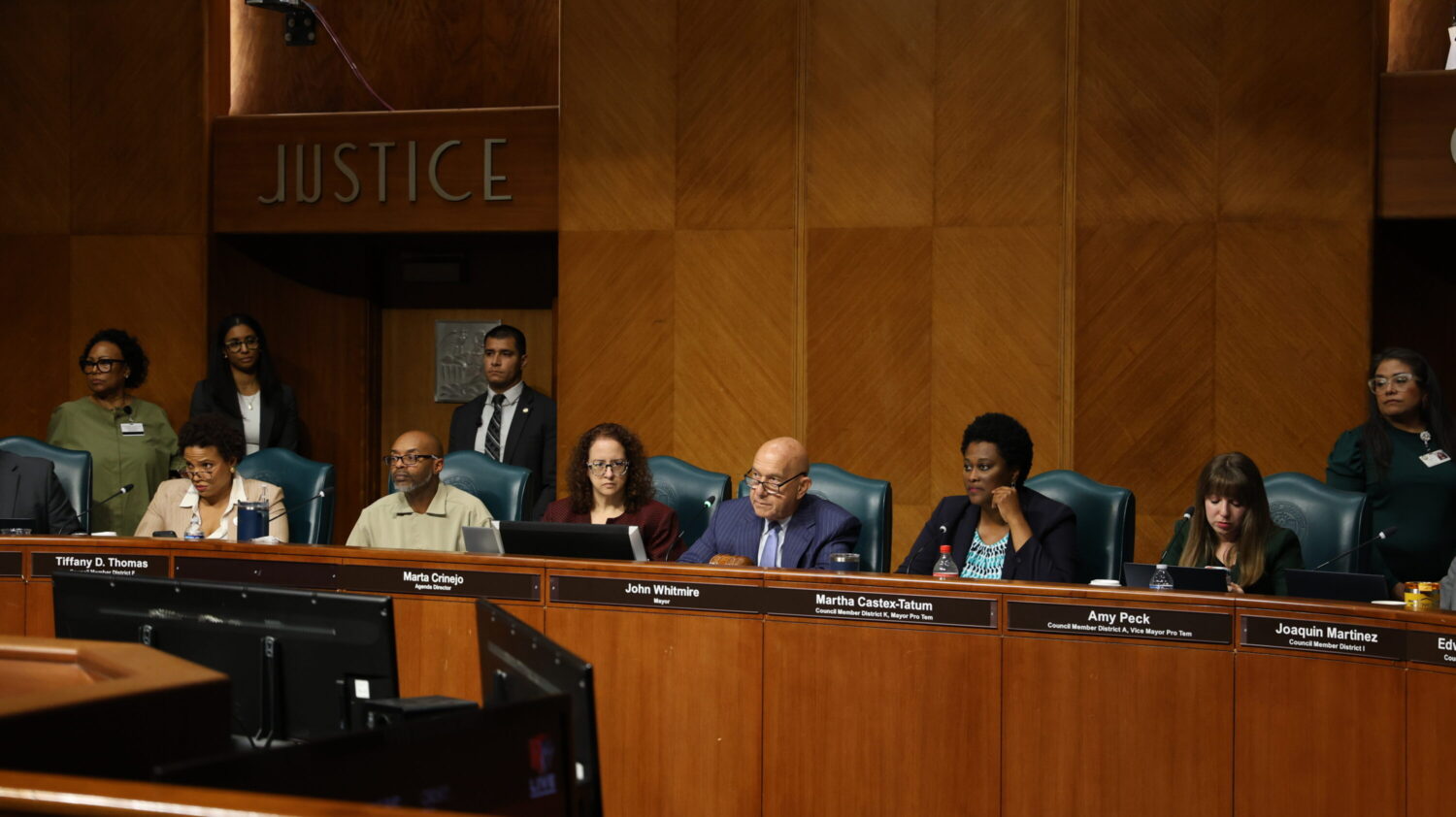
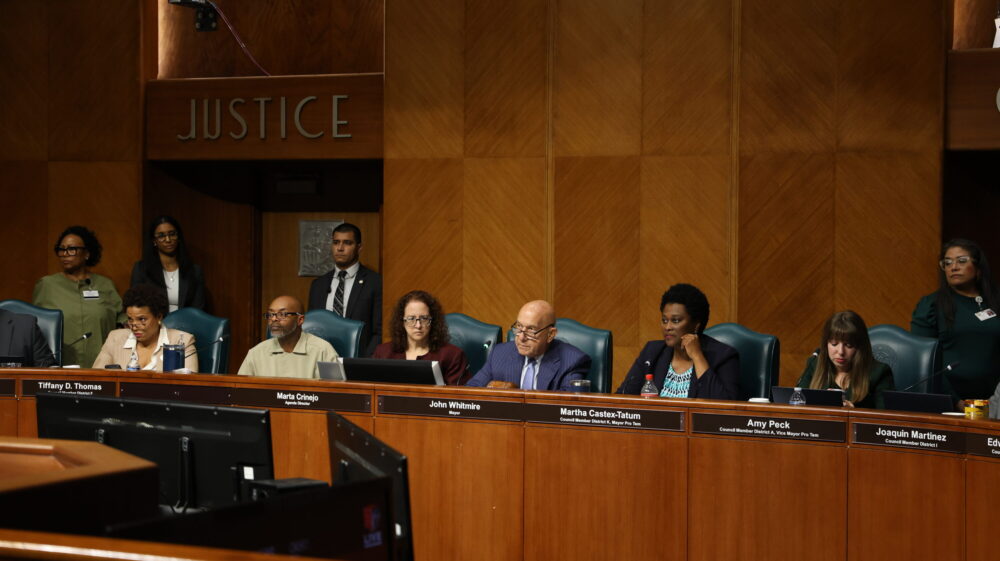
Pictured are Mayor John Whitmire and members of the Houston City Council on June 4, 2025.
A divided city council approved a proposal to use $30 million in stormwater mitigation funds to demolish blighted buildings on Wednesday, after Houston Mayor John Whitmire and City Controller Chris Hollins clashed over the measure.
“This is not a disagreement about whether blighted and dangerous buildings are a problem in Houston — they are,” Hollins, the city’s elected financial official, told council members before the vote. “This is about whether the city is legally permitted to spend $30 million dollars from a restricted stormwater fund to demolish buildings — and the answer is no.”
After Hollins’ remarks, Whitmire said city council members “just witnessed the controller abuse my generosity of allowing him to do personal privileges” during his monthly financial reports, which are intended to focus on the city’s current and projected fiscal situation. He accused Hollins of taking up “politics and clickbait and all the misinformation that we just heard.”
Sign up for the Hello, Houston! daily newsletter to get local reports like this delivered directly to your inbox.
According to Houston Public Works officials, there are more than 2,300 blighted buildings in line for demolition across Houston. An unclear number of them are near stormwater infrastructure — like open ditches or drainage pipes — and the public works department argues related illegal dumping and debris runoff create obstructions in the stormwater system.
During a presentation to the city council’s budget and fiscal affairs committee on Tuesday, Houston Public Works director Randy Macchi said the department is developing a “flow chart” that will help inspectors determine whether a direct connection exists between blighted buildings and stormwater obstructions.
According to a message sent by Whitmire’s office to city council members on Tuesday, blighted buildings will be eligible for demolition using stormwater funds if they meet one or more of the following criteria:
Building is within the 100-year or 500-year flood plain
Building is adjacent to inlets, ditches, channels or outfalls
There is a severe impediment to drainage based on runoff impacts or loose debris generation
The building is in an existing drainage-influenced area identified by the public works department’s Transportation & Drainage Operations team
Council member Abbie Kamin argued the criteria represent a “massive catch all” due to the widespread prevalence of those factors among properties in Houston.
According to Whitmire’s office, public works inspectors would need to document that demolition will:
Improve drainage conveyance or capacity
Reduce runoff, erosion or sediment loading
Reduce localized flood risk
The stormwater fund, which draws primarily from water and wastewater fees, stands at a record level this year — $166 million, compared to about $100 million last year and less than $80 million the year before.
The stormwater budget approved by the city council in June referenced a $25 million program “to fund the demolition of dangerous buildings.” The budget also called for nearly $90 million for maintenance of infrastructure, like storm sewers and roadside ditches, along with more than $40 million in debt service.
When the city demolishes blighted buildings, it places a lien on the property in an effort to recoup project costs from the property owner.
The city council delayed the demolition program when it first appeared on the agenda in December, after Hollins raised the spectre of litigation. He pointed to the city’s defeat in a lawsuit over a separate streets and drainage fund. The plaintiffs successfully made the case that the city illegally shortchanged the voter-mandated fund for flood mitigation.
After Whitmire’s administration reached a settlement to gradually ramp up the city’s full contribution to that fund over time, activists with the Northeast Action Collective and West Street Recovery filed an unsuccessful legal measure against the agreement. They likewise opposed the demolition program approved on Wednesday.
West Street Recovery co-director Alice Liu said the groups are “prepared to explore all of our legal options.”
“If it’s not illegal, it surely is immoral,” Northeast Action Collective member Daena Jones said. “Because we are flooding and we’re suffering. It’s the constituents who are suffering, not the people that’s making the decision.”
City attorney Arturo Michel said he’s “confident” the demolition program is allowed under Houston’s municipal charter and would survive a court challenge.
The measure passed Wednesday in a 9-7 vote, with council members Kamin, Edward Pollard, Sallie Alcorn, Tiffany Thomas, Mario Castillo, Julian Ramirez and Alejandra Salinas voting against the measure.
“I want every bit of money … in the stormwater fund spent on clear infrastructure maintenance and improvements, and to me, it’s just too much of a stretch to use that money for building demolition,” said Alcorn, chair of the budget and fiscal affairs committee.
It was the first meeting and roll call vote for Salinas, who won a special election in December to replace Letitia Plummer, an at-large council member who stepped down to run for Harris County judge.
“I echo Sallie Alcorn’s concerns and comments, but I agree with the mayor that this is an incredibly important issue, and I look forward to working with him to tackle it together,” Salinas told Houston Public Media after the vote.
Council member Fred Flickinger, who supported the program, acknowledged it was “a stretch as far as the use of these funds — but I don’t think it’s beyond the stretch of being reasonable.”