
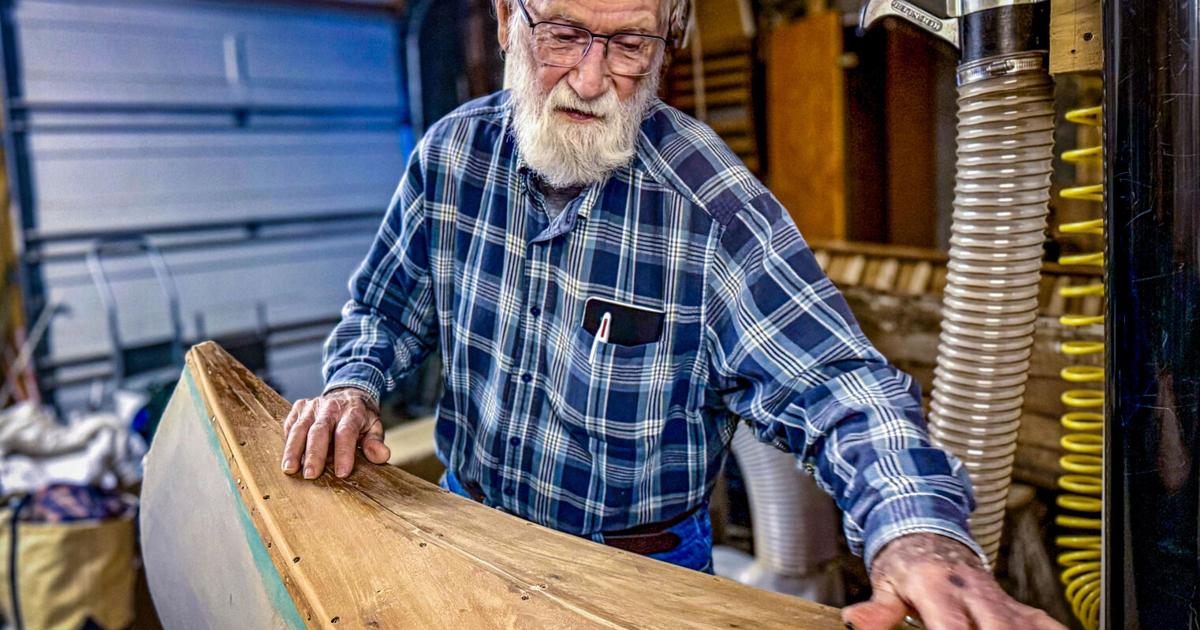
Dave Houston has spent a lifetime restoring things other people might replace. His career with the U.S. Forest Service focused on tree pathology, understanding the complex networks of causes that damage forests. His hobby has been restoring wooden canoes—he’s brought between 50 and 60 back to life over the years. And for the last 20 years, he’s been leading the effort to preserve Greenbanks Hollow, an industrial village along Joe’s Brook in Danville that burned to the ground in 1885 and spent nearly a century being reclaimed by the forest.
“I try very hard to restore old material and maintain it,” Houston says.
The philosophy runs through everything. Eighteen years ago, Terry Hoffer profiled Houston’s canoe work for the The North Star Monthly, he explained why he’d rather repair than replace: “Age represents history, a legacy and a degree of character that no new materials or modern techniques can provide.” He was talking about a 17-foot Kingsbury canoe he was restoring in his basement.
Eighteen years have passed since that interview, but recently the scene felt familiar. The Kingsbury canoe remains unfinished, and Houston, now 93, still talks about it with the same deliberate care and passion. He’s soft-spoken. His words carry weight and he doesn’t waste any of them.
But right now, those same hands that have restored dozens of canoes are trying to save something larger: a crumbling stone wall—all that remains of a building that never opened, burned before it processed its first load of wool. Now, it’s eroding a little more each spring into Joe’s Brook.
What Was Lost
Picture Danville in 1880. Sheep country. Most of the forest you see around here wasn’t there—it had been clear-cut for pasture. Benjamin Greenbank owned not just the five-story woolen mill on Joe’s Brook, but the fulling mill, the gristmill, the sawmill, the store, the post office, and most of the houses where his 45 workers lived with their families. The mill produced 700 yards of cloth daily. Twenty-five families depended on it directly, and dozens of sheep farmers supplied the wool.
Close
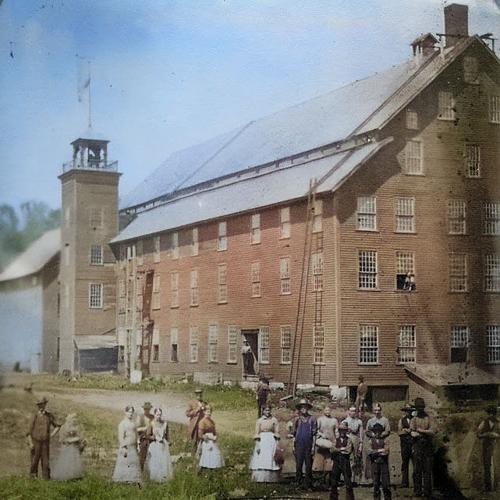
Benjamin Greenbank’s five-story woolen mill in Danville, Vermont, circa 1885, shortly before the devastating fire on December 14, 1885 that destroyed the entire industrial village of Greenbanks Hollow. The mill produced 700 yards of cloth daily and employed 45 workers before burning to the ground.
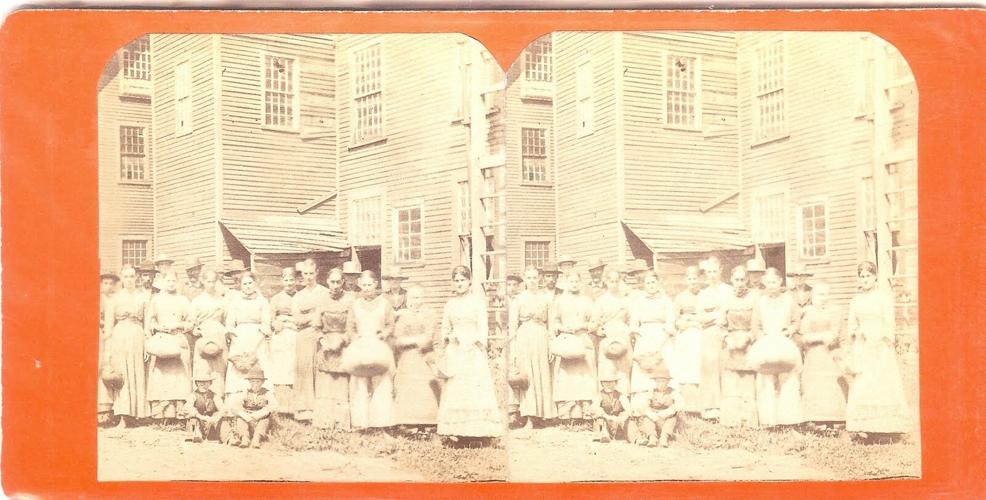
2010.14.21 Workers at Greenbanks Mill, South Danville, 1885
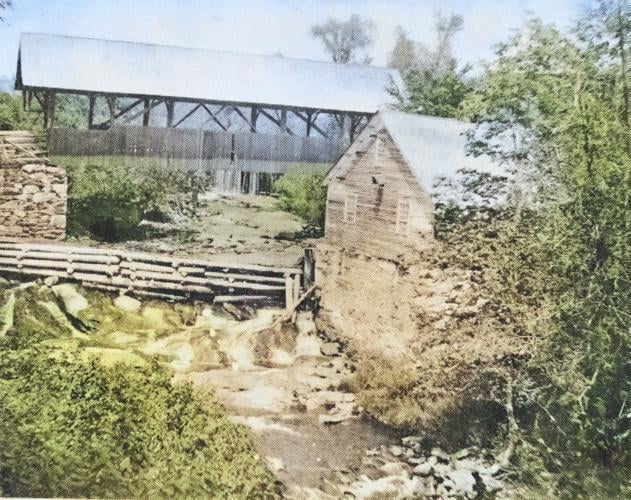
The fulling mill was Greenbank’s newest venture, built with iron-clad walls because the work of processing raw wool was so dusty it posed a constant fire hazard. The building was nearly ready in December 1885—machines installed, just about to be insured, days away from opening.
Then, on Dec. 14, the main woolen mill caught fire.
In two hours, everything was gone. The five-story mill. The store. The post office. The covered bridge that connected the hollow to the rest of Danville. Several houses. And the fulling mill, destroyed by embers before it ever processed a single load of wool.
The most disastrous fire that ever happened in Danville was the burning of the woolen mill, store building, two-story dwelling house, barn, etc., belonging to Benjamin Greenbank, which were totally destroyed last Monday night, December 14th.
“When that mill burned, all the people who were working in that mill had no jobs,” Houston says. “So they dissipated. Some of those were local people, but a lot of them were people who came and settled in places.”
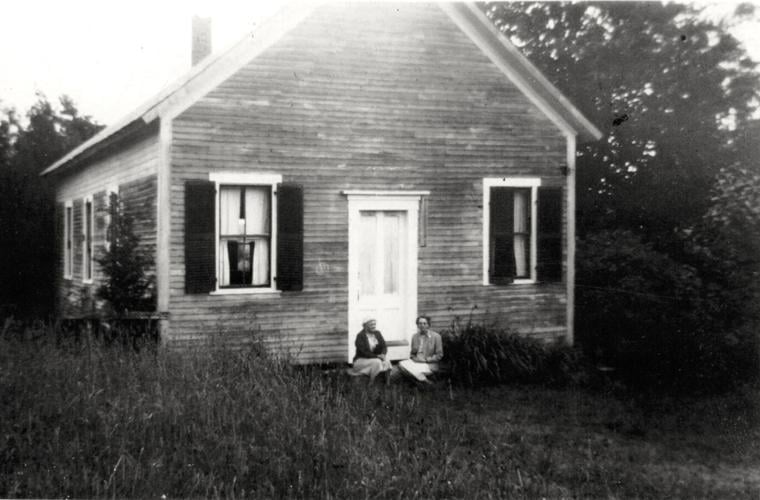
Greenbank didn’t rebuild. He moved his operations to Enfield, N.H., where a railroad spur gave him better access to markets. The workers left. A few buildings were reconstructed—the store operated for a while, the gristmill continued—but the community never recovered. The school limped along until June 1912, and then that closed too.
The economics were working against them anyway. Congress had repealed wool tariffs in 1846, three years before Greenbank even bought the mill. The industry was already in decline. The fire was just the final blow.
For 92 years—from 1912 to 2004—the forest took it all back.
The Partnership
Houston had known Hollis Prior from forestry conferences years before either could have guessed they’d end up working together. Houston had a Ph.D. from the University of Wisconsin and spent his career with the U.S. Forest Service doing research throughout New England, based in Connecticut. Prior, a Danville resident, worked for state forestry groups. They were colleagues who understood trees and the complex networks of causes that affect them.
Houston moved to Danville without even knowing Prior lived here.

Dave Houston (foreground) and Hollis Prior work together on trail construction at Greenbanks Hollow Historic Park in Danville, Vermont. The two former forestry colleagues began restoring the abandoned industrial village site in May 2005, leading Sunday evening work parties that cleared 11 historic mill foundations and built three trail systems over 18 years of partnership before Prior’s death in 2023.
In 2004, local historian David Warden donated five acres of Greenbanks Hollow to the Danville Historical Society. Warden had played there as a kid and later purchased and restored the Lowell House—the oldest house in Danville—which now sits across from the historic site and is owned by Patricia and Michael Hogue.
The Historical Society couldn’t afford the property taxes on the donated land. The town agreed to take ownership with one condition: the Historical Society would maintain and develop it as a historic site.
The historic Lowell House in Danville, Vermont, the oldest house in town, sits across from Greenbanks Hollow Historic Park. Local historian David Warden purchased and restored the Lowell House before donating five acres of the former industrial village site to the Danville Historical Society in 2004. The property is now owned by Patricia and Michael Hogue.
Houston and Prior started work in May 2005 with Sunday evening work parties. Houston was in his early 70s then. Prior’s wife Mary “really got everything going and hopping on this thing,” Houston says. “So we owe a lot to her.”
“When I came, no foundations were visible,” Houston says. “Everything was grown in, all grown in with trees. Woods had retaken, woods have taken over.”
The two men worked well together, taking their time. “Hollis and I had fun because we didn’t have to do it all at once. It wasn’t a rush job,” Houston says. “So we were given time to do it carefully and thoughtfully and get other people involved in it over time.”
What They Built
The schoolhouse still stood but was too far gone. Houston measured it up, documented the windows and doors, brought in Sally Fishburn to evaluate whether it could be saved.
“Could we restore it?” he asked her. “Give me a really honest opinion.”
Picasa
Historic site map of Greenbanks Hollow Park in Danville, Vermont, showing the locations of mill foundations, residences, and nature trails restored by volunteers led by Dave Houston since 2005. The map details Benjamin Greenbank’s industrial complex including the woolen mill, fulling mill, gristmill, sawmill, and worker housing along Joe’s Brook.
“I wouldn’t try to do that,” Fishburn told him. “It would be horribly expensive, rebuilding the whole new school.”
Houston asked Danville resident Darren Calkins to remove it. He thought it would take a while, planned to photograph the demolition, grab a few remnants. “I came back the next day, it was gone,” Houston says.
They cleared 11 historic sites—the foundations of Benjamin Greenbank’s five-story woolen mill, several of his houses, the store and post office, other residences, the gristmill and sawmill. They built three trail systems: a moderate path with steps and switchbacks traversing steep slopes, a bottomland loop through cedars with boardwalk bridges, and a spur trail with a sitting bench. When Cecil Lyon donated additional land that consolidated boundaries and added acreage along the brook, the nature trails could expand further.
Picasa
Houston built trail signs and wrote brochures explaining what visitors were seeing. The town crew installed an informative kiosk in the schoolhouse foundation. In 2017, they put up a visitor sign-in log box that now holds nine years of records.
How many volunteers have been involved over the years? “Oh my god, probably over 100,” Houston says.
There’s a core group of regular volunteers, and others from the community who help as needed. Houston maintains an email list he calls “the Greenbanks Hollow Group” for coordinating work days several times a year. Three annual fundraising events help sustain the work: the Ken-Ducky Derby Race in August and a Bean Hole Dinner in September each draw about 100 people, and an annual burn in January commemorates the 1885 fire with hot dogs, s’mores and cider for 80 or more. Combined, they bring in about $5,000 a year for maintenance.
The site they brought back into visibility has deep historical roots beyond the mills. Thaddeus Stevens, who would become an influential Pennsylvania congressman involved in post-Civil War constitutional amendments, was born in Greenbanks Hollow in 1792. The covered bridge, placed on the National Historical Registry in 1974, was restored in the early 2000s with federal funding. The hollow wasn’t just a footnote in Danville’s history—it had been the town’s largest manufacturing complex, and one of its native sons had helped reshape the nation and abolish slavery.
Loss and Continuity
Mary Prior died in 2010. The work continued. Then, in 2023, Hollis Prior died and the partnership that had shaped Greenbanks Hollow’s resurrection for 18 years was over.
But Houston kept going. At 91, having lost the co-chair who’d worked beside him since the beginning, he continued coordinating volunteers, planning improvements, maintaining what they’d built together.
Now the site draws visitors year-round. People stop because they discovered it on back roads, or because they’ve heard about it. They walk the trails, have picnics by the brook, take wedding photos. The visitor log records their thoughts. “This is our third time back,” some write.
“The sound of the brook really draws people because it’s beautiful,” Prior said in a 2017 video. “And during the summertime, you can sit there and just dream.”
Saving the Wall
One wall of the fulling mill still stands, right along Joe’s Brook where the ice and water hit it hardest every spring.
“Each year, you can kind of see a hunk comes out, it gets a little weaker,” Houston says. The back side is “beginning to come apart.” Two large trees are growing through gaps in the stone.
In August 2022, the Preservation Trust of Vermont and the Freeman Foundation awarded a $25,000 grant to the town of Danville to stabilize it, with one condition: repairs had to be done in partnership with the Danville Vermont Historical Society.
The crumbling stone wall of Greenbanks Hollow’s fulling mill along Joe’s Brook in Danville, Vermont, showing winter ice damage and erosion. This wall is the last standing remnant of the 1885 fire that destroyed Benjamin Greenbank’s industrial village. A $25,000 preservation grant aims to stabilize the historic structure before spring floods cause further damage.
Then came the complications. The wall sits on property owned by Patricia and Michael Hogue. The Hogues were willing to donate it—their deed required them to maintain the wall, and he was happy to be relieved of that responsibility—but a property line adjustment was needed. Which required a permits, surveys and legal documents.
The property line adjustment was finally completed in October 2025. Three years after the grant was awarded.
Now Houston is getting repair estimates. The traditional approach would cost hundreds of thousands of dollars—take the wall down stone by stone, label each piece, reconstruct it with stabilization, somehow get a crane into nearly impossible terrain. Houston has a different idea: build a cement wall behind the existing wall, infiltrate from behind with rebar, stabilize the base where the ice hits hardest. Similar to a barn foundation he built in Massachusetts years ago. It’ll need approval from the Vermont Division for Historic Preservation.
Houston says it’s likely that repairs will exceed the amount of the grant so they will need to seek additional funding. The goal is to begin work in spring 2026, before another season of ice blocks and rushing water takes its toll.
“The value of the wall is purely as a historic piece,” Houston says. It’s the remnant of a building that never opened, that burned from embers before it ever processed wool, that represented Greenbank’s attempt to fireproof his operation with iron cladding that ultimately didn’t matter. It’s the only physical evidence of what might have been.
After 20 years of bringing the hollow’s history back into visibility, Houston is working to save one last piece before it tumbles into the brook.
What Endures
The Kingsbury canoe is still in Houston’s basement, waiting. “I’ve had people cry when they saw it,” Houston told Hoffer in 2007, talking about other restorations he’d completed. “You make people very happy when you do their boats.”
Dave Houston examines a vintage Kingsbury canoe in his Danville, Vermont workshop. The 17-foot canoe with mahogany decks and cedar planking has been waiting for restoration in Houston’s basement for 18 years, while he focuses on preserving Greenbanks Hollow’s crumbling fulling mill wall.
The same reverence he has for damaged wood, he has for crumbling foundations. The same patience.
He started the Greenbanks Hollow project in his early 70s and now he’s planning the next phase, still coordinating volunteers, still figuring out how to save an eroding wall with insufficient funding and spring coming.
Close-up of Dave Houston’s hands working on wooden canoe restoration in Danville, Vermont. The 93-year-old preservationist believes in saving old materials rather than replacing them, a philosophy he applies to both antique canoes and historic mill foundations at Greenbanks Hollow.
Who comes next is an open question. There’s a core group of volunteers, but Houston has provided much of the organizational knowledge, the vision, the steady hand that’s guided the work for two decades.
The fulling mill wall still stands. Spring will come, bringing ice and water and another year of erosion. And Dave Houston will be there, figuring out how to save it, the same way he’s been figuring out how to save things—trees, canoes, foundations, history—for as long as anyone can remember.