
There’s never a dull day in the transfer portal.
The Demond Williams saga seemingly concluded Thursday, at least as far as the portal is concerned, when the Washington quarterback announced that he intends to return for the 2026 season.
It was just 48 hours earlier that Williams publicly said he intended to enter the portal, despite the fact he signed a contract to return to the school in 2026 just days earlier.
When the news of Williams’ potential departure broke, Arizona State transfer quarterback Sam Leavitt was on an official visit to LSU. But heavy speculation swirled around LSU being the potential landing spot for Williams if he were to leave.
We’re now a full week into the portal, and new LSU coach Lane Kiffin has yet to land his transfer quarterback. In addition to Leavitt, the Tigers hosted Cincinnati transfer Brendan Sorsby for a visit over the weekend, but Sorsby signed with Texas Tech.
Now that Williams is staying put, where does LSU go from here at quarterback? Let’s look at the available options, along with their current spot in The Athletic’s transfer quarterback rankings.
(Note: The last day a player can enter the portal is next Friday, but there is no deadline for when a player has to pick his new school.)
No. 2 Sam Leavitt: Leavitt and LSU coming together would still make sense. Leavitt would fit well in Kiffin’s offense, and he’s one of the most talented quarterbacks in the country. But Leavitt left LSU without sealing the deal and took an official visit to Tennessee on Wednesday. According to On3, that visit was extended to Friday morning. If the Vols end up landing Leavitt, LSU will have to pivot quickly.
Lane Kiffin to Sam Leavitt outside the Tennessee football complex pic.twitter.com/r9bP2gopKl
— Mark Nagi (@MarkNagi) January 9, 2026
No. 7 Dylan Raiola: Things have been eerily quiet regarding the Nebraska transfer. He has a big frame (6 feet 3, 230 pounds) and a big arm, but he’s not very mobile and had a tendency to hold the ball too long last season. He was productive, throwing for 4,819 yards and 31 touchdowns in the last two seasons, and led the Cornhuskers to back-to-back bowls after a seven-year drought, but he’s also coming off a broken fibula. His lack of mobility would make him a tough fit in Kiffin’s offense.
No. 11 Beau Pribula: Pribula visited Washington after Williams initially announced his departure, but now that Williams is back, that won’t be a landing spot. Pribula had an up-and-down season at Missouri, throwing for 1,941 yards and 11 touchdowns with nine interceptions. He had a good completion rate (67 percent), and he’s mobile, having rushed for 297 yards and six scores. His SEC experience helps, too. He just doesn’t have as high a ceiling as the quarterbacks LSU has targeted thus far.
Unproven options: There are some very talented young quarterbacks available who just need starting reps. Auburn’s Deuce Knight, the No. 13 quarterback in the portal, looked good in his lone start for the Tigers last year against Mercer. He’s a dynamic runner, but he has a lot of development ahead of him as a passer. And he has taken just 62 snaps so far.
USC freshman quarterback Husan Longstreet, who announced Thursday night that he’s entering the portal, is an intriguing possibility. The 2025 five-star recruit is a dual threat but a much more natural passer who has elite arm talent and can make highlight throws. He’s a tremendous talent, but is he ready to be an opening-night starter in the SEC? He has just 44 snaps to his name, so it might be tough for LSU to hitch its CFP hopes to someone that young.
Poach a guy: If Leavitt lands elsewhere and none of these other options are appealing, perhaps LSU simply tries to poach a sitting quarterback from another program. It would likely have to be someone outside the Big Ten, given how the Williams situation unfolded and how Big Ten contracts are structured (if the school pays a player’s buyout, it counts toward the school’s revenue-sharing cap for the upcoming season).
Lagway finds a home
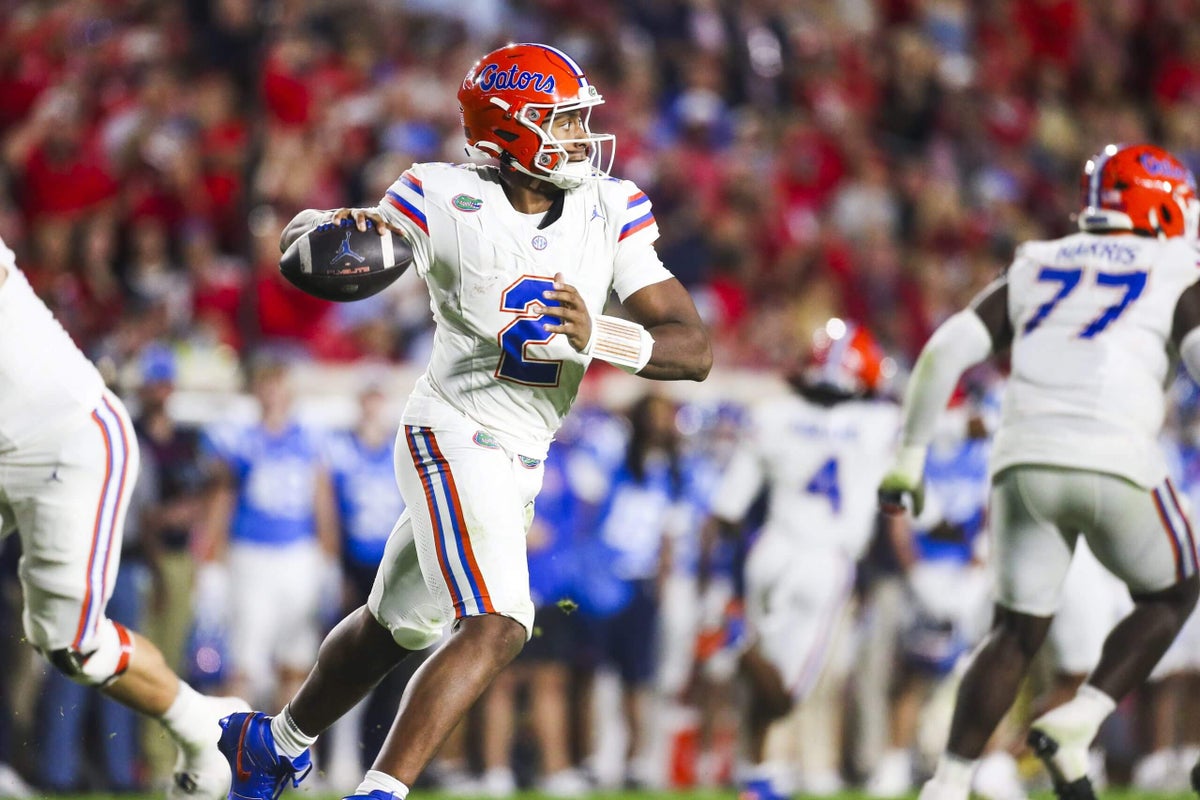
Two years after signing with Florida as one of the top recruits in the Class of 2024, quarterback DJ Lagway is returning to his home state. The former five-star prospect is set to enroll at Baylor, the alma mater of his father, Derek, a running back for the Bears from 1997 to 2001.
Can Lagway help revive the struggling program and save Dave Aranda’s job in the process? The 2026 season is make-or-break for Aranda, who’s going into his seventh year at the school and is 36-37, with three losing seasons in the last four years. School president Linda Livingstone announced in November that she would retain Aranda for 2026 amid an athletic director change.
Lagway must take several steps forward to become the player scouts thought he would be when he was such a coveted prospect coming out of Willis, Texas. His physical ability is still unquestioned, from his size and strength to his elite arm talent. But injuries nagged him during his two-year Gators career, and when healthy, he was far too inconsistent.
“He’s a slow processor on tape,” said a Power 4 offensive coordinator who was high on Lagway before this season.
Joining forces with offensive coordinator Jake Spavital, who has a long history of working with successful quarterbacks, should help Lagway immensely. Spavital just helped develop Sawyer Robertson into one of the nation’s most productive quarterbacks. He also worked with Fernando Mendoza and Davis Webb at Cal, Will Grier and Geno Smith at West Virginia and Johnny Manziel at Texas A&M. Don’t be surprised if Lagway turns into a 3,000-yard passer for Baylor. Since 2011, every Power 4 starting quarterback who has made 11 starts in a season with Spavital as his offensive coordinator and/or quarterbacks coach has surpassed 3,000 passing yards that season.
Horns add key RB
Texas filled a major need Thursday when it landed a commitment from Arizona State transfer running back Raleek Brown. The Longhorns had been looking to upgrade at the position after enduring their first season without a 1,000-yard rusher in the Steve Sarkisian era and losing running backs Quintrevion Wisner, CJ Baxter and Jerrick Gibson to the portal.
Brown, who began his career at USC, rushed for 1,141 yards and caught 34 passes for 239 yards in 2025.
Getting the running game back to the standard it was in Sarkisian’s first four years on the Forty Acres is vital. The Longhorns struggled to run the ball for the bulk of SEC play, averaging 93.1 yards per game against conference opponents. And that number was boosted by a 218-yard effort in the regular-season finale against Texas A&M. In the Longhorns’ other seven SEC games, they averaged a meager 75.3 rushing yards and just 2.7 yards per rush.
Sarkisian’s offense heavily utilizes play-action passing, and that becomes a lot less effective when the running game is lacking. And it makes it easier for opponents to pressure the quarterback, which Arch Manning endured plenty of last season (Manning was the 12th-most pressured QB in the Power 4 in the 2025 season).
The Longhorns have also filled a few other needs by picking up Rutgers cornerback Bo Mascoe, Michigan State tight end Michael Masunas and a pair of defensive linemen, Ian Geffrard (Arkansas) and Zion Williams (LSU). Getting safety Derek Williams back — he entered the portal last week but withdrew this week — was also helpful for new coordinator Will Muschamp’s defense. But there’s still work to be done after 21 scholarship players entered the portal since it opened.
The Longhorns are still in the race for Auburn receiver Cam Coleman, the top transfer available. Landing Coleman would be a welcome splash and give Manning a valuable weapon to work with in 2026.
UCLA’s makeover
UCLA coach Bob Chesney has brought seven players with him from James Madison, but none more significant than running back Wayne Knight, who committed to Chesney and the Bruins on Wednesday.
Knight rushed for 1,373 yards this season, which ranked seventh nationally, and nine touchdowns. He rushed for 212 yards in the Sun Belt Championship Game against Troy and 110 yards in the Dukes’ first-round Playoff loss to Oregon.
UCLA needs a major talent infusion, and Chesney is building an intriguing transfer class. On the offensive line, he’s brought in experienced players such as guard Riley Robell (James Madison) and tackle Hall Schmidt (Boise State). Wide receiver Leland Smith posted solid numbers at San Jose State this past season (43 receptions, 688 yards, three touchdowns), while Landon Ellis led James Madison with 624 receiving yards.
Iowa State safety transfer Ta’Shawn James recorded 33 tackles and five pass breakups in 2025, and Cal edge rusher Ryan McCulloch has some potential if he can stay healthy.
It’s unclear how high Chesney will be able to raise the Bruins’ talent ceiling, but at the very least, he should be able to raise the floor of the roster.
ASU building around new QB
Arizona State lost Leavitt, but it’s been adding solid pieces to help build up the passing game. The Sun Devils landed a commitment from Boston College receiver Reed Harris, who posted 673 receiving yards this season with inconsistent quarterback play. They’ve also added Colorado transfer Omarion Miller, who caught 45 passes for 808 yards and eight touchdowns in 2025, and Washington receiver Raiden Vines-Bright, who is a promising young player.
That’s a solid receiver unit for Kentucky transfer quarterback Cutter Boley, who many assume will jump into the starting role. Arizona State also added Michigan quarterback transfer Mikey Keene, a former starter at Fresno State.