
Happy new year! We followed tradition and ate our black-eyed peas New Year’s Day for good luck. Besides, I enjoy black-eyed peas and cornbread. It always reminds me of summers spent shelling them on the front porch with my sisters. Of course, we tried to do more snaps, but momma never let us get away with that. Daddy gave the neighbors the fruits of our labor. I realize now, Daddy was teaching us a valuable lesson on being generous to our neighbors.
We certainly could use some good luck with rainfall. The forecast isn’t looking very positive. Thankfully, the heavy fog is helping keeping the moisture level in the ground stable. I’m doing my part by putting out compost and mulch to keep the moisture in the soil stable.
While driving in the countryside, I noticed the bright yellow blooms of wildflowers along the roadsides. Even during a drought, Mother Nature will provide beauty. Wildflowers have evolved over a millennium, adapting to the vagaries of our weather conditions. This highlights the importance of using native plants in your landscape.
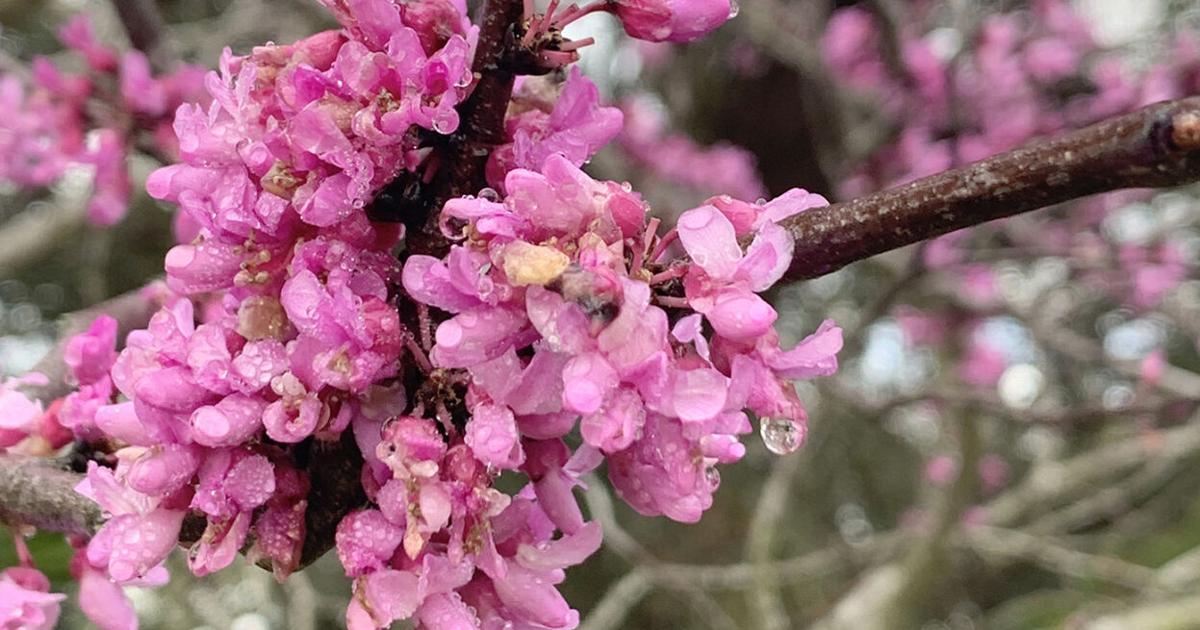
Our native redbuds are a perfect example of using natives in the landscape. Be sure to select a Texas or Mexican Redbud in order to have success in the garden. The Eastern Redbud does well in East Texas where the soil is acidic but will not thrive in our alkaline soil.
Redbuds, classic spring bloomers, are putting on an explosion of color. Come spring, their bare branches transform into rich purple flowers, developing leaf buds soon to open into glossy heart-shaped foliage.
Redbud legumes, which appear in late spring, provide food for numerous bird species. Redbuds are also the caterpillar host plant for a gossamer-winged butterfly, Henry’s elfin (Collophrys henrici).
Mankind has found many uses for all parts of the tree. The acidic flowers are sometimes pickled and used in salads. In Mexico, the flowers are fried. Fluid extracted from the bark has been used as an astringent and for the treatment of dysentery.
Soon the air will be filled with the scent of grape bubble-gum, the unique scent of the Texas Mountain Laurel, another Texas native. The small shrubby tree is a beautiful addition to the landscape and perfectly adapted to our soil and climate. The dark green leaves are the perfect backdrop for the rich purple pea-type blooms. It is prized for its ability to survive drought, pests and heat.
Plump woody seed pods with hard scarlet seeds follow the cascading blooms. The beans, leaves and flowers are poisonous. I’m sure you remember as a child, rubbing the beans on concrete to make them hot and chasing brother, sister or friend with the hot beans.
This charming tree also has low water requirements and thrives in our alkaline soil. It is deer resistant. Texas Mountain Laurel (Sophora secundiflora) serves as a larvae food plant.
A good use of what little water we have is to create a small herb garden. Herb gardens reach all the way back to cave dwellers. Cave paintings in France depicting herbs have been carbon dated from 13,000 to 25,000 BC. Growing herbs was essential to our ancestors – after all, patent medicines and pharmacies were not around the corner.
Many herbal remedies today are derived from three main herbal traditions – Western (Roman and Greek), Ayurvedic and Chinese. All ancient civilizations including the Mayan, Aztec and Egyptian used herbs for treating illness. American Indians used herbs for tanning and dying leather as well as treating illness.
The Western herbal tradition was based on the Greeks and Romans. Ancient Romans and Greeks crowned their leaders with dill and laurel. Romans used dill to purify the air.
In the 5th century BC, Hippocrates, a Greek physician, listed approximately 400 herbs in common use. 65AD, Pedanius Dioscorides, a Greek physician serving with the Roman army, wrote “De Materia Medica” in which he described the medicinal uses of many herbs. It is still considered one of the most influential herbal books.
During the Roman Empire the only medicines available were based on herbs or other natural remedies. Patients could seek out physicians but health care started with treatments devised by the head of the household. The head of the household treated family and servants with concoctions like vinegar or wine for disinfecting wounds and egg yolk mixed with poppy juice and egg shell ash to cure dysentery. Roman surgeons and physicians used extracts of opium (morphine) and henbane seed (scopolamine) as pain killers.
Greek physician Galen used Buckhorn (Rhammuz fragula) in the 2nd century to protect against witches and demons. Today, it would more likely be used as a laxative! Hippocrates used anise to treat coughs – it is still used today.
Ayurvedic style of herbal medicine comes from India. It is the holistic approach to healing that originated around 1500 BC. This form of medicine is based on the philosophy that good health is the result of natural balance. Illness occurs when an imbalance is present and used herbs, diet and natural remedies to restore balance.
Chinese herbal medicine dates back 2,000 to 3,000 years. It was the belief in a constant battle between the opposing forces of ying and yang. When it was out of balance, the burning of herbs near the skin (maxibustion) and herbal medicines were used to return the patient to health. There are 2000 volumes of Chinese medical classics in the U.S. National Library of Medicine.
In the Middle Ages, herbs were used to preserve meat as well as covering the rotting taste of meals that couldn’t be refrigerated. Herbs helped mask odors of people who bathed irregularly or not at all. Herbs were also scattered on the floors of castles to mask the odors of everyday living where bones from food as well as other unsavory things were tossed.
The Middle Ages didn’t favor the advancement of herbs in medicine. The Middle Ages were a dangerous time for the practicing herbalist. The Catholic Church considered them witches and pagans and burned them at the stake.
In medieval Europe, all plants were assumed to have medicinal value. During the Renaissance medical, botany and horticultural fields began to diverge. It was slow to part and didn’t separate for several centuries.
I will go into herb gardening in depth with my next column. Looking for ways to get an efficient way to use our diminishing water supply.
Happy gardening!