
Overview:
The 2nd Annual Housing Summit in Dallas discussed the city’s housing crisis, including gentrification, disinvestment, and environmental justice. Panelists offered solutions such as “gentle-fication,” mixed-income development, and community land control. However, the summit also highlighted the need for policies that protect tenants from predatory evictions and prioritize preservation and repair of legacy homes to prevent displacement. The summit revealed that Dallas knows what to do, but the question for 2026 is whether it will finally choose to do it.
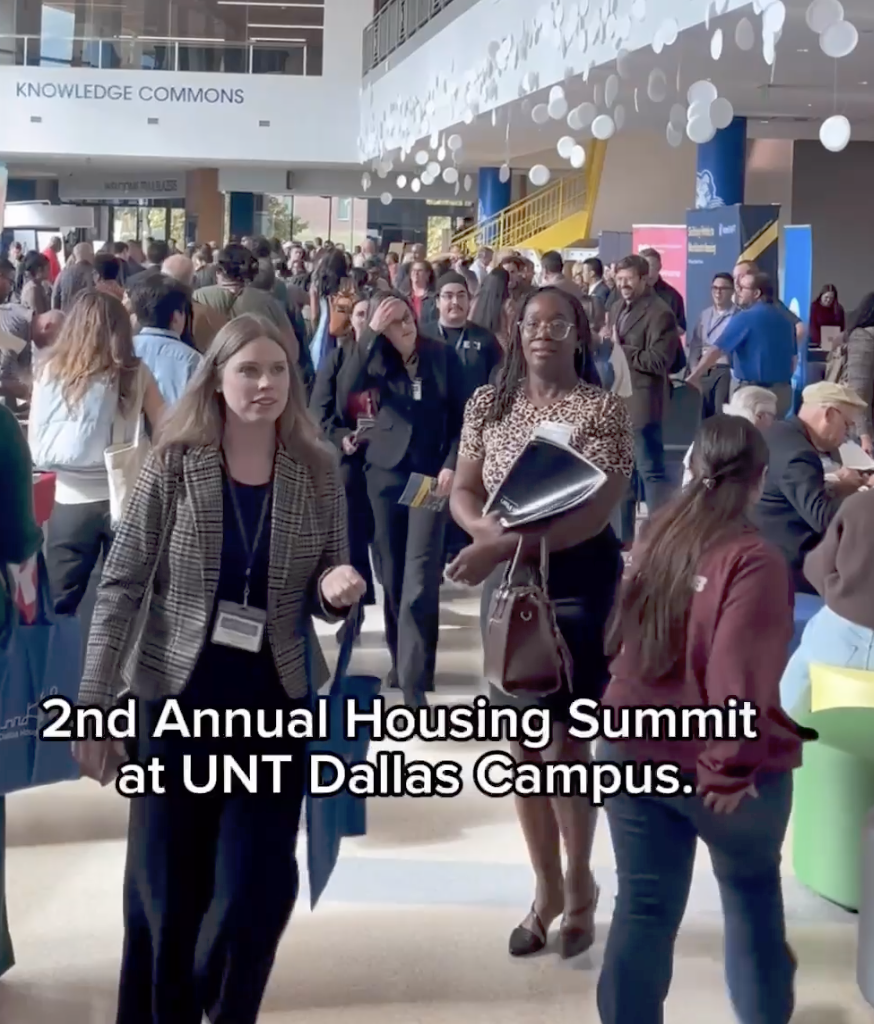
The 2nd Annual Housing Summit, hosted by Dallas Housing Coalition convened in November 2025 at UNT Dallas. The summit brought together dozens of non-profits, policy analysts, architects, developers, and civil servants to connect and strategize around housing in Dallas, and the greater DFW Metroplex.
Dallas Weekly sat in on two panels at the summit to bring our readers highlights from those conversations. From policy analysis to personal testimonies, the new year provides the Dallas community with an opportunity to take all the talk out of the reception halls and into the streets.
Monte Anderson, Options Real Estate Investments, Inc
Stephanie Behring, Re:Studio Architecture & Real Estate
Paul Carden, Venture Commercial
Benje Feehan, buildingcommunityWORKSHOP
Dallas Developers Rebrand Gentrification
The morning’s first panel set the stage with an interesting new term. Monte Anderson, a self-described “town maker” and developer, attempted to draw a contrast between gentrification and what he called “gentle-fication.”
DW: “Could you give us your definition of gentrification, and how is that different from the term you used, gentle-fication?”
MA: “Gentrification is when the big corporate developers are coming to town and wiping out whole blocks. Gentle-fication is sticking it to the man. So it’s when the locals get ownership.”
Anderson pointed to the Bishop Arts District, where zoning changes and TIF policies triggered land value spikes that caused a wave of dispossession and displacement. In contrast, he offered the example of a successful project in Duncanville: his company converted a 30 x 90 square foot commercial building into a multi-unit mixed use property. This allowed for a Latino business owner who was previously leasing his barbershop space, to become the owner of that building, and generate supplemental income from the other available units. He suggests that Juan Trejo’s successful transition of the Texas Fadez Barbershop is a perfect example of what he calls “gentle-fication”.
Architect Stephanie Behring pushed back gently, reframing the crisis. “Disinvestment is actually causing more problems than gentrification,” she argued, highlighting the slow decay of neighborhoods the market has ignored.
Anderson’s most revealing moment came with his “roommate house” presentation: a 3,000-square-foot, single-family-zoned home hacked into five separate rental units. Each has a locking door and a high-powered wet bar—not a full kitchen, a distinction that keeps it technically compliant. Anderson emphasized that a key component to this strategy is to separate each unit with a locking door that can be opened to make it appear as only one unit when a code inspector visits.
“We wanted to be able to split this house up into multiple units, but it’s single-family zoned. It didn’t meet the zoning, so we hacked the code, and this is how we did it.”
Monte Anderson
Curbcuts and Schools
Oak Cliff developer Paul Carden dissected how “curb cuts”—the driveway access points in single-family suburbs—create pedestrian collision points. Denser, gentle multifamily development, he argued, can actually be safer by reducing these conflicts.
“If your driveway is from the rear, then you’re not having driveways cross sidewalks. And it just works so much better. So promote alleys.”–Stephanie Behring
During the Q&A portion, Lisa Marshall, a homelessness advocate, pointed to the human cost of school closures in relation to housing. “It’s not just the school… It’s the teachers… the janitor, the kitchen staff. Does that play into your presentations when you’re going for permitting?”
Paul Carden emphasized that walkability, mixed-income development, and community amenities in attracting and retaining families, is central to attracting families and revitalizing school populations. He drew from a personal experience of choosing to stay in Dallas over other suburban parts of the metroplex, as it’s become increasingly common for Millennial and Gen Z families to choose urban density over suburban sprawl.
Gloria Ardilla, Dallas Free Press+Josephine Torres Cultural and Community Center
Nicole Raphiel, St.Phillip’s School & Community Center
Victor Toledo, Greenleaf Ventures
Froswa’ Booker-Drew, Soulstice Consultancy- Moderator
The keynote panel, moderated by Dr. Froswa’ Booker-Drew, plunged deeper into the history of intentional neglect. Gloria Ardilla, co-founder of the Josephine Torres Cultural Center, traced current displacement back to 1909 when the City of Dallas hired German-born city planner George Kessler to develop a water management and long-range growth plan for the city. In this plan Kessler gives his assessment of Dallas’ existing infrastructure. He described a “lack of uniformity in sizes of blocks and arrangement in the street” resulting in over-congestion. “Since then… nothing has changed,” Ardilla asserted, framing Dallas’ housing crisis as a century-long continuum of weaponized incompetence.
Victor Toledo of Greenleaf Ventures pointed to new tools, like Texas Senate Bill 840—which prevents cities from prohibiting multifamily housing in commercial zones—and the Dallas Public Facility Corporation as mechanisms to build affordable stock.
During the Q&A, an audience member raised concerns about a comment Victor Toledo made related to redeveloping or developing near industrial sites earlier in the conversation.
“When I heard you talk about 200 acres of multi-family housing on ‘heavy industry’, I got a little bit triggered. Can you talk a little bit about what you as a developer will do and the city of Dallas will do to ensure that the children who live in that community will not be affected by that heavy industry?”
In response, Toledo offers to initiate and pay for legal proceedings to address GAF or other bad environmental actors in the city.
“If you need somebody to start the lawsuit or to initiate the action to get rid of them, I will certainly do that at my own expense.”
This exchange is an example of the ongoing struggle against environmental injustice in the West Dallas and Joppa community. Moreover, tensions at this past summit prove that this will likely be a point of contention in 2026. Most developers and city officials treat the implications of a project’s proximity to heavy industrial businesses as an after thought, while residents and community advocates are constantly reminding them of the adverse effects pollutants have had on public health.
In a 2024 health survey of the Singleton Corridor reported figures like 24% of participants experiencing lead poisoning, and 32% with cancer. The Singleton/Westmoreland Authorized Hearing was held just 3 days before on November 18, 2025 at the West Dallas Multipurpose Center. Another hearing is scheduled for January 13, 2026.
“A Policy Issue”: Evictions and Illegal Dumping
Drawing a direct line from the illegal dumping documented in Fair Park’s shadow, I posed a question to the panel: “How can we stop landlords and developers from weaponizing law enforcement to violently evict tenants and dump their belongings on South Dallas streets?”
The Dallas County Sheriff & Constable offices play a crucial role in the final stages of the legal eviction process, primarily in serving official paperwork and physically enforcing a court-ordered Writ of Possession if a tenant does not vacate voluntarily.
Nicole Raphiel of St. Philip’s responded briefly stating, “That’s a policy issue. That’s just 100% policy issue.”
According to the Texas State Law Library, the landlord must coordinate with the constable to move the tenant’s belongings outside, but cannot do so in rain, sleet, or snow, and the property can’t block public access (sidewalk, passageway, or street). This section of the Texas Property Code that city and county officials have allowed Dallas landlords to violate with absolute impunity.
Bold Housing Policy Suggestions
Here’s how the panelists answered when asked to detail one “bold” housing policy they’d like to see implemented in the future:
Nonprofit Developer Nicole Raphiel: Tax freezes for mission-driven organizations at the point of property purchase or renovation, enabling them to keep rents truly affordable.
For-Profit Developer Victor Toledo: Streamlined permitting via self-certification for architects and engineers, bypassing city review bottlenecks to accelerate building.
Community Advocate Gloria Ardilla: A “community fund” sustained by developer incentives, directly funding grassroots organizations with on-the-ground solutions for housing and environmental justice.
Policy Analyst Alex Horowitz: A sweeping shift to “by-right” approvals, removing discretionary hurdles to allow more housing, of all types, to be built as quickly as possible.
These proposals, while not mutually exclusive, highlight the friction in Dallas’s path forward. Is the city’s prioritizing speed, affordability, community control, or equity?
The Importance of Preservation
Nicole Raphiel emphasized that true community stability stems from controlling the land itself.
“If you own the land, you control what happens to the land […] Government can’t do it alone. Developers can’t do it alone. Organizations cannot do it alone.”
She highlighted the crisis facing legacy residents, noting, “One of the things that I’ve seen is that so many of them do not have the ability to take care of the deferred maintenance.”
Echoing this, Gloria Ardilla underscored the human cost of gentrification and the existential need for preservation.
“West Dallas is by far the most gentrified neighborhood in Dallas. The preservation piece is so very important because there’s not enough Social Security that many receive, not enough disability, that they have to go and live somewhere else and live on the incomes that they currently have.”
In historically Black and Latino Dallas neighborhoods like Pleasant Grove, Joppa, and South Dallas, many of the legacy homes have been quietly falling into irreversible disrepair. For decades, income-restricted families in these areas have been unable to afford preventative maintenance, and especially not the large-scale repairs, like storm damage and foundation issues. These damages always worsen with time, leading to mold, pest infestations, and structural instability.
This is a leading cause of displacement and another identifiable prerequisite to gentrification in vulnerable Dallas neighborhoods. As homes become more and more damaged, some families decide to cut their losses and start anew. The city’s Home Improvement & Preservation Program (HIPP) was meant to address this issue, but currently its webpage states “THIS PROGRAM IS CLOSED AND NO LONGER ACCEPTING NEW APPLICATIONS” in bold red font.
Key Takeaways
The most prevalent takeaway was the clear consensus that “growth without displacement” requires an intentionality that the City of Dallas has historically avoided. It requires preserving and repairing legacy homes, not just building new ones. It demands cleaning up industrial poison before approving apartments. It needs policies that protect tenants from predatory evictions as fiercely as they protect developer profits.
As Pastor Marcus King noted in a later panel on activating vacant and underutilized land, projects require “the collective will.” The summit revealed a city brimming with ideas, expertise, and even political tools. What remains in desperately short supply is the city’s willingness to defend our rights as renters, homeowners, and humans.
The Fair Park ordeal taught us that revenue is not reinvestment, and promises are not progress. The Housing Summit taught us that Dallas knows what to do. The question for 2026 is whether or not the city is ready to take action.
Related