
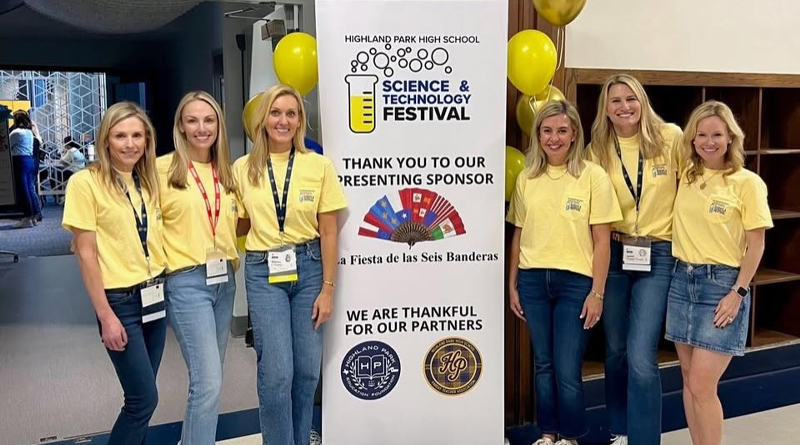
Think of a circus. There’s more action than one spectator could possibly take in. But the talented members of this company are leaders in medicine, engineering, genetic therapy, and other STEM fields.
Highland Park High School students experienced a day filled with hands-on learning and got an insider’s view of STEM careers during their school’s annual Science and Technology Festival on Nov. 17.
About 50 presenters spoke with students during this year’s festival. Students could choose to attend a session that sparked their interest during their regularly scheduled science and technology classes.
The event was chaired by Abby Ruth and Molly Soper. Presenting sponsors were La Fiesta de las Seis Banderas, the Highland Park Education Foundation, and the Highland Park High School parent teacher association.
It’s hard to choose just one presentation when options include talks on the history of robotic surgery, careers in video game development, and a day in the life of a hand surgeon. People Newspapers went back to school for the day and joined students for several classes of STEM-inspired learning.
ER docs in training
Need stitches? Students at Highland Park High School have the skills to sew you up.
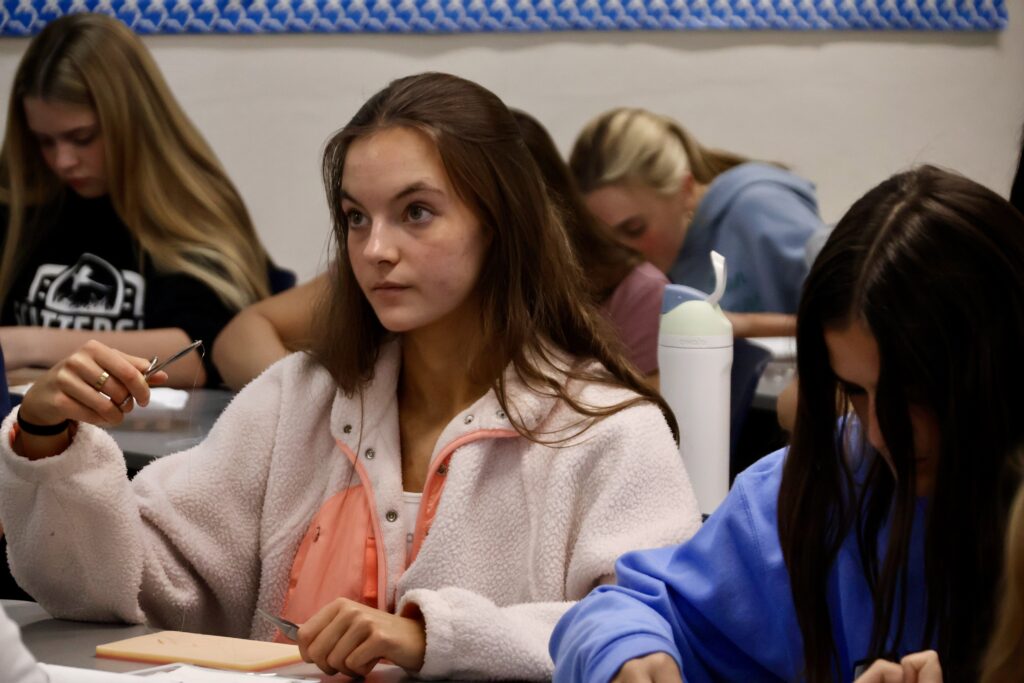
Emergency medical physician Heather Owen gave a packed class of students a lesson in how to use simple interrupted sutures to help superficial injuries heal. The high schoolers practiced on “skin” — actually, small squares of silicon.
Owen directed students in how to take “bites” by putting their needles through the pretend skin.
Once students mastered the basics, she told them how to get style points by leaving equal spaces between the sutures, keeping consistent spacing on both sides of a wound, making sure their knots lay flat and were all on the same side, and not pulling so tight that they caused the skin to pucker.
“If you were to go home and you had three sutures really close to each other, and one up here and one up here, you’d be like, ‘Oh my. That doesn’t look very good,’” she told students.
This is Owen’s second year teaching the hands-on skill. Last year, she had as much fun as the high schoolers did.
“Exposure to the different aspects of medicine is really my greatest goal, to help them know what emergency medicine is,” Owen said. “But they can do anything that they want to. And something like this, that seems so challenging at first, they literally master in 30 minutes.”
Dog detectives
Not all technology is shiny. It can be furry, with a wet nose and a waggy tail.
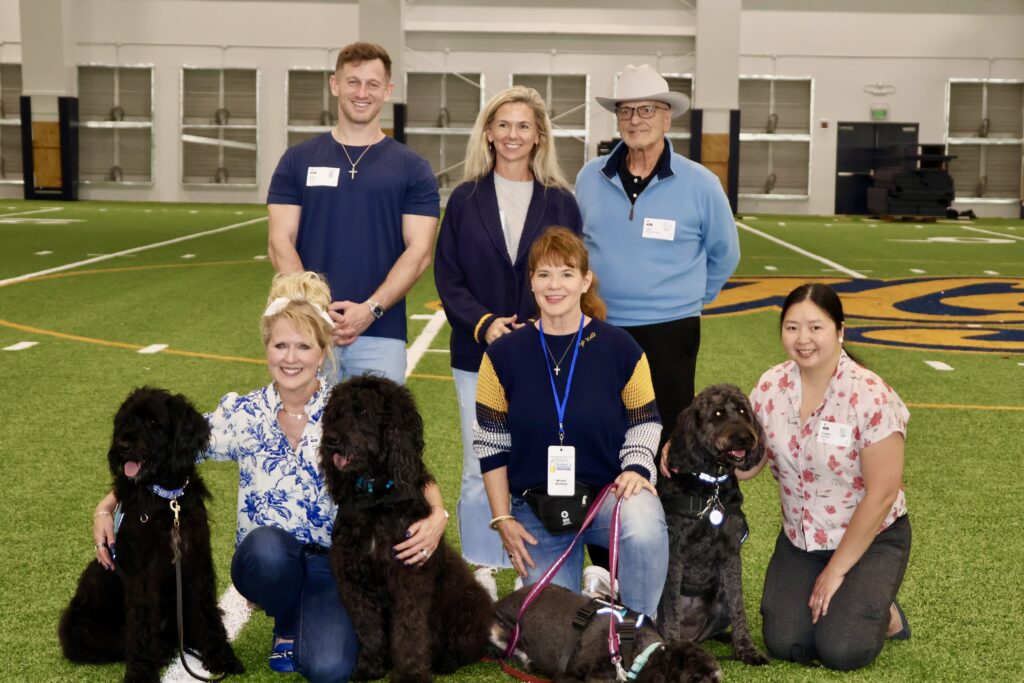
Students met some superpowered service dogs during a presentation from Dogs in Vests and Novacek’s 84 Labradoodles.
Amy Novacek told students that she has blood sugar issues and Addison’s Disease, a rare autoimmune disorder that causes her body to produce an insufficient amount of cortisol.
She has a device designed to alert her when her blood sugar levels are low, but it can’t monitor her cortisol.
Her dogs can, though. They’ve been trained to use their sense of smell to tell when Novacek’s cortisol and blood sugar levels are out of range and even fetch her medicine.
“Is there anything your dogs do, or do they just love you like crazy?” Novacek asked students. “That’s why most of us have dogs. The really cool thing about our dogs, though, is they help people do life.”
Dogs in Vests owner Miriam Richard explained how she’s trained dogs in scent detection, a skill that has been key to protecting her son, who is unable to eat any starches. Even the amount found in a crouton crumb could be enough to send him to the hospital. One summer, the family had to take that trip 11 times.
Richard said that thanks to the keen senses of his expert helpers, her son has been in the hospital just once in the last nine years.
Animal advocates
One of the yellow-billed stork chicks in the nest looked healthy, but the younger of the two was lethargic.
Could he have an infection, Dallas zookeepers wondered, or had the tiny bird been struggling against a piece of straw over his head?
He had actually tried, and failed, to swallow a giant fish. After zookeepers removed it and gave him some fluids, he made a full recovery.
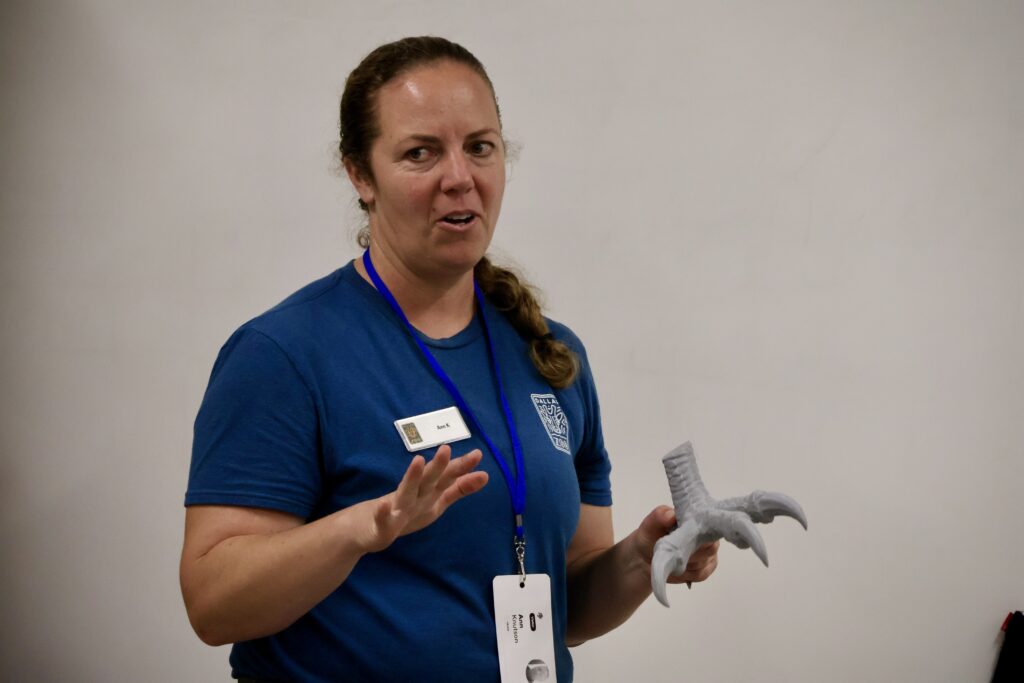
Ann Knutson, Dallas’ Zoological manager of birds, decoded this and other mysteries of animal behavior for students during her presentation, “Wild Works: The Science and Care Behind Every Animal.”
Zookeeping has evolved in the 20 years she’s been in the profession, Knutson told students. It has become about much more than making sure animals have food and water.
“Modern zookeeping is really a science driven, welfare focused profession that blends animal care, behavior, conservation, communication, and collaboration to support thriving animals and sustainable populations,” she explained.
Zookeepers rely on notes, data, and record keeping to find patterns in animal behavior, then problem-solve to determine how they can improve the welfare and enrich the lives of animals.
Outside of the zoo, Knutson has helped birds thrive in the wild, including the critically endangered mangrove finch — the rarest bird in the Galapagos.
“I love my job,” Knutson told students. “I think you can make a direct impact on conservation … by inspiring people to make a change in their life, even if it’s just caring about animals.”
Small, but still supersized
They’re in each of the electronics that consumers rely on to make their lives easier, from smartphones and cars to the robotics in Amazon Prime distribution centers.
But even though semiconductors are crucial to the functioning of modern devices, they’re tiny, and invisible to those who use them.
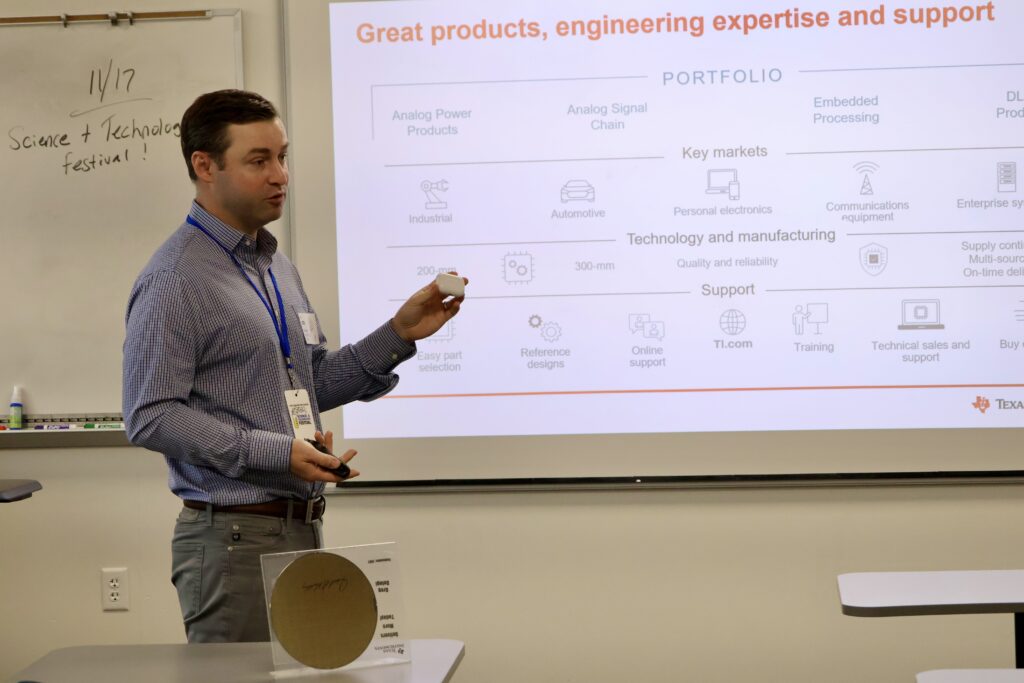
Highland Park High School students got an inside look at the world of semiconductors, and a peek into one of the top companies that makes them, thanks to HP alum Sam Delagi, equipment branch manager of Texas Instruments’ (TI’s) Sherman facility.
Delagi told students that they may be familiar with the name TI thanks to its best-in-class calculators. But the company’s famous classroom tools account for less than 1% of its revenue.
“TI is so big, but you won’t see it anywhere. It’s in everything around us,” he said. “It’s in TVs. It’s in projectors, and it’s just creating a better, more connected world.”
Delagi took students inside TI’s plant in Richardson, where the company manufactures more than 100 million analog chips each day. Students examined one silicon wafer of chips that Delagi brought with him to the classroom.
TI is continuing to grow, Delagi said. He’s part of a startup team building a new plant in Sherman to meet anticipated demand. The plant is a $30 billion investment for TI, and the largest economic development project in Texas history.
“We are expanding our capacity very drastically,” Delagi said, “and are very proud to be doing it in Texas.”
Art and AI
Students didn’t just listen to new media artist Taylor Cleveland talk.
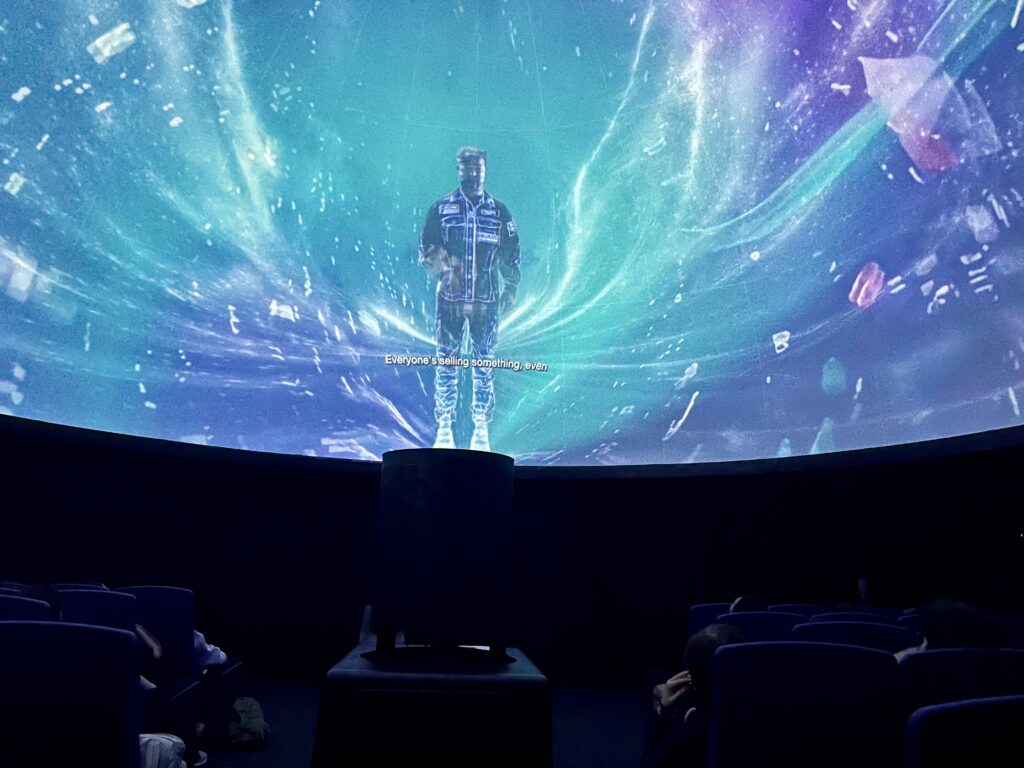
They experienced his story as it unfolded around them in Highland Park High School’s Digitarium at Pierce Planetarium during an artistic, immersive short film he made specifically for the SciTech Festival.
Cleveland spoke directly to students during part of Reels to Real, then introduced case studies of the work he’s done at the cross section of marketing, art, and technology.
Cleveland’s projects for viral marketing company TriplePlay Studios include the creepy use of actors to promote the movie Smile, and the mysterious campaign to advertise Marvel Studios’ Secret Invasion.
Students had a chance to ask Cleveland questions after the presentation. But for Cleveland, the answers were often secondary to the act of questioning. He encouraged students to think critically, and to separate themselves from the trends they see in social media.
“Who are you outside of all of those things that are external to you, that are coming in from your device or your media, that ultimately are products of other people, and probably, more times than not, products of brands that are paying to get to you?” he asked students.
AI, he said, isn’t a fad. It’s going to change the way that we think, see the world, and view ourselves.
“It’s something that you should use. You should know how it works,” he said. “But it’s also something that you should question and push back on as well.”