
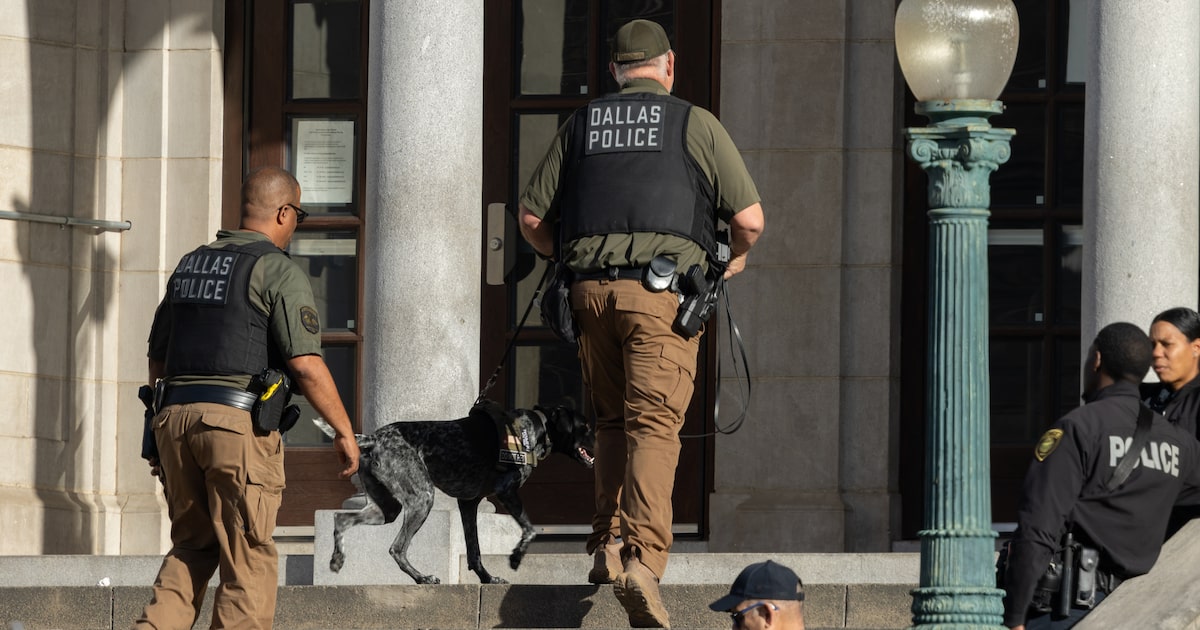
A rash of threats against schools across North Texas over the past week has caused heightened security — and heightened stress — at dozens of campuses.
All the recent threats were determined to be hoaxes, police said. But experts say such threats can disrupt school operations, drain law enforcement resources and leave students traumatized, even if the danger itself was never real.
“The ambiguity, the uncertainty and the anxiety creates very serious social and emotional stressors for kids, staff and parents,” said Ken Trump, a Cleveland-based school security consultant. “People are walking on eggshells.”
On Jan. 6, a bomb threat at Dallas ISD’s North Dallas High School prompted more than 40 Dallas Police Department units to respond. About an hour before the school day was scheduled to begin, officers began moving students and staff away from the school so they could search the building. Police determined there was no danger, and students and teachers resumed the school day about two hours later.
The Education Lab
The following day, campuses in several districts around North Texas, including Fort Worth, Eagle Mountain-Saginaw and Lake Dallas ISDs, went into secure status after a video emerged on social media that included threats against 14 Texas schools.
Related

The threats were not considered credible and appeared to come from outside the country, according to a Fort Worth Police Department news release issued last week. Still, district leaders tightened security at campuses named in the social media post.
Three high schools in Fort Worth ISD — Diamond Hill-Jarvis, South Hills and Arlington Heights — were among the campuses included in the threat. District spokesperson Jessica Becerra said those three campuses were placed in secure status following the threats.
Also among the campuses included in the threats was Lake Dallas High School. Leaders in Lake Dallas ISD notified parents that day that schools would resume normal operations the following day, but that all absences would be excused.
Monday morning, just five days after the hoax video threat emerged online, several campuses in Frisco ISD received threatening emails, prompting the district to place all its campuses in secure status. Frisco police said they didn’t think the threat was credible, but district leaders allowed parents to pick up their kids early.
Related
“We understand that any report of a threat can be unsettling,” district leaders said in the email to parents. “Please know that the safety and well-being of our students and staff is our highest priority.”
An emotional and psychological toll
Threats against schools can take a toll on student mental health, whether the threats are credible or not, said Lynda Gibson, a professor of psychology at the University of Illinois Urbana-Champaign. Gibson, a former doctoral intern with Dallas ISD’s Department of Psychological and Social Services, said when hoax threats and active shooter drills become a common feature of student life, it can create heightened tension in schools. Students eventually begin to feel like they’re constantly under threat.
In the days after a threat at school, parents need to be on the lookout for changes in their children’s behavior. Every child is different, Gibson said, so trauma responses can vary widely from one student to the next. But if children seem distant and socially isolated after a traumatic event, it could be cause for concern. Likewise, if they cling to their parents more than usual or seem anxious about leaving home, it could be a sign they’re struggling, she said.
Frequent hoax threats can also cause students and staff to take each individual threat less seriously than they should, Gibson said. That could be a problem if a real threat ever arises and students and teachers don’t follow their school’s active shooter protocols because they assume it’s another false alarm.
Trump, the school security consultant, advises school leaders against closing schools any time they receive a threat they determine isn’t credible. He acknowledged that district leaders are under a great deal of pressure from parents and other community members whenever a threat arises, but urged them to “resist the temptation to make knee-jerk reactions.”
“Take a tactical pause while you’re in the fog of war, if you will,” he said. “If you believe, based upon your assessment of the situation, that it’s not a credible threat, then don’t close to provide emotional security blankets.”
Most districts targeted by threats over the past week placed their campuses in secure status, meaning teachers bring all students inside the building and lock all external doors, but the school day continues largely as normal otherwise. That status represents increased security compared to a normal school day, but falls below a full lockdown, in which teachers lock classroom doors and turn off lights, and students get out of sight.
Disruptions across the community
Hoax threats against schools can cause a huge amount of disruption for schools and communities. They pull law enforcement resources away from areas where they’re needed, Trump said, sometimes for days or weeks after the initial threat is over.
Related
In the hours immediately after the threat comes in, officers are on campuses for security sweeps, which can take hours. Long after buildings are cleared and the normal school day resumes, investigators continue to try to find the origin of the threat. In cases where the threat comes from a student placing a prank call, police can often wrap up the investigation quickly. But if it comes electronically or it originates overseas, it can take considerably longer, he said.
False threats also cause upheaval among parents and the entire community, Trump said. Thanks to digital communication, misinformation that once took days and weeks to spread now takes minutes. Rumors spread. Worried parents flock to schools to take their children home for the day.
Aside from the disruptions they cause, Trump said hoax threats can have major consequences for the people who make them. Police are getting better at figuring out where electronic threats came from, he said, and many states have created stiffer penalties for those who send them.
“It’s not a hoax. It’s not a joke,” he said. “You will eventually be identified, and then you’re going to face a ton of bricks.”
The DMN Education Lab deepens the coverage and conversation about urgent education issues critical to the future of North Texas.
The DMN Education Lab is a community-funded journalism initiative, with support from Bobby and Lottye Lyle, Communities Foundation of Texas, The Dallas Foundation, Dallas Regional Chamber, Deedie Rose, Garrett and Cecilia Boone, Judy and Jim Gibbs, The Meadows Foundation, The Murrell Foundation, Ron and Phyllis Steinhart, Solutions Journalism Network, Southern Methodist University, Sydney Smith Hicks, and the University of Texas at Dallas. The Dallas Morning News retains full editorial control of the Education Lab’s journalism.