
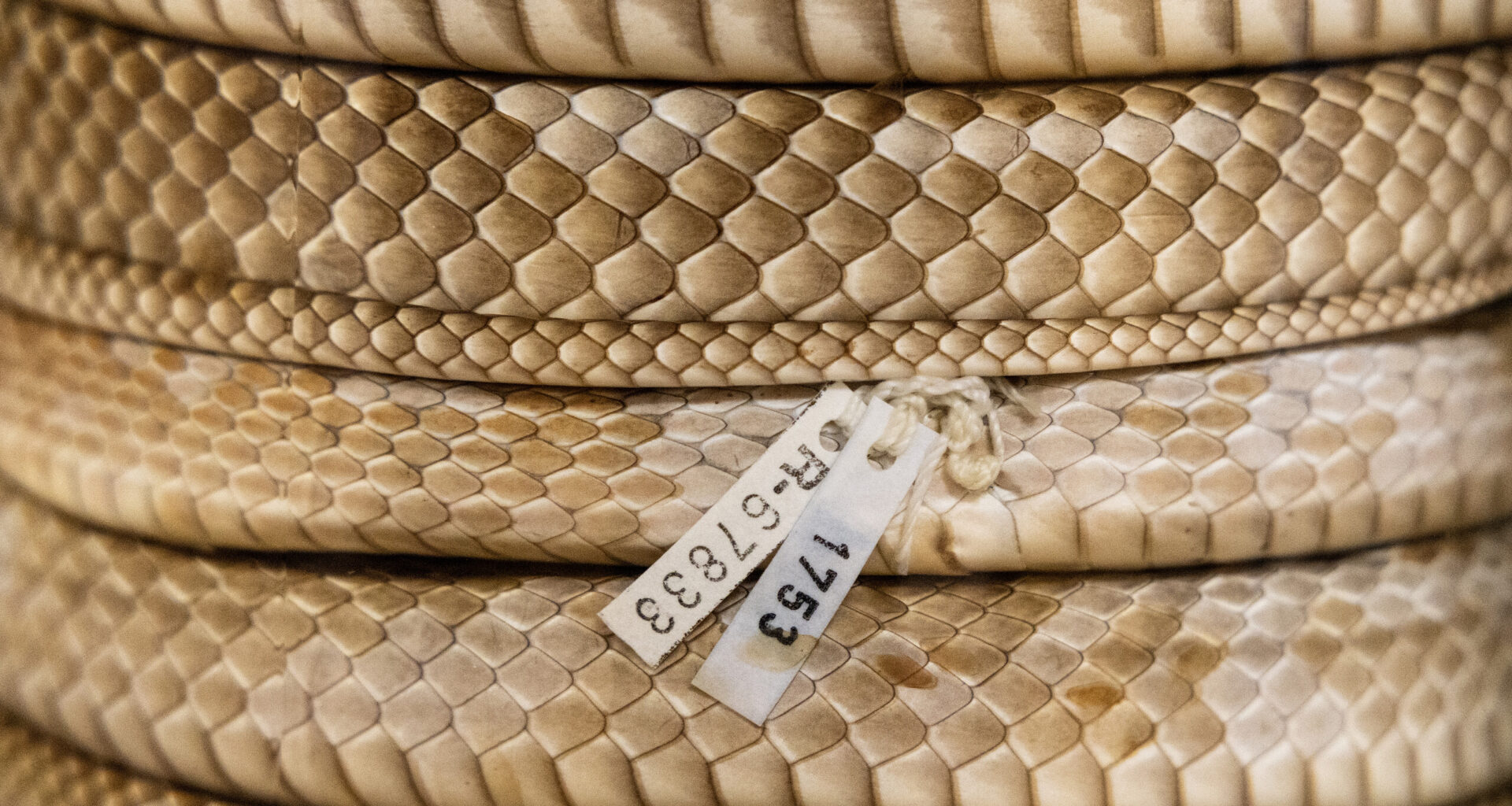
Western diamondback rattlesnakes are not hard to come by in Texas — or at UTA’s Amphibian and Reptile Diversity Research Center, where the research museum stores around 600 of them.
But a rattler recently found in the garage of a North Texas home made history for the research center, which recorded it as the first spotted in Denton County.
The rattlesnake joins more than 200,000 other specimens housed at the University of Texas at Arlington and preserved by experts to gain a better understanding of amphibians and reptiles and their ecological roles.
Jars of reptiles and amphibians preserved in ethanol line rows of shelves in the unassuming building on UTA’s campus. Instead of serving to educate the public about a topic, the museum’s collection of artifacts is for researchers to study.
Field experts often rely on data and ecological studies on animals from scientific museums to further their own research, said Greg Pandelis, who manages the UTA center.
“All of that stuff comes back down to a specimen in a museum,” he said.
Not your everyday museum
For most, the word museum likely conjures up images of art hanging on a wall or dinosaur skeletons towering over awe-struck visitors. But a research museum functions differently, Pandelis said.
Scientific collections such as those found at UTA’s center “are the fundamental basis of our understanding of all life on Earth, even in this day and age where people are doing things like genomics and various other digital-based work,” Pandelis said.
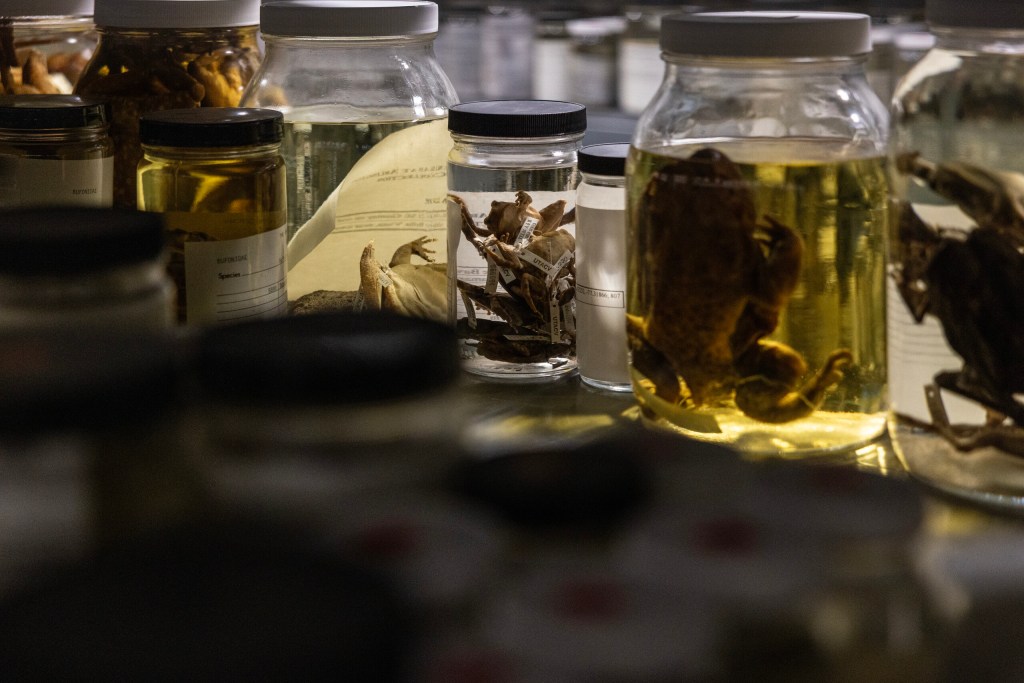 Jars of specimen line shelves of the University of Texas at Arlington Amphibian and Reptile Diversity Research Center on Jan. 7, 2026. (Maria Crane | Fort Worth Report/CatchLight Local/Report for America)
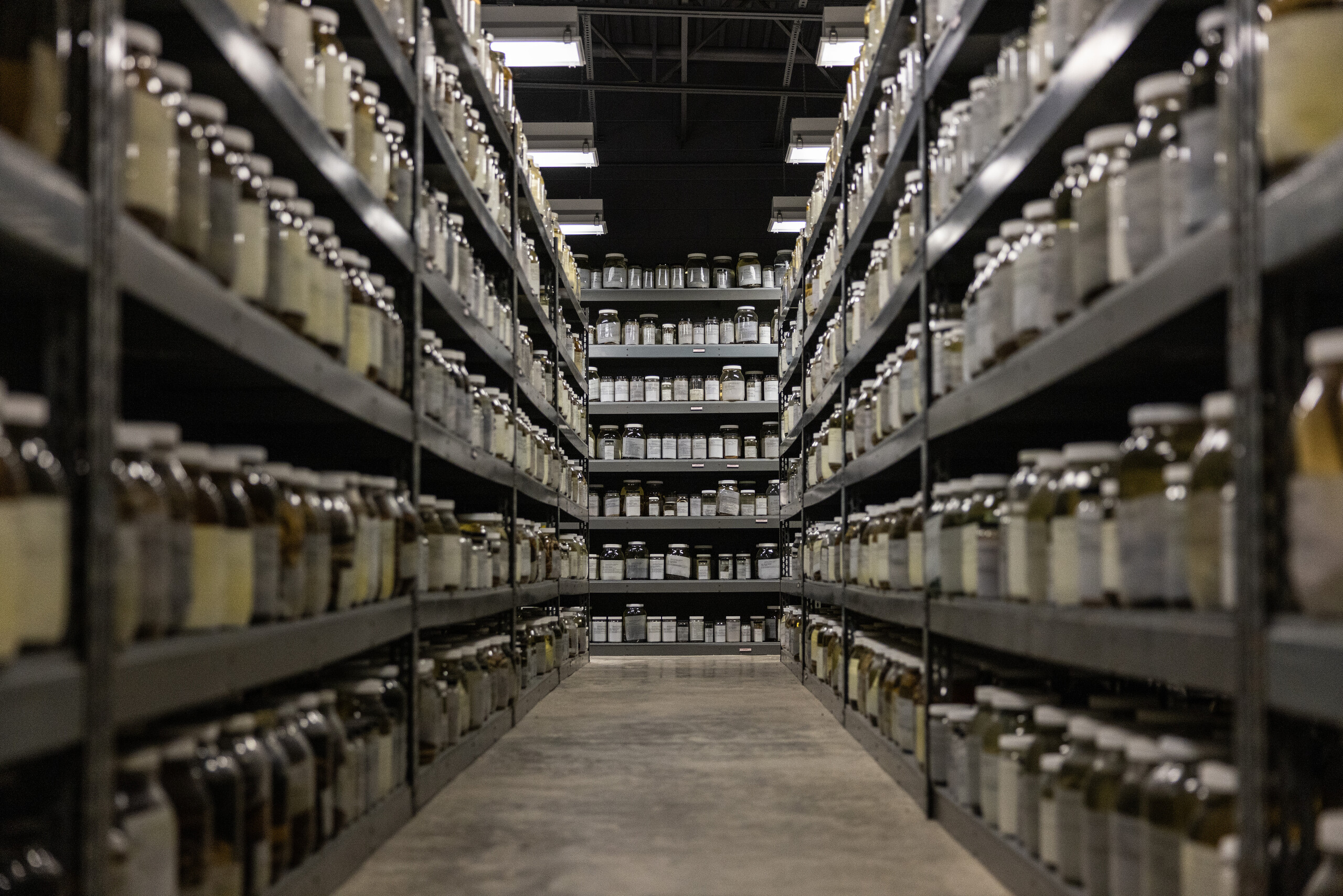 Each specimen at the UTA ARDRC is sorted alphabetically and hierarchically. (Maria Crane | Fort Worth Report/CatchLight Local/Report for America)
The center’s assortment of specimens was not always so broad and not always used for research. It started in 1956 when biology professor William Pyburn began collecting birds, reptiles, amphibians and other animals to use for his classes.
Over time, an overwhelming interest in herpetology by faculty members resulted in a collection of amphibians and reptiles far outnumbering other animals. The university donated its feathered and furry specimens to the Fort Worth Museum of Science and History and narrowed its focus to herpetology.
Now, the center houses the largest herpetological research collection in Texas and is among the largest in the world.
Some specimens are found dead, but researchers have permits to collect ones that are alive.
Scientists follow established protocols for collecting living specimens and take “the bare minimum” in order to not threaten the species, Pandelis explained.
“Many of us do conservation biology, so that would be completely counterintuitive if we’re actually causing detriment to a native population,” he said.
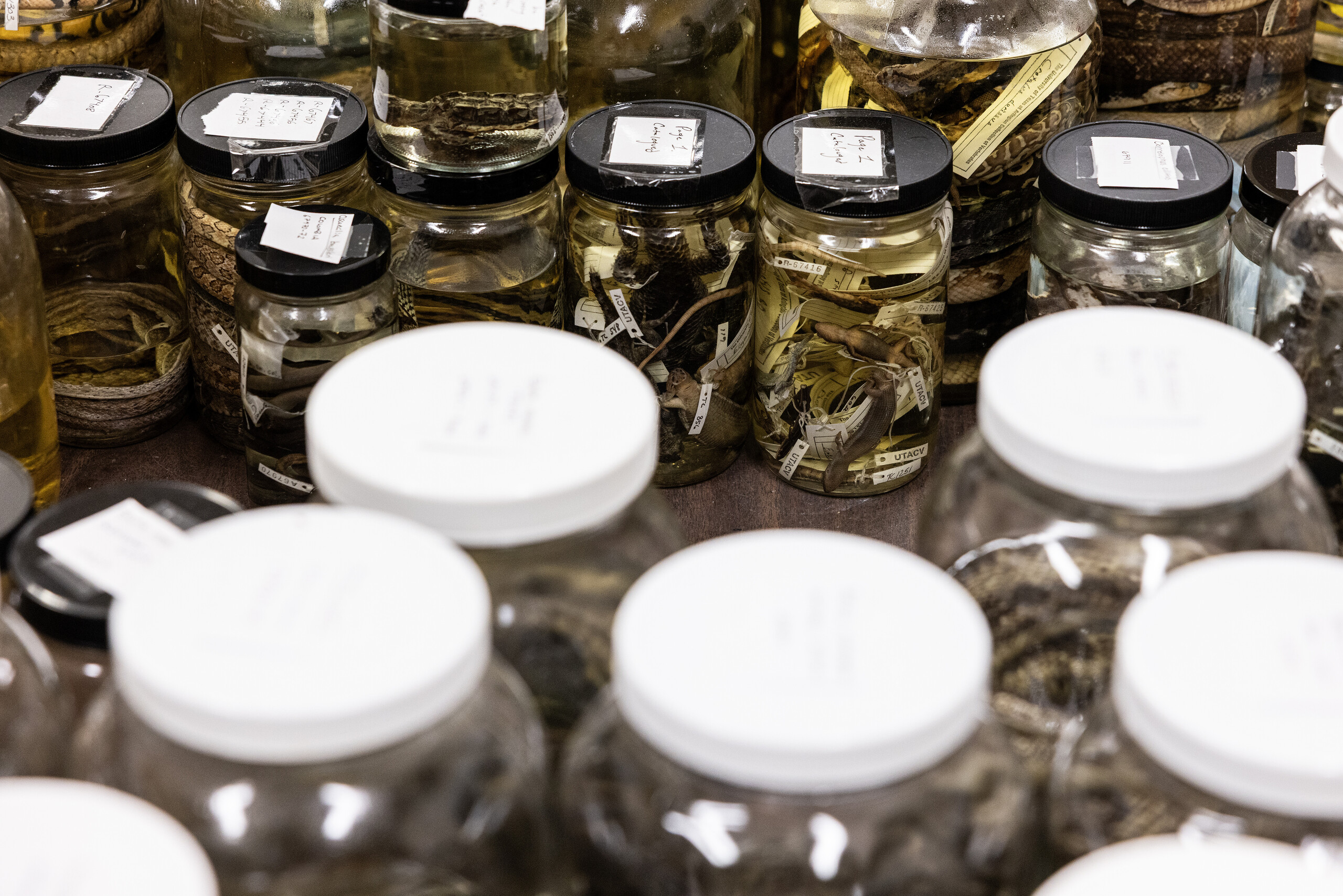 Specimen are prepared before being labeled for study at the UTA ARDRC on Jan. 7, 2026. Each specimen is labeled with a sequence so researchers can identify what they are working with. Typically, a chunk of tissue, liver or muscle is taken from the specimen and put into a deep freezer for researchers to study when needed. (Maria Crane | Fort Worth Report/CatchLight Local/Report for America)
If researchers only took a nonlethal tissue sample and released the animal, they would not be able to later tie the genetic data collected to a specific animal and its phenotype, or physical appearance.
Through permits issued by state and UTA officials, the collected specimens are euthanized, preserved and catalogued in the research museum’s database.
“Having the actual whole organism here preserved makes that tissue sample so, so much more valuable,” Pandelis said.
A “rare” North Texas discovery
Western diamondback snakes are typically found in Texas’ deserts, but the snake found in Argyle on Nov. 6 heralded a small, undetected population rather than a solitary reptile migrating from other areas, Pandelis said.
State experts have hundreds of years worth of research on the western diamondback rattlesnake, Pandelis said, which is why discovering a new population in Denton County made history.
The animal was discovered Nov. 6 by an Argyle resident who donated the rattlesnake for preservation and research purposes.
Preserving the specimen allows experts to broaden their understanding of the species’ genetics, diet, pathogens and other features, Pandelis said. Researchers also gain a wider look at a species’ ecology and evolution when animals are stored and preserved.
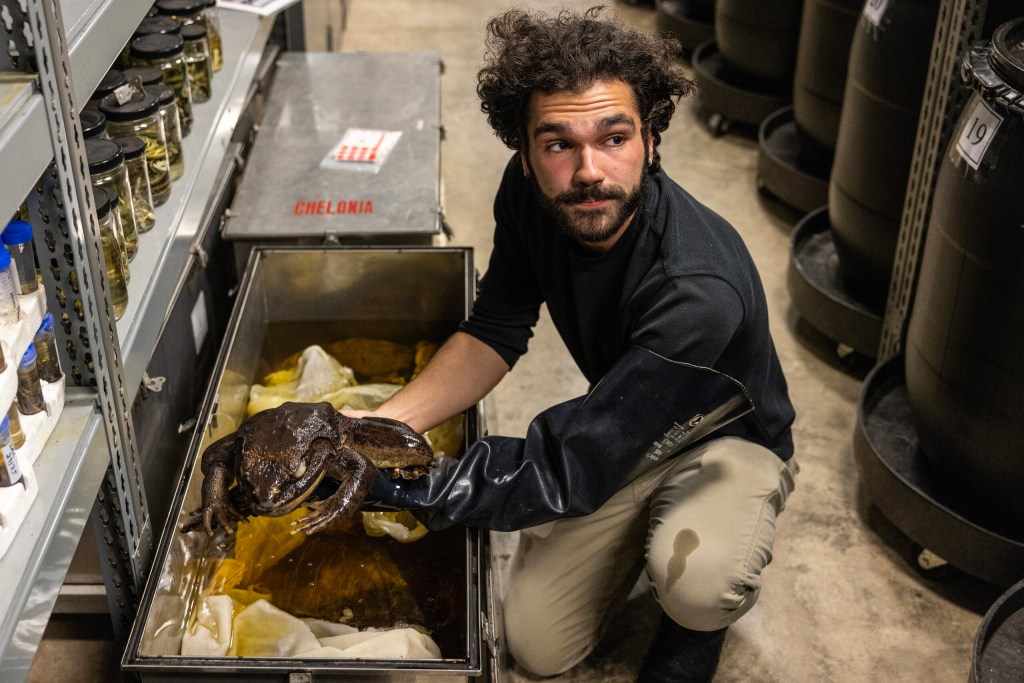 University of Texas at Arlington Amphibian and Reptile Diversity Research Center collections manager Greg Pandelis holds an African goliath frog on Jan. 7, 2026. (Maria Crane | Fort Worth Report/CatchLight Local/Report for America)
“All of these things together make a super specimen for understanding what is going on with rattlesnakes in Texas,” Pandelis said.
The discovery of the Argyle rattlesnake adds to the research center’s database, which currently preserves nearly 597 western diamondback snakes. About 400 of them were collected from Texas counties, including Tarrant, Dallas, Parker and Jack.
“There’s this whole missing data point in Denton County that is now filled because of that specimen,” Pandelis added.
The Argyle snake is well on its way to being included in studies by experts outside the university.
Once specimens are cataloged, researchers around the world can use them free of charge as a “scientific service,” Pandelis said.
“That’s the beauty of it. It’s not a one and done thing,” he said.
Nicole Lopez is the environment reporter for the Fort Worth Report. Contact her at nicole.lopez@fortworthreport.org.
McKinnon Rice is the higher education reporter for the Fort Worth Report. Contact her at mckinnon.rice@fortworthreport.org.
The Fort Worth Report partners with Open Campus on higher education coverage.
At the Fort Worth Report, news decisions are made independently of our board members and financial supporters. Read more about our editorial independence policy here.
This <a target=”_blank” href=”https://fortworthreport.org/2026/01/13/how-a-rare-rattlesnake-inspiresss-research-at-uta-and-beyond/”>article</a> first appeared on <a target=”_blank” href=”https://fortworthreport.org”>Fort Worth Report</a> and is republished here under a <a target=”_blank” href=”https://creativecommons.org/licenses/by-nd/4.0/”>Creative Commons Attribution-NoDerivatives 4.0 International License</a>.<img src=”https://i0.wp.com/fortworthreport.org/wp-content/uploads/2021/04/cropped-favicon.png?resize=150%2C150&quality=80&ssl=1″ style=”width:1em;height:1em;margin-left:10px;”>
<img id=”republication-tracker-tool-source” src=”https://fortworthreport.org/?republication-pixel=true&post=365494&ga4=2820184429″ style=”width:1px;height:1px;”><script> PARSELY = { autotrack: false, onload: function() { PARSELY.beacon.trackPageView({ url: “https://fortworthreport.org/2026/01/13/how-a-rare-rattlesnake-inspiresss-research-at-uta-and-beyond/”, urlref: window.location.href }); } } </script> <script id=”parsely-cfg” src=”//cdn.parsely.com/keys/fortworthreport.org/p.js”></script>