
 Listen to this article
At a glance:
Corpus Christi board votes to allow up to $2M for government building demolitions
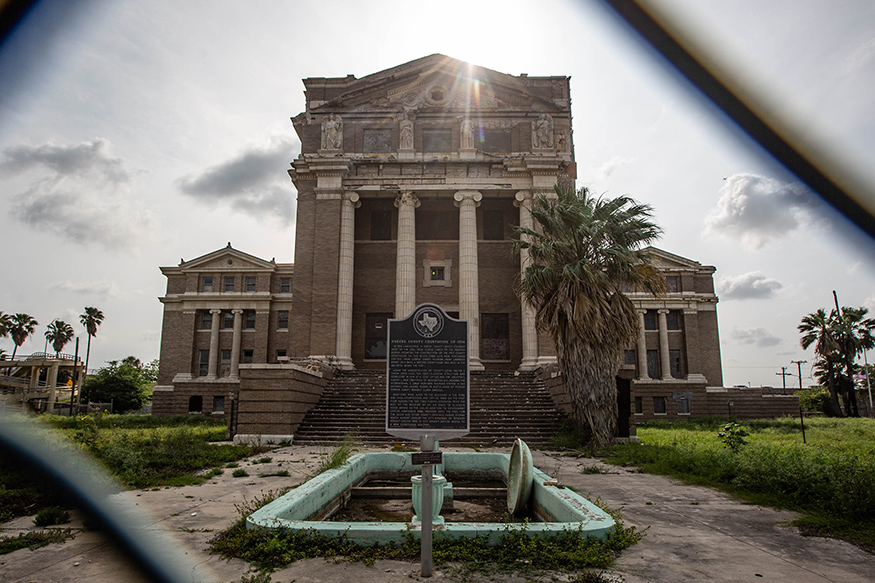
Funding could be used to tear down the 1914 Nueces County Courthouse
City and county officials clashed over pressure tactics tied to TIRZ participation
Final approval and a courthouse-specific contract are expected Jan. 27
CORPUS CHRISTI, Texas — The board that oversees the special property tax fund for downtown Corpus Christi has given a preliminary nod to using as much as $2 million to tear down the 1914 Nueces County Courthouse — but not without several city officials first expressing displeasure over the approach that was employed to push the issue.
The Nueces County Commissioners Court had vowed to exit an economic development program that relies on downtown property tax values, should the board deny the funding.
Corpus Christi City Councilman Gil Hernandez, also a board member, said during the Jan. 13 meeting that although he supported financing the teardown, he didn’t appreciate the county’s “methods that are being used for it.”
He initially used the word “extortion” and later described it in the subsequent City Council meeting as “coercion.”
“Ultimately, I agree that we can participate with tearing down the old courthouse — I know it’s been an odyssey for the county for many, many years,” Hernandez said. “I’m in support of the funding, but again, this could have been handled a little bit differently.”
Nueces County Commissioner Mike Pusley, also a board member, took exception to the county’s position being referenced as extortion. There is a partnership in improving downtown, and demolishing the old courthouse would serve as a benefit to the area, he said.
“Extortion is a terrible thing to say, and I’m just really disappointed in that,” Pusley said. “What I’m trying to do is salvage our partnership.”
The board that oversees the economic development program — known as a tax increment reinvestment zone (TIRZ) — approved amending a project and financing plan that outlines the uses of funding. The 11-1 vote was for the plan to include among allowable uses as much as $2 million for the demolition of government buildings.
The approval by the TIRZ board, and subsequently the Corpus Christi City Council, was not specific to the 1914 Nueces County Courthouse. A contract specific to the proposed demolition of the historic courthouse is expected to be brought to the board and the City Council for consideration on Jan. 27.
A TIRZ functions by taxing entities contributing to the program a portion of new or increased property taxes from a certain area, which would otherwise go to their respective budgets. The TIRZ revenue is then steered back into the area where it was collected for improvements.
TIRZ revenue cannot be used for purposes other than improving the area from which it was drawn. The idea is that reinvesting the funding will spur more economic development and thus increase property values.
The county, which joined the TIRZ in 2009, has contributed about $5.5 million during that span, said Arlene Medrano, executive director of the Downtown Management District.
The city has contributed about $12 million, she said.
Should the county withdraw from the program, the downtown TIRZ would stand to lose about $370,000 annually, Medrano said. Without renewal of a 20-year contract, the loss would total about $8.7 million, she added.
Some county commissioners have criticized how TIRZ funding has been used, contending that city projects, not county ones, are the primary beneficiaries.
Conversely, several City Council members have disagreed with the county’s assessment, instead suggesting that all projects provide a benefit to all participating taxing entities.
Funding to raze the crumbling, 112-year-old courthouse has been the only ask since the county joined the TIRZ, according to Pusley.
The courthouse was added to the National Register of Historic Places in 1976 but abandoned a year later when the county moved operations to a new building. Last year, the Texas Historical Commission removed the historical preservation easement from the old courthouse, allowing potential demolition.
While some observers have lamented the anticipated demolition of the courthouse, several commissioners have said it’s the only reasonable conclusion due to long vacancy and corresponding deterioration. Attempts over the years to rescue the building through sale and redevelopment have been unsuccessful and, at this point, infeasible due to the structure’s state, some officials have said.
Tearing down the building will mitigate blight in the downtown area, Medrano told the board.
“This has been an eyesore in the downtown, in our city, for 48 years,” she said. “This is the gateway into downtown, and so we receive millions of cars and traffic every year and that’s the first thing that they see.”
Several City Council members, all of whom serve on the TIRZ board, raised concerns about the future of the property and the lack of plans for immediate redevelopment.
The county intends to sell what Pusley believes will be valuable property, he said. However, a buyer has not been identified.
It’s unclear how much it will cost to raze the building. Pusley said contractors have estimated demolition to cost between $1.5 million and $2 million; however, that price doesn’t consider asbestos remediation that is being evaluated.
Under the county’s proposal, requested funding would be a reimbursement of as much as $2 million over a three-year period. Any additional costs for the demolition would be covered by the county, Pusley said. One potential source would be proceeds from a recent sale of property to the Port of Corpus Christi, he added.
There is a bigger picture to be considered for the area, Mayor Paulette Guajardo said.
“At the end of the day, this is a partnership … that maybe the communication kind of went astray,” she said.
Editor’s note: This article first appeared in the Corpus Christi Caller-Times and then was distributed on the USA TODAY Network via Reuters Connect.