

TEXAS — On Monday, the U.S. Supreme Court lifted restrictions on aggressive immigration enforcement actions by federal agents. In Chicago, some 300 federal agents are staged, ready to perform immigration operations. In Massachusetts, Immigration and Customs Enforcement (ICE) launched “Patriot 2.0,” focused on people Department of Homeland Security officials say are dangerous criminals in the United States illegally.
These are some of the recent headlines spurred by the ongoing crackdown by President Donald Trump’s administration on immigrants the federal government says are in the country without proper authority.
“I arrested an ISIS terrorist by the previous administration,” said ICE Assistant Director Matthew Elliston. “Who knows what he would have done?”
Elliston is in charge of hiring 10,000 new ICE deportation agents as directed by the White House.
“We stop things from happening before they happen,” the veteran ICE agent said. “We target people who are criminals who are on the street with the idea that if we take them out of the street, recidivism dies.”
Elliston was in Texas for a recent two-day hiring event hosted in Arlington.
ICE officials reported 3,000 people attended the event, and 700 applicants received tentative job offers.
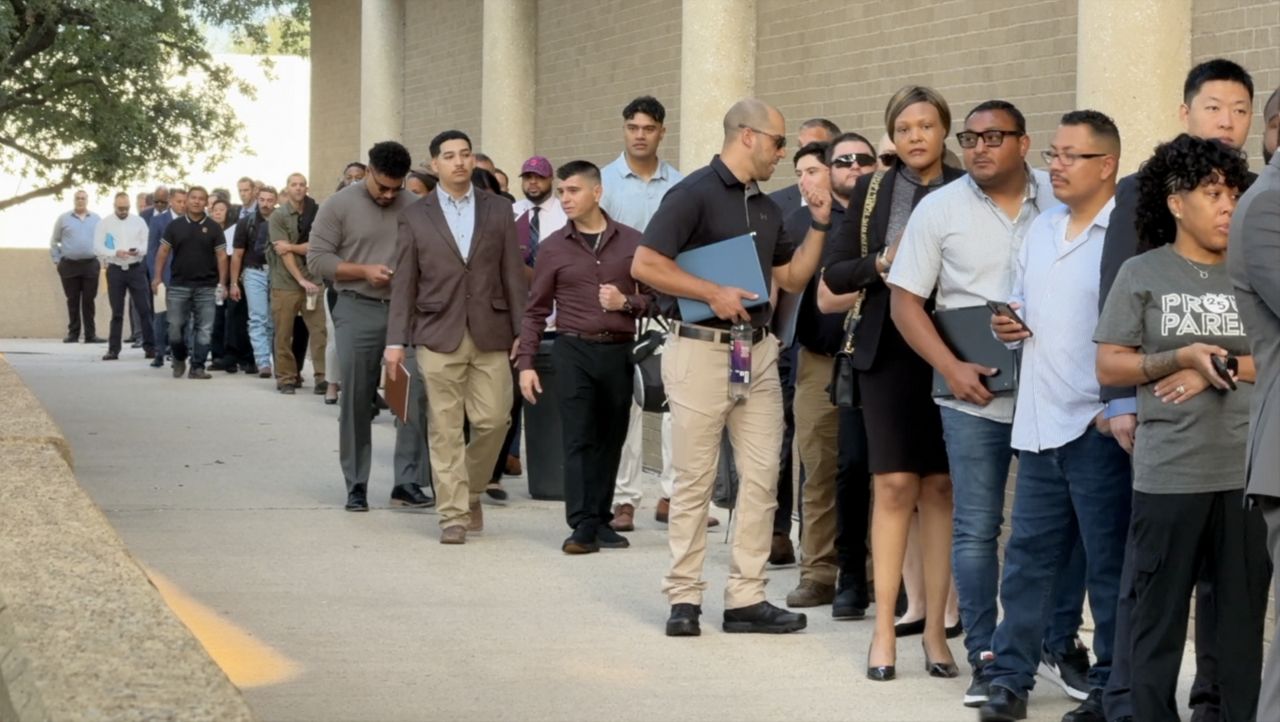
Hundreds of applicants wait in line to enter ICE hiring event in Arlington, Texas. (Spectrum News 1)
The One Big Beautiful Bill Act dedicates more than $170 billion over the next four years for border and interior enforcement. The administration’s stated goal is to remove 1 million immigrants each year.
“The dynamics of being a deportation officer are so unique to this line of work. From the very beginning of the immigration cycle to the very ends of it,” said Elliston. “It’s all under the world of ICE.”
Congress approved $75 billion for ICE in the funding bill, which breaks down to about $18.7 billion each year.
In previous administrations, ICE’s budget was around $8-10 billion a year, according to congressional budget records.
Elliston said applicants with law enforcement or military backgrounds at the event will be reviewed first; however, all skill sets are welcome to apply.
“We could use people with language skills, people with intelligence backgrounds, we could use people with public relations backgrounds, attorneys,” he said.
According to Homeland Security officials, the immigration enforcement agency logged more than 100,000 applications, as age restrictions have loosened. Applicants can be 18 years of age with no cutoff age for employment consideration. Bonuses of up to $50,000 and student loan repayment benefits are part of the package too.
Experts who study immigration and government policy have raised concerns that this type of mass hiring in a short period of time could spur problems that have been documented in similar previous large employment opportunities.
“The organization is under pressure to bring in as many people as possible. So there’s a tendency to cut corners,” said Josiah Heyman, with the University of Texas at El Paso’s Director of Center for Inter-American and Border Studies.
Between 2006 and 2009, the U.S. Border Patrol went on a hiring spree. Standards and training were lowered, resulting in 8,000 more officers. The Associated Press reported a spike in misconduct, like domestic violence, civil rights violations and off-duty crime. Arrests totaled 336 between 2007 and 2012, a 44% increase. Another 100 agents were charged with corruption, including accepting bribes to smuggle people and drugs.
Heyman said, “Being under pressure to hire people will lead to overlooking evidence of problem behaviors.”
In addressing questions of concern about hiring thousands of people as quickly as possible, Elliston defended the hiring process.
“You don’t get into the firm process until our Office of Professional Responsibility’s Personnel Security Unit has said this person has a good background,” he said.