
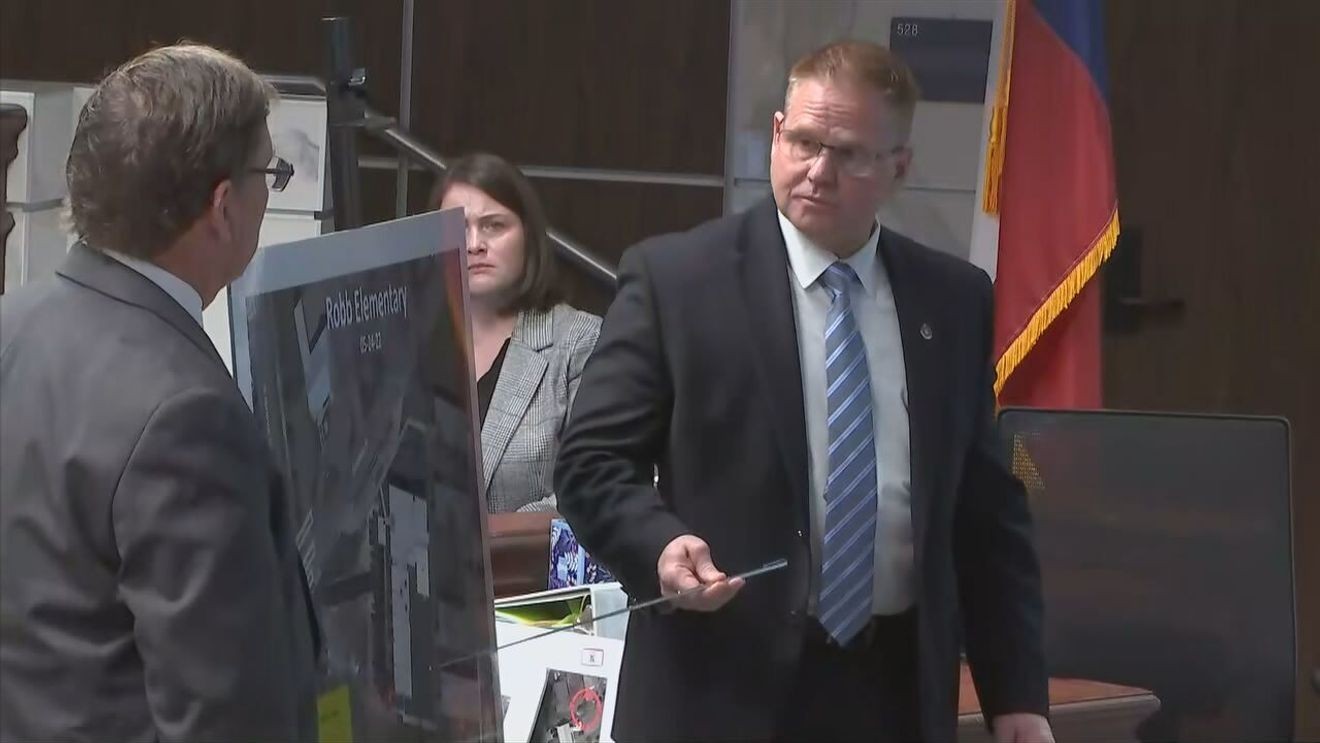
CORPUS CHRISTI, Texas – In the trial against former Uvalde CISD officer Adrian Gonzales, a Homeland Security agent testified on Friday about counting how many shots were fired and the locations of each officer during the Robb Elementary shooting.
Investigators also detailed the gunman’s movements and the gunfire timeline, second by second. They testified that the shooter paused just before 11:32 a.m., then continued along the west side of the building. About one minute and four seconds later, he entered through the west door.
RELATED: Retired officer testifies on chaos inside Robb Elementary during shooting
WATCH | Step-by-step analysis of law enforcement actions…
During that brief window, additional Uvalde police officers arrived at the intersection of South Grove and Geraldine. Authorities said 60 shots were discharged in Room 111 alone. Overall, the shooter fired 173 rounds, law enforcement fired 35, and one casing remains classified as unknown. Nineteen students and two teachers were killed when a gunman opened fire at Robb Elementary School in Uvalde in 2022.
Lieutenant Nick Hill, Investigative Analyst for the Texas Depart of Public Safety, broke down the gunman’s movements and the gunfire second-by-second during the shooting.
Nico LaHood, who is defending Gonzales, said to Hill that the animation is limited.
“And is it fair to say that this exhibit is still limited in the same way this is limited, correct?” asked LaHood.
“There are limitations, yes,” answered Hill. “I put it together based on verifiable video and audio evidence because I wanted to present the most unbiased view of the event. My ultimate objective was to tell the truth of what happened as accurately and as completely as possible.”
LaHood also questioned the agent’s opinion about what his client’s opportunity was to take action that would have stopped the killing.
“They did not say ‘shots fired.’ But your position is – and we’ll move on – that Adrian had a better opportunity than these three men together, armed with a long rifle, who had line of sight on the same side of the shooter. You’re just saying Adrian had a better opportunity.”
“That’s all,” answered Hill. “Yes, I’m saying he had a better opportunity.”
The cross examination just kept getting more heated as LaHood asked more questions about officers he says were just standing around.
“He’s already parked here, standing around. Nobody cares about this street,” said LaHood. “You can smile all you want. He’s standing around, right? What was funny about what I said? Why did you smile? I want to know why you smiled. Nobody cares about this street.”
“So he didn’t drive to this door. He didn’t drive to this door. They drove around. They drove around in the direction of where they believed the gunshot came from,” said LaHood. “You seem to want to put yourself in their mind and make excuses for them. I’m asking, you can say no, I’m asking you a question. Overrule that objection and allow the question, please. Are you making excuses for them? Yes or no?
A juror has been replaced by an alternate due to a family emergency.
The trial in Corpus Christi, Texas, is tightly focused on Gonzales’ actions. Prosecutors allege he abandoned his active shooter training and did not try to engage or distract the gunman while he was still outside the school. They said Gonzales failed again minutes later when a group of officers went inside the school only to retreat when they came under heavy gunfire.
While much of the trial has been focused on events outside the school when the attack started, prosecutors are using the carnage inside the classroom as the ultimate result of what they said was Gonzales’ failure to stop the gunman when he had a chance.
The opening days of the trial included dramatic replays of the initial emergency calls, testimony from teachers who huddled with terrified students, and the mother of one of the victims recounting how her daughter had asked to leave school early that day.
Jurors have also seen graphic photos from inside the school and classrooms. Prosecutors noted how students made 911 calls from inside the classroom with the gunman.
The trial is a rare case in which a police officer could be convicted of allegedly failing to act to stop a crime and protect lives.
Gonzales and former Uvalde schools Police Chief Pete Arredondo are the only two responding officers that day to face charges. Arredondo’s trial has not yet been set.